

On this page
If an arithmetic progression (AP) starts with a positive number and has a negative common difference, its terms will steadily decrease. Eventually, the sequence will cross zero and become negative. Finding the exact position where this happens is a standard problem when studying sequences.
The method relies on the formula for the general term of an AP and setting up a simple mathematical inequality.
Why does a sequence turn negative?
An arithmetic progression is defined by its first term (a) and its common difference (d). The formula for the nth term is aₙ = a + (n − 1)d, a standard sequence property found in algebra references.
If the common difference is a positive number, the sequence grows forever. But if d is a negative number, each term is smaller than the one before it. No matter how large the starting positive number is, repeatedly subtracting a fixed amount will eventually pull the sequence below zero.
How do you set up the inequality?
To find out exactly when the sequence becomes negative, you need to find the position n where the term aₙ is less than zero. You set up the inequality:
a + (n − 1)d < 0
You must use a strict inequality (<) rather than an equals sign (=). This is because zero itself is neither positive nor negative. If a term in the sequence happens to fall exactly on zero, that term is not negative; the negative terms will only start at the next position.
Because n represents a position in the sequence, it must be a positive whole number (1, 2, 3, and so on). When you solve the inequality, you will usually get a decimal or a fraction. The first negative term will be the smallest whole number that is strictly greater than your result.
Which term of the AP is the first negative term?
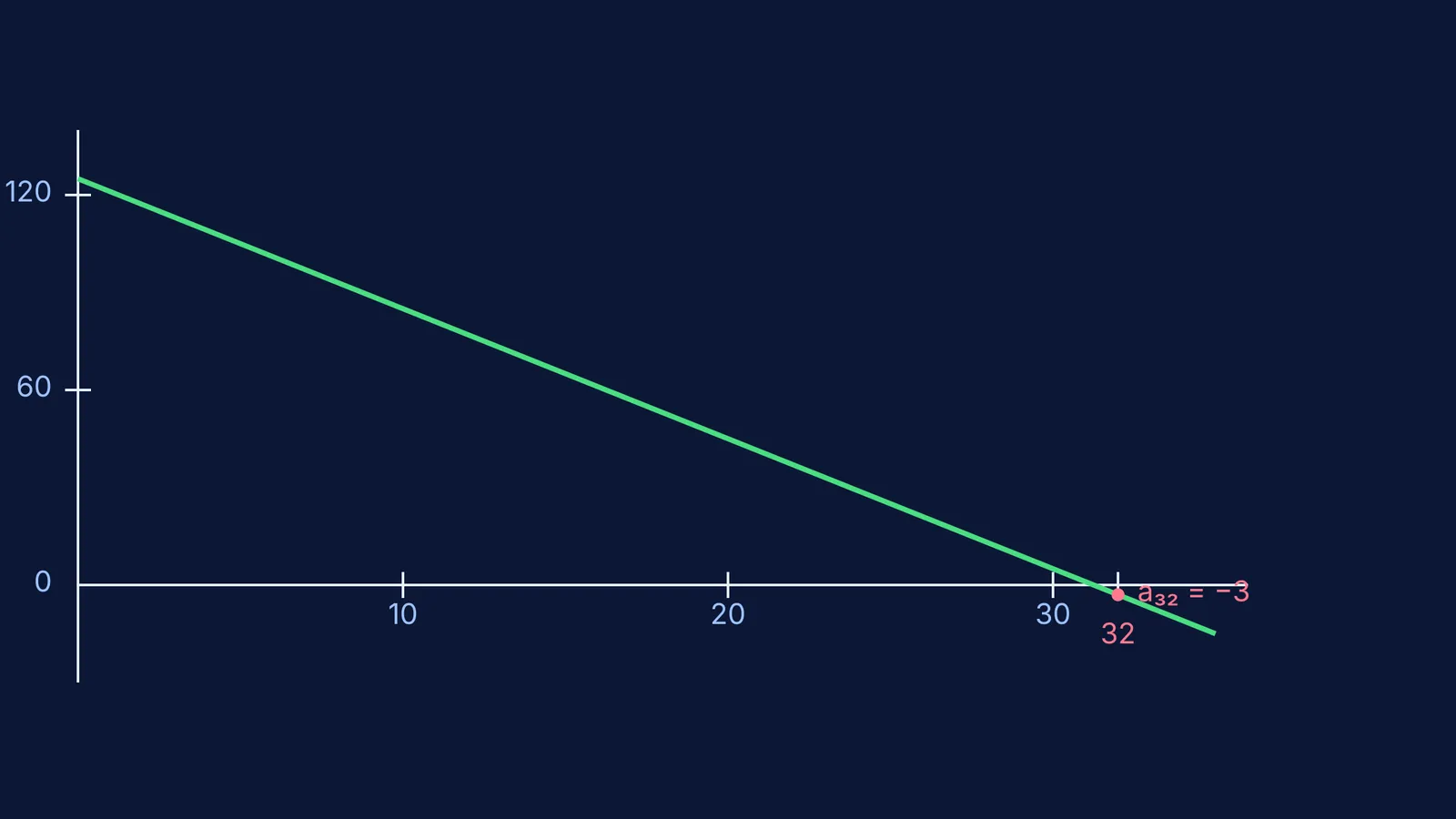
Consider a classic example sequence: 121, 117, 113, …
1. Find a and d The first term a = 121. The common difference d = 117 − 121 = −4.
2. Substitute into the inequality aₙ < 0 121 + (n − 1)(−4) < 0
3. Solve for n Expand the bracket: 121 − 4n + 4 < 0 125 − 4n < 0
Move 4n to the other side to keep it positive: 125 < 4n n > 125 / 4 n > 31.25
4. Pick the next whole number The position n must be an integer strictly greater than 31.25. The smallest integer that fits this rule is 32.
Therefore, the 32nd term is the first negative term in this progression. If you calculate it to check, a₃₂ = 121 + (31)(−4) = 121 − 124 = −3.
What if a term is exactly zero?
Sometimes, solving the inequality gives you an exact whole number. For instance, consider the sequence 24, 21, 18, …
Here, a = 24 and d = −3.
Setting up the inequality: 24 + (n − 1)(−3) < 0 24 − 3n + 3 < 0 27 < 3n n > 9
Because the inequality is strictly greater than 9, the smallest valid whole number is 10. The 10th term is the first negative one. If you check the 9th term, it is 24 + (8)(−3) = 0. The sequence lands perfectly on zero, so the negative terms begin one step later.
How does the zero term check help?
When solving sequence problems in exams like the JEE or school finals, examiners often ask "which term is 0?" before asking for the first negative term. Finding the zero term is simpler because it uses an equation (aₙ = 0) rather than an inequality.
If the problem asks which term is the first negative term and you are uncomfortable working with inequalities, you can solve for zero first.
Using the 121, 117, 113 sequence again, you would set aₙ = 0: 121 + (n − 1)(−4) = 0 125 − 4n = 0 4n = 125 n = 31.25
Since n must be a whole number, 31.25 tells you that the sequence skips over exactly zero between the 31st term and the 32nd term. The term before 31.25 (which is the 31st term) is the last positive number, and the term after 31.25 (the 32nd term) is the first negative number. This logic provides a practical alternative path to the same answer without reversing inequality signs.
If you are stuck on setting up an inequality or visualising a sequence, the Fermi Problem Library explains the reasoning behind the method rather than just printing the final answer. You can also refer to the Fermi Concept Library for lessons on arithmetic progressions and their standard formulas.


