

On this page
When you use the sum formula for an arithmetic progression (AP), you often end up solving a quadratic equation. Sometimes, this mathematical equation gives you two positive whole numbers for n (the number of terms). It feels like a mistake at first glance—how can adding 4 terms give the exact same total as adding 13 terms?
According to the official NCERT Class 10 Mathematics curriculum, an AP is simply a sequence where the difference between consecutive terms is constant, and that difference can be positive, negative, or zero. It is that negative difference that creates the mathematical condition for a double answer.
Why does the sum of an AP give two values of n?
The double answer happens when a sequence starts with positive numbers but has a negative common difference (d). As you move along the sequence step by step, the terms get smaller and smaller.
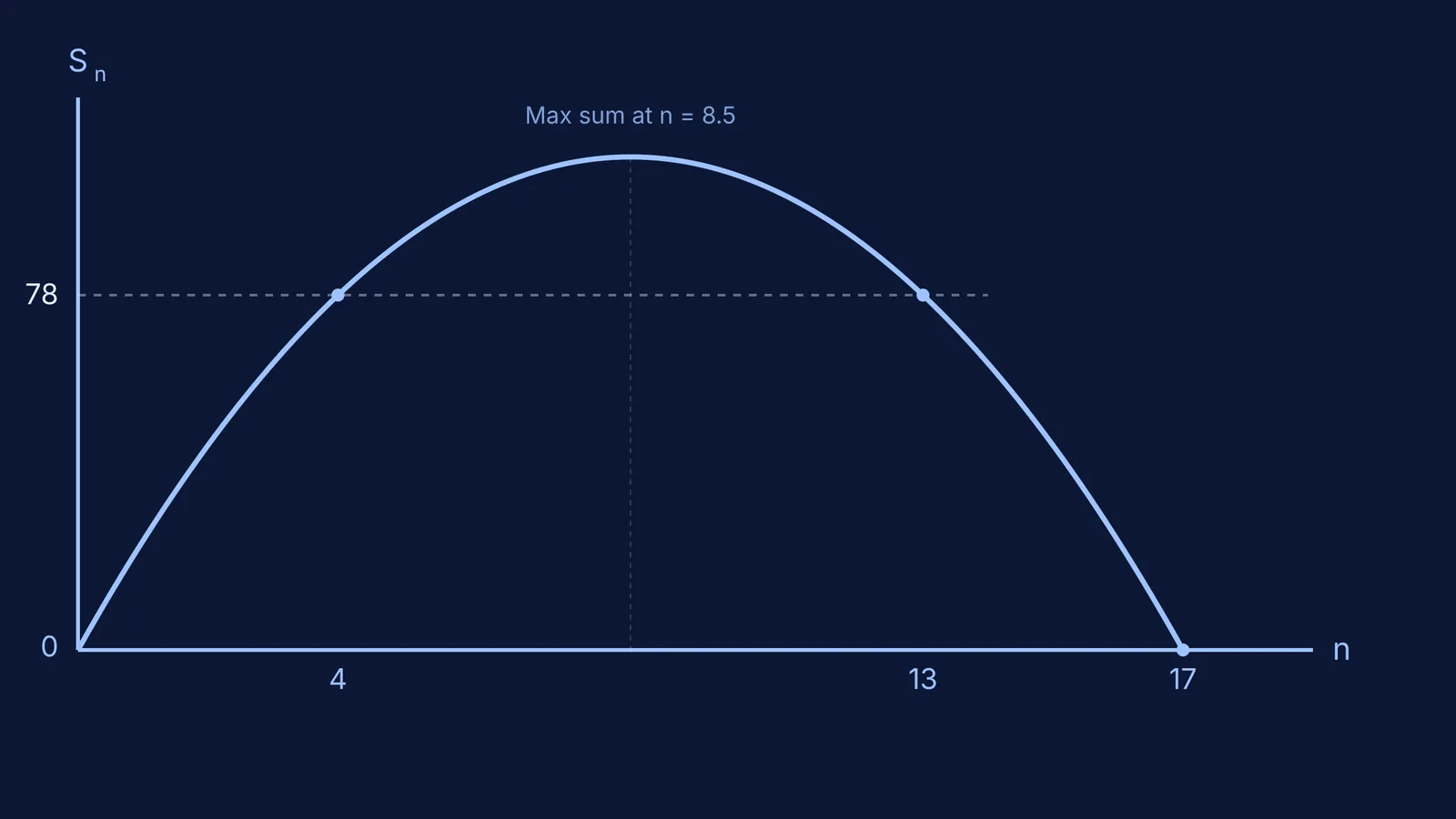
Eventually, the terms cross zero and become negative. If you keep a running total as you go, the sum grows rapidly while you add the positive terms, reaches a peak value, and then starts to shrink as you begin adding the negative terms.
Because the sum goes up and then comes back down, it reaches the same total in two different places. Both answers are mathematically valid. The sum of the terms between the smaller n and the larger n is exactly zero.
How many terms must be taken so that their sum is 78?
Consider the classic AP: 24, 21, 18, ... How many terms must we add to reach a sum of 78?
Here, the first term a = 24 and the common difference d = -3. Using the sum formula S_n = (n/2)[2a + (n-1)d]:
78 = (n/2)[48 + (n-1)(-3)] 156 = n[51 - 3n] 3n² - 51n + 156 = 0 n² - 17n + 52 = 0
Factoring this quadratic gives (n-4)(n-13) = 0. So, n = 4 or n = 13.
Let us write out the first 13 terms to see clearly why both results work: 24, 21, 18, 15, 12, 9, 6, 3, 0, -3, -6, -9, -12
Case 1 (n = 4): The sum of the first 4 terms is 24 + 21 + 18 + 15 = 78.
Case 2 (n = 13): The sum of the first 13 terms is also 78.
Look at the specific terms from the 5th to the 13th: 12 + 9 + 6 + 3 + 0 - 3 - 6 - 9 - 12 = 0. The later negative terms perfectly cancel out the middle positive terms, leaving the sum unchanged.
If you understand the sequence concept but struggle to set up or factor the quadratic equation smoothly, the Fermi Problem Library has worked problems with a step-by-step solver that explains the reasoning rather than printing an answer.
How do you handle the double answer in an exam?
When an exam problem asks for the number of terms and your quadratic equation gives two answers, you need to know how to present your final result:
Check for integers: n must be a natural number (a positive whole number). If your quadratic gives n = 4 and n = -4.5, you must reject the negative fraction. The only valid answer would be 4.
State the reason: If both values are positive integers, do not just leave them hanging on the page. Exam boards expect you to write a concluding sentence stating that the sum of the terms between the two values is zero, which is why both n values produce the same total.
Once you know why this mathematical phenomenon happens, a double answer becomes a useful check that you have set up the algebra correctly. For more ways to connect mathematical sequences and their sums, see the trick for Recovering aₙ from a formula for Sₙ or the rules for Inserting arithmetic and geometric means between two numbers.


