

On this page
A decreasing arithmetic progression (AP) starts positive and drops by the same amount every step. Its running total grows while you add positive terms, then shrinks once negative terms arrive. So "what is the maximum sum?" really means "where does the AP change sign?"
How do you find the maximum sum of a decreasing AP?
The NCERT Class 10 textbook gives the nth term of an AP with first term a and common difference d as aₙ = a + (n − 1)d (NCERT Mathematics, Chapter 5: Arithmetic Progressions). The same chapter gives the sum of the first n terms as Sₙ = n/2 [2a + (n − 1)d], or Sₙ = n/2 (a + l) when you know the last term l.
The chapter also notes that aₙ = Sₙ − Sₙ₋₁. Each new term is exactly what it adds to the sum. A positive term pushes the sum up, a negative term pulls it down, and a zero term leaves it unchanged.
Here is the method:
Confirm the sequence is an AP and find a and d (our guide on how to check if a sequence is an arithmetic progression covers this). The method below is for a > 0 and d < 0.
Set aₙ ≥ 0 and solve a + (n − 1)d ≥ 0 for n.
Take the largest whole number n that satisfies it. Call it k.
Work out Sₖ. If aₖ = 0 exactly, then Sₖ₋₁ = Sₖ, and both are the maximum.
Step 2 is the same calculation as finding the first negative term of an AP: the maximum sum stops one term before it.
Worked example: when does the sum of 20, 17, 14, ... stop growing?
Here a = 20 and d = −3, so aₙ = 20 − 3(n − 1) = 23 − 3n.
Set 23 − 3n ≥ 0. Then 3n ≤ 23, so n ≤ 7.67. The largest whole number is k = 7.
Check the boundary: a₇ = 2 is positive and a₈ = −1 is negative.
S₇ = 7/2 (20 + 2) = 77. That is the maximum sum, and it is reached at 7 terms only. Adding the eighth term gives S₈ = 76.
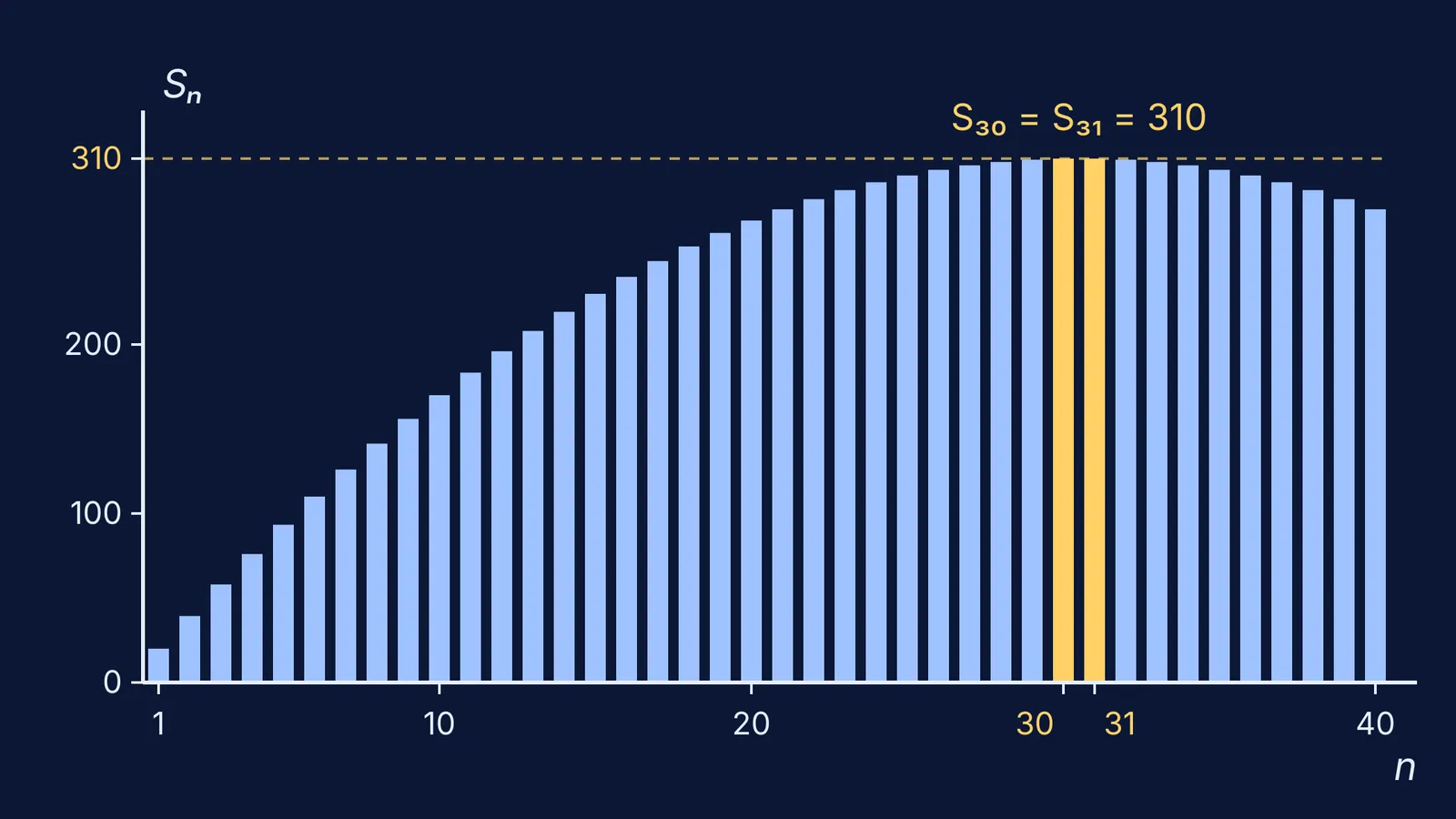
Why can two values of n give the same maximum sum?
Take the AP 20, 19⅓, 18⅔, ... Here a = 20 and d = −2/3, so aₙ = 20 − (2/3)(n − 1) = (62 − 2n)/3.
Set (62 − 2n)/3 ≥ 0. Then n ≤ 31, and this time the boundary is exact: a₃₁ = 0.
The 30th term is a₃₀ = 2/3, so S₃₀ = 30/2 (20 + 2/3) = 15 × 62/3 = 310. The 31st term adds nothing, so S₃₁ = 31/2 (20 + 0) = 310 as well.
The answer: the maximum sum is 310, reached after 30 terms or after 31 terms. If the question asks how many terms give the maximum, write both values of n.
Why it works: aₖ = 0 means a + (k − 1)d = 0, so k = 1 − a/d. Here 1 − 20/(−2/3) = 31.
Can you check the answer with the quadratic formula for Sₙ?
Expand the NCERT sum formula and you get Sₙ = (d/2)n² + (a − d/2)n. With d negative, this is a downward-opening parabola in n, so it has a single highest point.
The vertex sits at n = 1/2 − a/d. Because n must be a whole number, the maximum is at the whole number nearest the vertex.
First example: n = 1/2 + 20/3 ≈ 7.17, so the nearest whole number is 7.
Second example: n = 1/2 + 30 = 30.5, exactly halfway between 30 and 31, so the two sums tie.
The vertex is a half-integer only when the AP has a zero term: the same tie, seen another way. Symmetry about the vertex is also why one sum can appear at two values of n, as our post on why the sum of an AP can give two values of n explains.
What mistakes cost marks in these questions?
Solving aₙ > 0 instead of aₙ ≥ 0, and missing the tie at a zero term.
Forgetting to flip the inequality when dividing by a negative d.
Rounding 7.67 up to 8. Always round down: you want the last non-negative term.
Giving the vertex (a fraction such as 30.5) as the number of terms.
To practise, try a few APs with fractional d in the Fermi Problem Library, where a step-by-step solver explains the reasoning rather than printing an answer. If the formulas themselves feel shaky, the Fermi Concept Library gives each concept in mathematics its own lesson and its place in the map.


