

On this page
Savings, salary and instalment questions in the arithmetic progressions chapter often go wrong before any formula appears: a wrong n, a d with the wrong sign, or a total when the question wanted one month's figure. A short routine before you calculate helps catch these slips.
How do you find a, d and n in an AP word problem?
The NCERT Class 10 textbook defines an arithmetic progression as a list of numbers in which each term is obtained by adding a fixed number to the preceding term, except the first term (NCERT Class 10 Mathematics, Chapter 5). In money questions, read the story as three labels:
a is the first amount: the first salary, the first week's saving, the first instalment.
d is the fixed change per period: an annual increment, ₹10 more each week, or a negative number when a balance falls.
n counts periods, not calendar years. If someone starts work in 1995, find n first, then convert: year = 1995 + (n − 1).
NCERT Exercise 5.2, Q19 (Subba Rao's salary) asks for exactly this kind of year. The chapter also shows a negative d: the balance on a ₹1000 loan, after paying 5% of it every month, runs 950, 900, 850, ..., 50.
Before choosing a formula, write one line: a = __, d = __, n = __ (n counts __). If you cannot fill the last blank, reread the question. If turning words into algebra is the sticking point, our guide to setting up equations from Class 10 word problems builds the same name-it-first habit.
Does the question ask for aₙ or Sₙ?
NCERT gives the nth term as aₙ = a + (n − 1)d, and the sum of the first n terms as Sₙ = n/2[2a + (n − 1)d], or Sₙ = n/2(a + l) when the last term l is known (NCERT Chapter 5). The wording tells you which one you need:
salary in the 10th year, the last instalment, in which year: one term, so aₙ.
total saved, how much in all, total repaid: a running total, so Sₙ.
how many months to repay a loan: usually Sₙ = loan amount, solved for n.
Worked example: what is the salary in a given year?
A trainee's starting stipend is ₹18,000 a month, rising by ₹1,500 a month every year. What is the monthly stipend in the 6th year, and how much is earned in the first 6 years?
a = 18,000, d = 1,500, n = 6 (n counts years).
The 6th-year stipend is one term: a₆ = 18,000 + 5 × 1,500 = ₹25,500 a month.
The total adds the six monthly rates, S₆ = 6/2 [36,000 + 7,500] = ₹1,30,500, then multiplies by 12 months: ₹15,66,000.
Step 3 is the trap: the AP moves year by year while the money arrives month by month. Write the unit next to every term.
How much will weekly savings add up to?
You save ₹50 in the first week and ₹10 more each week after that. How much do you save in the 20th week, and over 20 weeks?
a = 50, d = 10, n = 20.
One week: a₂₀ = 50 + 19 × 10 = ₹240.
Total, using the last term: S₂₀ = 20/2 (50 + 240) = ₹2,900.
How do you solve an instalment question when n is unknown?
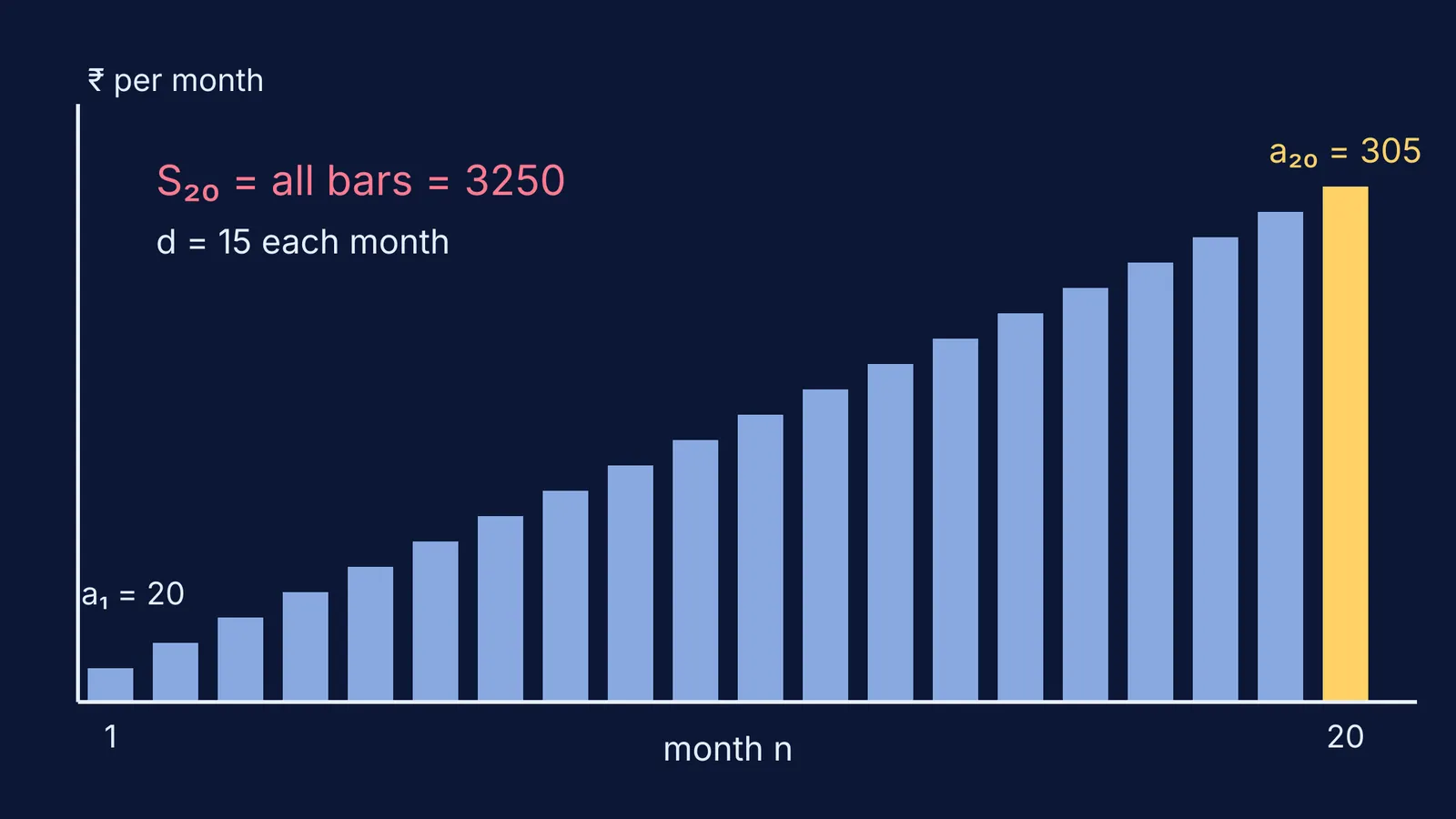
A loan of ₹3,250 is repaid by paying ₹20 in the first month and increasing each payment by ₹15 a month. How many months will it take?
a = 20, d = 15, n unknown. The loan is the total of all payments, so Sₙ = 3,250.
n/2 [40 + 15(n − 1)] = 3,250 gives 3n² + 5n − 1,300 = 0.
Factorise: (n − 20)(3n + 65) = 0. A count of months must be a positive whole number, so n = 20, not −65/3.
Check: a₂₀ = 20 + 19 × 15 = ₹305, and 20/2 (20 + 305) = ₹3,250.
Say why you reject a root: NCERT's Example 6 rejects an n that is not a positive integer, while in Example 13 both roots are accepted (NCERT Chapter 5). Substituting back is the habit behind working backwards to check maths word problems.
If your setup keeps going wrong at step 1, the Fermi Problem Library has worked problems with a step-by-step solver that explains the reasoning rather than printing an answer, so you can see where a and d came from.
Which NCERT questions should you practise next?
Work these from Chapter 5 of the NCERT textbook, writing the three-label line first:
Exercise 5.2, Q19 and Q20 (Ramkali's weekly savings): find n from a single term.
Shakila's money box, set up in Section 5.1 and solved in Section 5.4: a total.
Exercise 5.3, Q15 (a daily penalty rising by ₹50) and Q16 (₹700 shared as seven prizes, each ₹20 less than the last).
Once APs feel routine, the same idea carries into harmonic progression problems, which flip into an AP. If the gap is the idea of a sequence itself, the Fermi Concept Library gives every concept in mathematics its own lesson and its place in the map.


