

On this page
If you have ever read a Dettol bottle and wondered whether it is meant for your skin or your floor, chemistry has a neat answer: it depends on what you put it on, and for some chemicals on how much you dilute them. This idea turns up in Class 12 chemistry, objective questions and board "give reasons" answers.
What is the difference between an antiseptic and a disinfectant?
Both kill microorganisms or stop them growing; the difference is what you put them on.
Antiseptics are applied to living tissue such as wounds, cuts, ulcers and diseased skin, according to the NCERT Class 12 chapter Chemistry in Everyday Life (a copy of the 2019-20 edition).
Disinfectants are applied to inanimate objects such as floors, drainage systems and instruments, says the same NCERT chapter.
The US Centers for Disease Control and Prevention draws the same line in its Guideline for Disinfection and Sterilization in Healthcare Facilities: antiseptics are "applied to living tissue and skin" and disinfectants "only to inanimate objects".
The reason for the split is safety. The NIOS senior secondary chemistry lesson on drugs and medicines says disinfectants "are harsh and are not safe to be used on living beings" because they can damage living tissue.
Why is 0.2% phenol an antiseptic but 1% phenol a disinfectant?
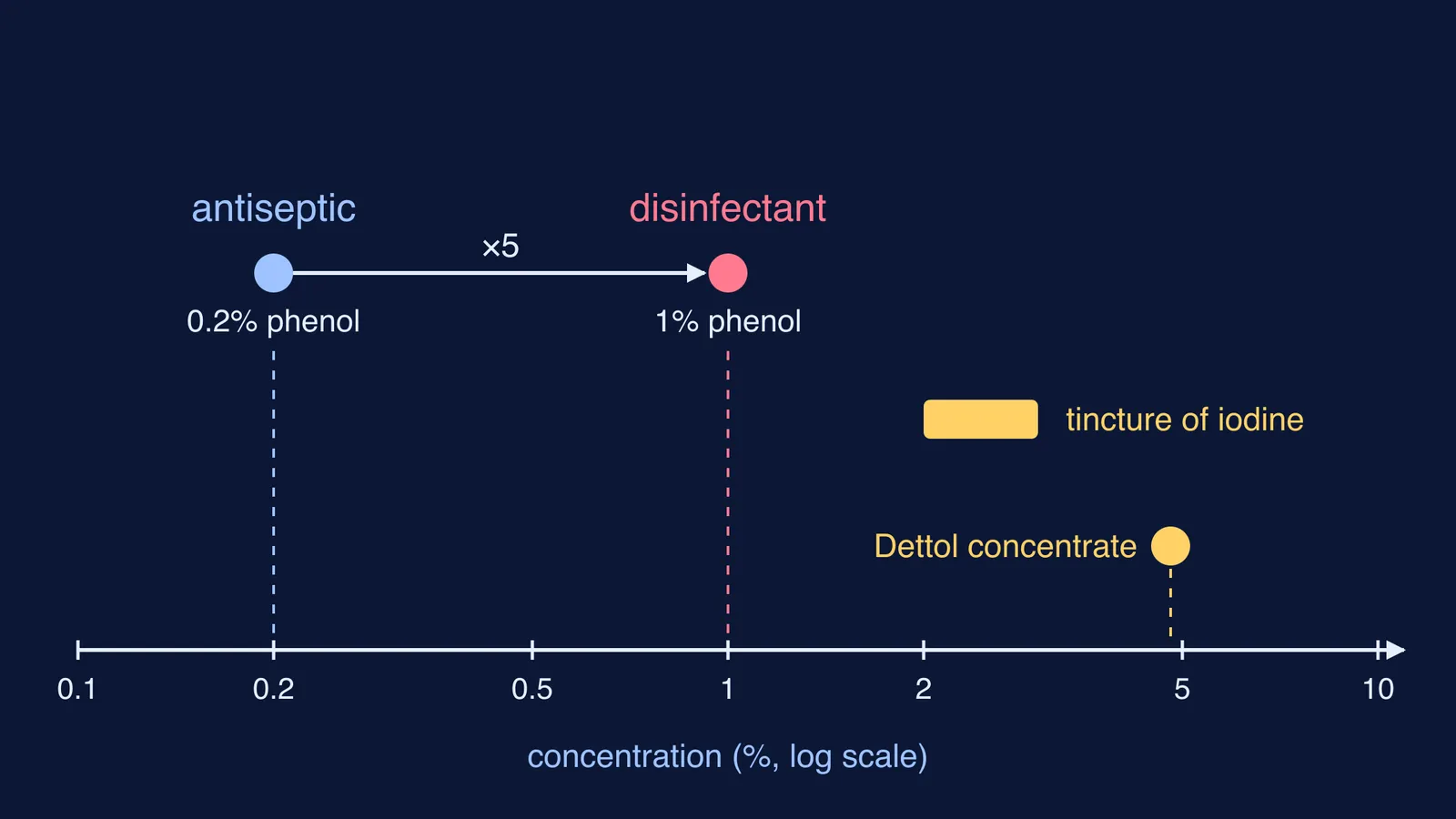
NCERT puts it in one line: "Same substances can act as an antiseptic as well as disinfectant by varying the concentration." Its example is that a 0.2% solution of phenol is an antiseptic, while a 1% solution is a disinfectant (NCERT Class 12, Unit 16).
The NIOS lesson explains why. Phenol is safe on living tissue at low concentrations, but at high concentration it can damage tissue, so at 1% or more it is used as a disinfectant. NIOS also notes that most antiseptics and disinfectants are powerful poisons that kill microbes by interfering with their metabolism.
So the molecule never changes. A 1% solution simply has five times as much phenol in the same volume as a 0.2% solution. That extra amount is harsh enough to harm the microbes on a floor, but also harsh enough to harm your skin. If you want to revise why phenol's -OH group behaves the way it does, read our guide to alcohols, phenols and ethers.
What are Dettol and tincture of iodine made of?
The NCERT chapter lists the examples you are expected to know:
Dettol: NCERT describes it as a mixture of chloroxylenol and terpineol. Chloroxylenol is a phenol ring carrying a chlorine atom and two methyl groups, so it is a close chemical relative of phenol.
Dettol's strength: the UK Dettol Liquid product information lists chloroxylenol at 4.8% w/v and tells users to "always dilute the product before use".
Tincture of iodine: a 2-3% solution of iodine in an alcohol-water mixture, applied on wounds.
Other antiseptics: iodoform for wounds, boric acid in dilute solution as a weak antiseptic for eyes, and bithionol added to soaps. For how soaps themselves clean, see soap vs detergent.
Disinfectants: chlorine at 0.2 to 0.4 ppm in water, and sulphur dioxide in very low concentrations.
Notice the chlorine example. At 0.2 to 0.4 ppm it is used at a far lower concentration than 1% phenol (1% is roughly 10,000 ppm), yet it still counts as a disinfectant because it treats water, not a person. That is the definition doing the work, not the number.
How do you answer antiseptic and disinfectant questions in exams?
Run every question through three checks, using the examples from the NCERT chapter:
What is it applied to? Living tissue means antiseptic; a floor, drain, instrument or water supply means disinfectant.
Which chemical is it? Match it to the pairs above (Dettol: chloroxylenol + terpineol; tincture of iodine: 2-3% iodine in alcohol-water).
Is a concentration given? For phenol, 0.2% points to antiseptic use and 1% to disinfectant use.
Worked example: diluting phenol on paper. A lab has a 1% phenol solution. How much do you need to make 100 mL of a 0.2% solution?
Use C1V1 = C2V2. So 1% x V1 = 0.2% x 100 mL, which gives V1 = 20 mL. Take 20 mL of the 1% solution and make it up to 100 mL with water. That is a dilution factor of 5, the exact gap between NCERT's two phenol solutions.
If the definitions still blur together, the Fermi Concept Library gives each chemistry concept its own lesson and shows where it fits in the wider map. For C1V1 = C2V2 numericals, the Fermi Problem Library has worked problems with a step-by-step solver that explains the reasoning rather than printing an answer.
Next, revise the rest of the drugs chapter with our explainer on antihistamines and tranquilizers.


