

On this page
Your Class 11 redox chapter is running inside you right now. Cells that burn food with oxygen make reactive by-products, and molecules called antioxidants hold them in check. Here is what they do at the level of electrons, and why the pill version disappointed in clinical trials.
What are free radicals?
Free radicals are highly reactive chemicals that form when an atom or molecule gains or loses an electron, according to the US National Cancer Institute. Left with an unpaired electron, a radical pulls an electron or hydrogen atom from a neighbour, which can then become a radical itself.
Cells also make some on purpose. A 2020 review by Helmut Sies and Dean Jones in Nature Reviews Molecular Cell Biology describes hydrogen peroxide and the superoxide radical (O2•−) as signalling agents made by more than 40 enzymes, including the mitochondrial electron transport chain. At low levels they help cells adapt; at high levels they cause damage the authors call oxidative distress. The goal is balance, not zero. (You met the superoxide ion in the oxides, peroxides and superoxides of the alkali metals.)
What do antioxidants do in a cell?
An antioxidant is a chemical that interacts with and neutralises free radicals, preventing them from causing damage (National Cancer Institute). In redox terms a chain-breaking antioxidant is a reducing agent: it gives away an electron or hydrogen atom and becomes a radical too stable to keep a chain going.
The best-known example is a relay between two vitamins, set out by the Linus Pauling Institute at Oregon State University:
Peroxidation of an unsaturated fatty acid (RH) in a cell membrane forms a lipid peroxyl radical (ROO•).
ROO• takes a hydrogen from the next lipid, which becomes a radical too: a chain reaction.
Fat-soluble vitamin E (α-tocopherol), sitting in the membrane, donates the hydrogen of its –OH group instead. ROO• becomes ROOH, and vitamin E becomes the tocopheroxyl radical (vitamin E–O•), breaking the chain.
Vitamin C, the primary water-soluble, non-enzymatic antioxidant, turns vitamin E–O• back into vitamin E; it can donate two electrons in turn, ending as dehydroascorbate (Linus Pauling Institute).
Glutathione regenerates vitamin C, and NADPH restores glutathione.
Lipid peroxyl radicals react about 1,000 times faster with α-tocopherol than with unsaturated lipids, the same vitamin E source notes, so vitamin E wins the race for the radical. Food makers use similar chemistry to stop oils going rancid: see how antioxidant preservatives work in food.
Worked example, steps 3 and 4 as half-reactions:
Vitamin E–OH → vitamin E–O• + H+ + e− (oxidation: vitamin E is the reducing agent)
ROO• + H+ + e− → ROOH (reduction: the lipid radical is quenched)
Ascorbate (AscH−) → ascorbate radical (Asc•−) + H+ + e− (oxidation)
Vitamin E–O• + H+ + e− → vitamin E–OH (reduction: vitamin E is recharged)
Why did antioxidant supplement trials disappoint?
Observational studies had linked high blood levels of vitamin E and beta-carotene with less lung cancer (ATBC report). Randomised trials then tested pills:
ATBC (1994): 29,133 male smokers in Finland were assigned vitamin E, beta-carotene, both or placebo and followed for five to eight years. Vitamin E did not reduce lung cancer, and lung cancer was 18% more common among men given beta-carotene (New England Journal of Medicine).
SELECT (2011): among 34,887 men analysed, those taking 400 IU of vitamin E daily had a 17% higher risk of prostate cancer than the placebo group (JAMA).
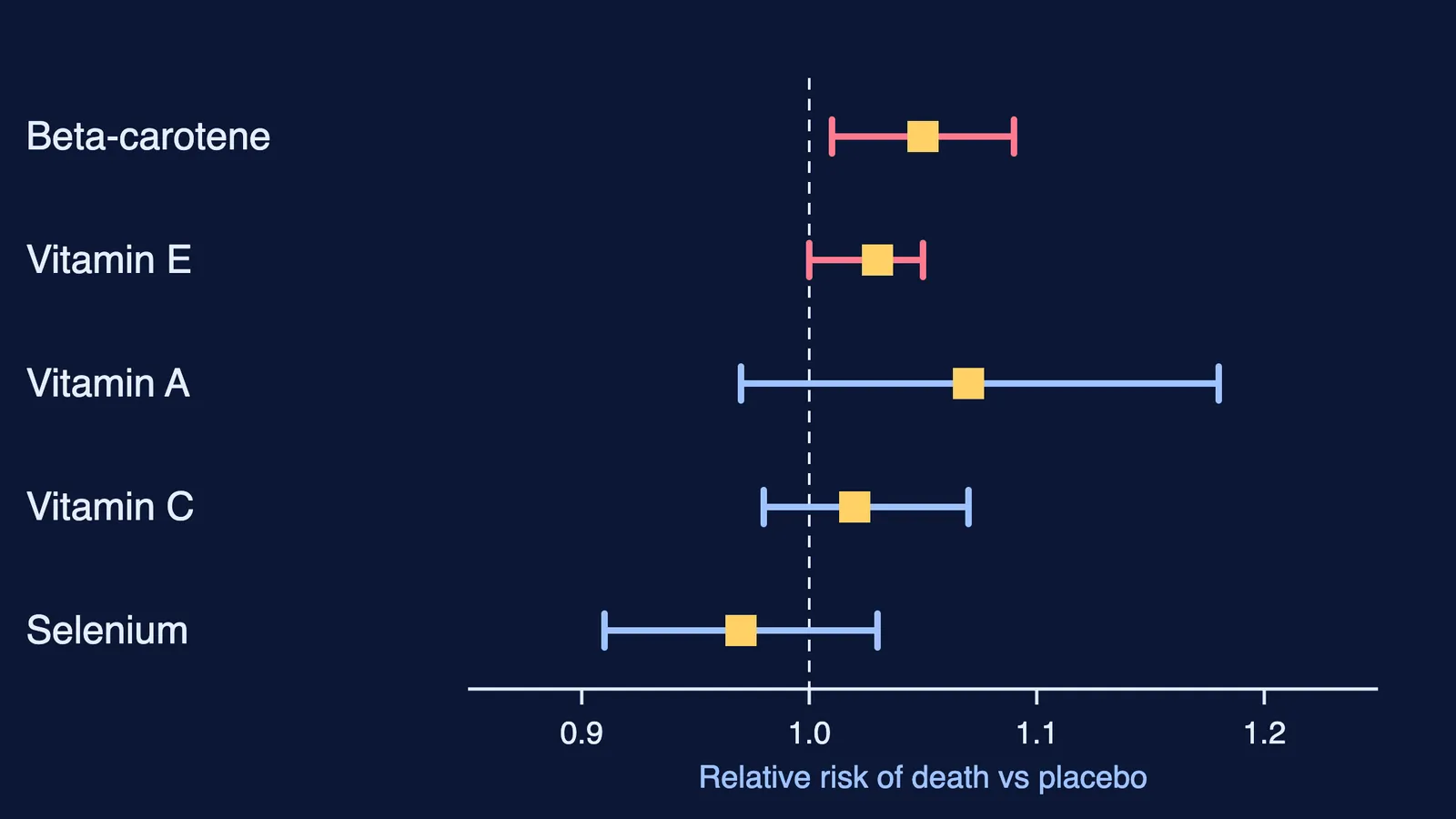
Cochrane review (2012): pooling 78 randomised trials with 296,707 participants, the authors found no evidence to support antioxidant supplements for prevention, and in trials at low risk of bias beta-carotene and vitamin E seemed to increase mortality (Bjelakovic and colleagues).
Why the gap? Sies and Jones note that wiping out reactive oxygen species with small antioxidant molecules did not counter disease in trials, and their review describes those species as signals cells need. The US National Center for Complementary and Integrative Health adds that purified antioxidants might act differently from those in food, and that high doses of vitamin E may increase the risk of bleeding.
How do you judge an antioxidant claim?
Ask four questions of any advert or forwarded message:
Was it a randomised trial in people, or a test tube or observational survey?
Did it measure a blood marker, or real outcomes such as disease and death?
Was the dose close to what food provides, or many times more?
Who was studied, and do they resemble you?
You can see vitamin C's reducing power in the lab with the DCPIP test for vitamin C in juices.
If redox in biology still feels like two separate chapters, the Fermi Concept Library covers every concept in physics, chemistry, biology, mathematics and computing, and the Fermi Problem Library has a step-by-step solver that explains the reasoning, so you can practise oxidation states until they feel automatic.


