

On this page
Antimatter began as a line of algebra in 1928 and now works every day inside hospital scanners. Here is what it is, how it was predicted and found, and the short calculation that explains how a PET scan sees inside the body.
What is antimatter, in one sentence?
Antimatter is made of antiparticles, each with the same mass as its matching particle but the opposite electric charge, as CERN explains. The electron's antiparticle is the positron: an electron's mass, with charge +e instead of −e.
When a particle meets its antiparticle, the two annihilate and leave only energy behind, mostly in the form of photons and pions (CERN). For an electron and a positron, it is gamma-ray photons.
How did Dirac predict antimatter?
In 1928 the British physicist Paul Dirac wrote down an equation that combined quantum theory with special relativity to describe an electron moving at relativistic speeds (CERN). He published it as The quantum theory of the electron in the Proceedings of the Royal Society.
The equation allowed a partner to the electron with the same mass and opposite charge, which physicists came to read as an "anti-electron" (CERN). CERN's page credits the equation with winning Dirac the Nobel Prize in 1933. The lesson is in the method: Dirac made the maths obey both theories, then took its strange extra solutions seriously.
How did Carl Anderson find the positron?
Carl Anderson discovered the positron in 1932, showing that Dirac's anti-electron was real (CERN). His full report, The Positive Electron, appeared in Physical Review in March 1933.
A charge moving through a magnetic field feels the force F = q(v × B), so a positive and a negative particle at the same speed bend in opposite directions. Once you know which way a track is travelling, a particle with an electron's mass that curves the "wrong" way is a positron.
How much energy does antimatter release?
Here is the calculation behind every PET scan.
The rest energy of an electron is 0.51099895069 MeV, the CODATA 2022 value published by NIST. A positron has the same mass, so the same rest energy.
An electron and a positron nearly at rest carry about 2 × 0.511 = 1.022 MeV in total, and almost zero momentum.
A single photon always carries momentum, so one photon cannot leave with zero total momentum. The simplest outcome is two photons.
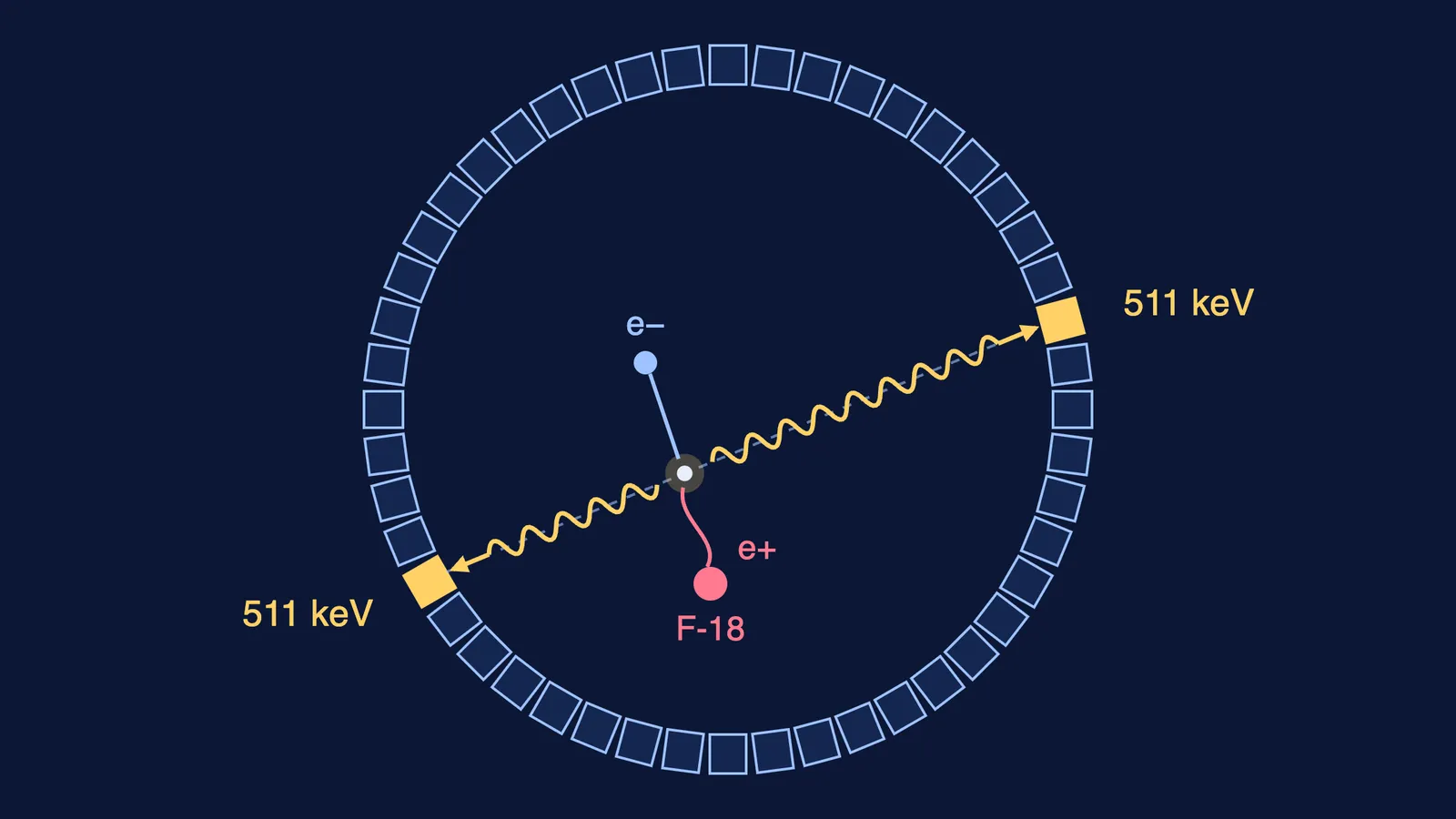
To cancel each other's momentum, the two photons share the energy equally and fly in opposite directions: 511 keV each.
All of the pair's mass becomes light, the same E = mc² bookkeeping behind why 1 amu equals 931.5 MeV. If the momentum step is where you lose the thread, the Fermi Problem Library has worked problems with a step-by-step solver that explains the reasoning rather than printing an answer.
How do PET scans use antimatter?
PET stands for positron emission tomography. The radiolabels used in PET give off positrons, each positron annihilates with an electron, and two gamma-ray photons travel in opposite directions to the scanner's detectors, according to the US National Institute of Biomedical Imaging and Bioengineering. A widely used tracer is FDG, a slightly modified glucose molecule labelled with fluorine-18 (same page).
Because the photons leave back to back, two detectors on opposite sides that fire together mark a line through the body. The annihilation happened somewhere on that line, and many such lines build the picture. How a nucleus emits a positron in the first place is covered in positron emission and electron capture, with equations.
Fluorine-18 has a half-life of 109.77 minutes, according to the IAEA nuclear data service. Try the arithmetic: six hours is 360 minutes, about 3.3 half-lives, so only around 10% of the tracer is left. A dose made in the morning cannot wait for next week.
Doctors use PET to look for cancer, to study brain problems such as tumours, memory disorders and seizures, and to see how a heart attack has affected the heart; the PET scan itself takes 20 to 30 minutes (RadiologyInfo). If someone in your family has a PET scan planned, their doctor and the nuclear medicine team are the people to ask about preparation and safety.
How can you explain antimatter in an exam answer?
A four-line answer for a viva or short-answer question:
Definition: an antiparticle has its particle's mass and the opposite charge; the positron is the anti-electron.
History: Dirac's 1928 equation predicted it; Anderson found the positron in 1932.
Energy: an electron-positron pair at rest usually becomes two photons of 511 keV each (the electron's rest energy, per NIST), back to back, conserving energy and momentum.
Use: PET scanners detect those photon pairs to map where a tracer has gone in the body.
If curving tracks are hard to picture, the Fermi Simulation Lab has interactive simulations for ideas that are easier to see than to read. If modern physics feels like loose topics, Fermi's AI tutor can work out what you already know and build a plan for the session.
Curious about the hospital side? Read how to become a medical physicist in India.


