

On this page
If you have drawn the transverse section of an anther, you have drawn four rings around each pollen sac. Most students can name them. Fewer can say what each ring does, and that is where marks slip. This guide goes from the outside in, explains why the tapetum gets the most attention, and ends with a ten-minute revision plan.
What are the four layers of the anther wall?
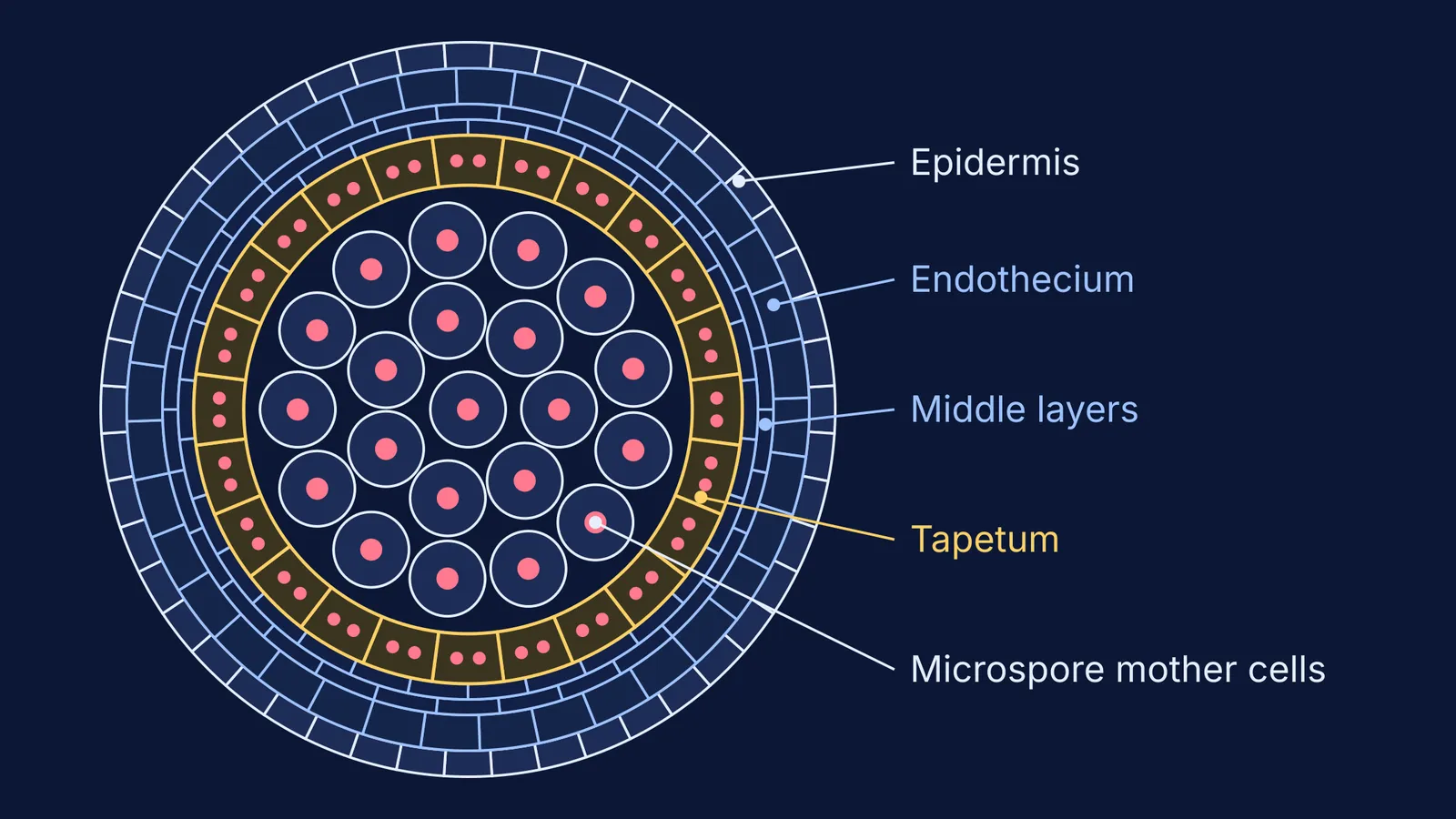
A typical anther is bilobed and dithecous, and in transverse section it shows four microsporangia, two in each lobe, according to the NCERT Class 12 biology textbook, Chapter 1. Each microsporangium is generally surrounded by four wall layers. From outside to inside:
Epidermis: the outermost layer of cells.
Endothecium: the layer just below the epidermis, which helps the anther split open.
Middle layers: the cells between the endothecium and the tapetum.
Tapetum: the innermost layer, in direct contact with the cells that will become pollen.
NCERT's summary is worth learning: the outer three layers protect the microsporangium and help in dehiscence of the anther to release the pollen, and the tapetum nourishes the developing pollen grains (NCERT, Chapter 1). At the centre of a young microsporangium sits the sporogenous tissue, whose cells undergo meiosis to form microspore tetrads.
How does the endothecium help the anther open?
The anther does not simply burst. A study of *Arabidopsis* by Sanders and colleagues in The Plant Cell explains that the endothecial layer must expand and lay down fibrous, lignified bands in its cell walls for the anther to open. Cells of the stomium also play an active part, and the wall breaks at a specific site that runs the length of the anther to release the pollen.
The middle layers are short-lived. A review of anther development in rice and *Arabidopsis* in Genetics and Molecular Biology notes that the middle layer becomes less prominent as the anther develops, with only remnants left by stage 7, around the time of meiosis.
What is the function of the tapetum?
The tapetum is the anther's supply layer. NCERT says its cells possess dense cytoplasm and generally have more than one nucleus (NCERT, Chapter 1). Research papers and reviews add detail that helps in long answers:
Food: the tapetum surrounds the developing microspores and provides them with lipids, carbohydrates and proteins (Ortolan et al., Genetics and Molecular Biology).
Freeing the tetrads: the four microspores of a tetrad are held in a callose wall, and the tapetum secretes the enzyme callase that frees them (Quilichini, Douglas and Samuels, Annals of Botany).
Building the pollen wall: genes needed to make sporopollenin, the tough material of the exine, are expressed specifically in the tapetum (Quilichini et al.).
Coating the pollen: lipid-rich pollen coat materials made and stored in the tapetum are deposited onto pollen grains when tapetal cells undergo programmed cell death (Quilichini et al.).
A 2022 review in Seed Biology by Yao, Hu and Yang adds a fifth job: the tapetum supplies small RNAs that regulate gene methylation in the germline cells. Timing matters too. In the rice *tdr* mutant, the tapetum and middle layer break down late, the microspores collapse and the plant is completely male sterile (Ortolan et al.).
To revise the exine itself, our explainer on sporopollenin, exine and germ pores picks up where the tapetum's job ends.
How do you remember the anther wall layers for exams?
Use three columns: layer, one-word job, one exam trap. Say it aloud once, then write it from memory.
Epidermis: protects. Trap: it is part of the anther wall, not the pollen grain wall.
Endothecium: opens. Trap: the fibrous bands are in the endothecium, not the epidermis.
Middle layers: short-lived. Trap: NCERT writes them in the plural, and only remnants are left by around meiosis.
Tapetum: feeds. Trap: it is the innermost layer, so it touches the sporogenous tissue, not the epidermis.
A mnemonic from outside in: Every Exam Means Tea (Epidermis, Endothecium, Middle layers, Tapetum).
Worked question: Name the innermost wall layer of a microsporangium and give two of its functions.
Answer: The tapetum. It nourishes the developing pollen grains, and it secretes callase, which frees the microspores from the tetrad.
Then practise the diagram. Our guide to drawing the T.S. of an anther shows where each label goes, and what happens inside the pollen grain next is covered in 2-celled vs 3-celled pollen at shedding.
If a term in this chain still feels shaky, such as meiosis in the pollen mother cell, the Fermi Concept Library has a lesson for every concept in biology, each placed in its map so you can see what it connects to. To test yourself on worked questions, the Fermi Problem Library has a step-by-step solver that explains the reasoning rather than printing an answer.


