

On this page
Every autumn, stoats and Arctic hares in the far north shed their brown summer fur and grow a white coat. The main timing signal is not snow or cold but something more regular: how long the nights are.
Which animals change coat colour in winter?
A 2018 review in Biological Reviews counted more than 20 species of birds and mammals in the northern hemisphere that moult from brown in summer to completely white in winter (Zimova et al., 2018). Its examples include the snowshoe hare, the Arctic fox and the willow ptarmigan, a bird of the grouse family.
In winter, the Arctic hare has a long, thick white coat with black-tipped ears, and in summer it moults to brownish-grey or grey-blue (Animal Diversity Web). The stoat (Mustela erminea), also called the short-tailed weasel, makes the same brown-to-white switch in much of its northern range.
Not every population of these species turns white. A study in Science mapped winter coat colour across eight species, including hares, weasels and foxes, and found that a larger share of each population moulted to white at higher latitudes (Mills et al., 2018).
Why do animals turn white in winter?
Across species, the main function of the white winter coat is camouflage against snow, the 2018 review concluded (Zimova et al., 2018). A white animal on white ground is hard to see, whether it is hiding from a predator or creeping up on prey.
What triggers the change: cold, snow or day length?
Photoperiod, the number of hours of daylight in a day, is the main driver of when the colour moult happens (Zimova et al., 2018).
Over 3 winters with very different amounts of snow, wild snowshoe hares did not change when they started moulting, or how fast they turned white in autumn. Only the speed of the spring change back to brown varied (Mills et al., 2013).
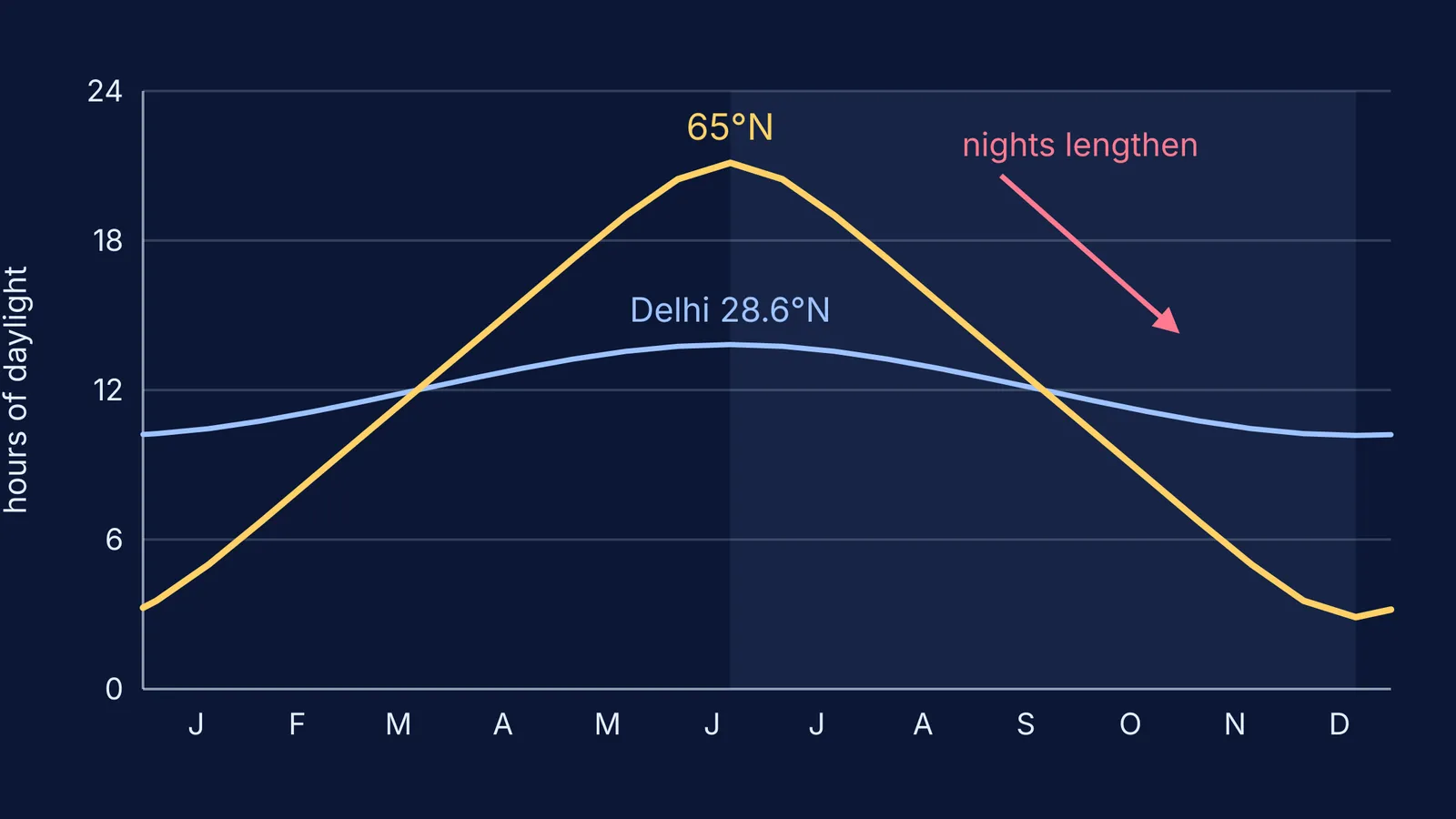
Near the Arctic Circle, day length swings far more across the year than it does in India, so the signal is strong. Our post on how latitude changes day length lets you compare places.
How does day length turn fur white?
The message travels through hormones, in this chain:
The pineal gland releases melatonin at night, and the length of that release is proportional to the length of the night (Butler et al., 2010). Longer nights mean a longer melatonin signal.
In Djungarian hamsters, short days lower the level of prolactin, a hormone made by the anterior pituitary (Duncan and Goldman, 1984). Revise the anterior pituitary hormones and what they do.
In the same hamsters, the fall in prolactin appears to set off the winter moult, and a rise in prolactin seems to be needed for the summer coat to grow back (Duncan and Goldman, 1984).
The evidence comes from experiments that changed one hormone at a time. In 1969, researchers implanted melatonin in brown male stoats, which then moulted into a white coat, while untreated stoats stayed or turned brown (Rust and Meyer, 1969). In the hamster study, daily prolactin injections stopped the winter moult that short days normally cause, and a drug that blocks prolactin release stopped the spring moult (Duncan and Goldman, 1984).
Genes matter too. Whether a snowshoe hare turns white or stays brown in winter depends on how its Agouti pigmentation gene is regulated, and the brown winter version arrived through interbreeding with jackrabbits (Jones et al., 2018).
What happens when the snow comes late?
Because the moult follows the calendar, not the weather, a warmer winter can leave a white hare on brown ground. Climate projections in the snowshoe hare study forecast 29 to 35 fewer days of snow cover a year at the study sites by mid-century. Unless coat timing evolves, hares would spend four to eight times as many days mismatched by the end of the century (Mills et al., 2013).
How do you answer this in a biology exam?
Use a five-step chain for any long answer on seasonal change in animals:
Stimulus: shorter days and longer nights in autumn.
Signal: a longer melatonin release from the pineal gland each night.
Hormone change: prolactin from the anterior pituitary falls.
Response: the animal moults and grows a white coat.
Advantage: camouflage against snow.
Worked example, in assertion-reason style. Assertion: a stoat kept under long summer days through a cold winter would be expected to stay brown. Reason: the timing of the colour moult is set mainly by photoperiod, acting through melatonin. Both are true, and the reason explains the assertion. The trap is a reason about cold: it sounds sensible, but cold is not the main trigger.
If the hormone chain is where you get lost, the Fermi Concept Library gives every biology concept its own lesson and its place in the map, so you can see how the pineal gland and pituitary connect. For practice, the Fermi Problem Library has worked problems with a step-by-step solver that explains the reasoning rather than printing an answer.
Colour change that takes seconds works very differently: see how chameleons change colour.


