

On this page
For decades, scientists believed that chameleons changed their appearance by moving pigments around inside their skin cells, much like cuttlefish or octopuses. In cephalopods, specialized organs called chromatophores contain sacs of pigment. Muscles stretch these sacs to reveal the color, or contract them to hide it. But this pigment-based mechanism could not fully explain the brilliant, rapid shifts of species like the panther chameleon, which can transition from a leafy green to a fiery red in a matter of seconds.
In 2015, a team led by Michel Milinkovitch at the University of Geneva discovered the real mechanism: chameleons use structural colour. Rather than simply spreading dyes, they rely on physics. Under their skin's surface, chameleons have specialised cells called iridophores. These cells contain a precise, three-dimensional lattice of guanine nanocrystals. Unlike the passive structural color seen in a peacock feather or a butterfly wing, which remains fixed, the chameleon's system is entirely active and tunable.
How does a chameleon change colour?
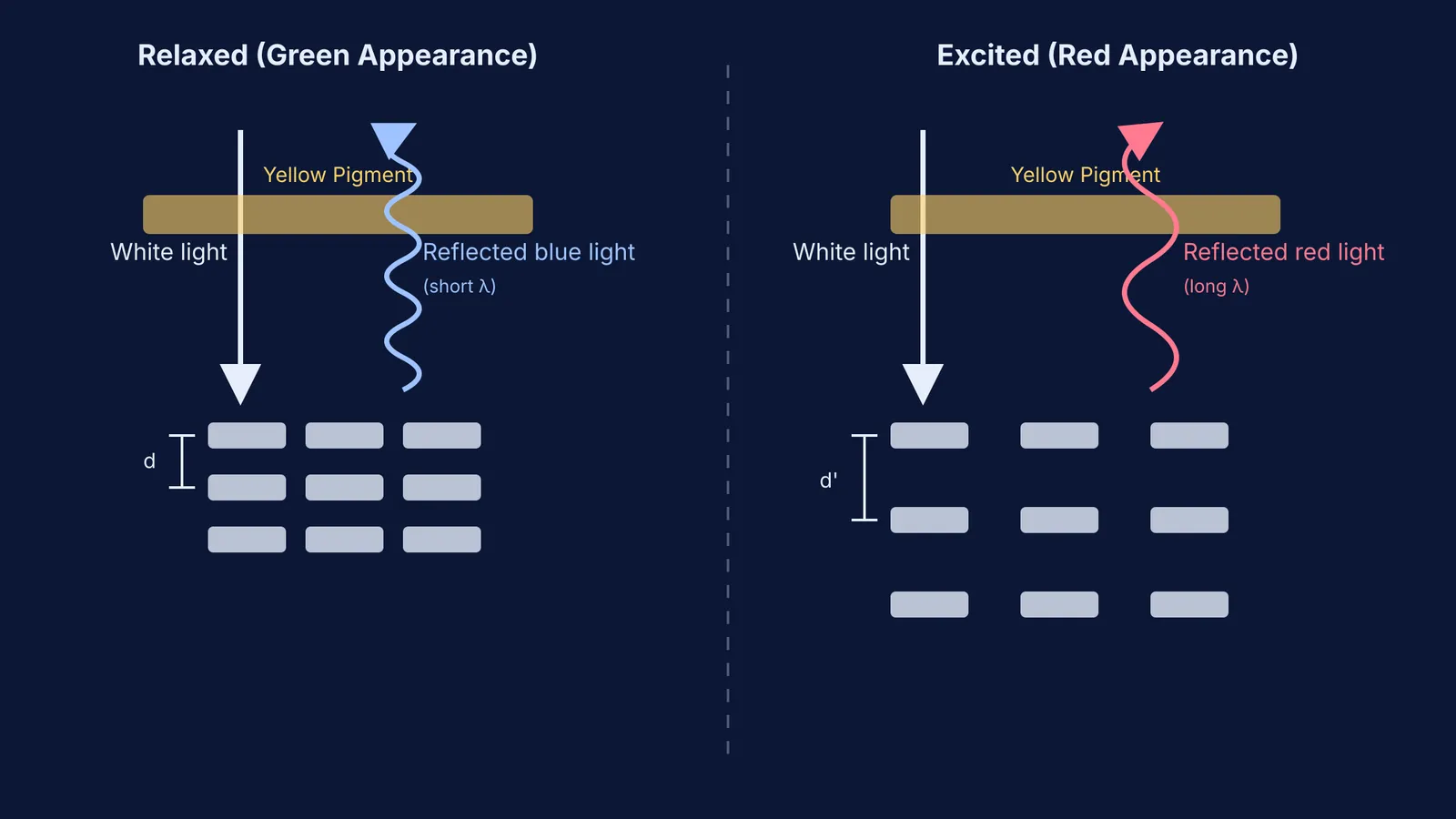
By actively tuning the distance between these tiny crystals, the chameleon changes the way light waves bounce off them. When the animal is calm and relaxed, the nanocrystals are packed closely together. In this dense configuration, the lattice constructively reflects short wavelengths of light, specifically blue light.
However, a chameleon does not look blue when it is relaxed. The lizard has a superficial layer of yellow pigment cells, known as xanthophores, sitting just above these crystal-bearing iridophores. When the reflected blue light passes back outward through the yellow layer, the combination makes the animal appear green. This provides excellent natural camouflage in a leafy forest environment.
What happens when a chameleon gets excited?
When a chameleon becomes excited—whether to intimidate a rival male or attract a potential mate—it stretches its skin, allowing the lattice of nanocrystals to expand.
As the physical spacing between the guanine crystals increases, the lattice begins to reflect longer wavelengths of light. The reflected light shifts smoothly across the spectrum: from blue to green, then to yellow, orange, and finally red. Because the structural colour produced by this interference is so intense, it completely overpowers the yellow pigments above it. This results in the spectacular, fiery displays that panther chameleons are known for.
Understanding how these waves bounce and combine is a core part of physics. If you want to see exactly how changing the crystal spacing alters the phase difference vs path difference of the outgoing waves, it helps to look at a moving model. Interactive simulations for the ideas that are easier to see than to read are available in the Fermi Simulation Lab.
Do chameleons change colour for camouflage?
While we often use the word "chameleon" to describe someone who seamlessly blends into the background, their most dramatic colour changes are actually for social signalling, not hiding. A green resting state provides camouflage, but the bright red and orange displays are explicitly meant to be seen by other animals.
However, their unique skin structure does offer another invisible, highly practical benefit. The 2015 study also found a second, deeper layer of iridophores containing larger, less organised crystals. Instead of reflecting visible light, this deep layer strongly reflects near-infrared light from the sun. In the hot, sun-baked environments where these reptiles live, this deep layer acts as a passive thermal shield, preventing the cold-blooded animal from overheating. This dual-layer organization is an evolutionary novelty that brilliantly combines social display, camouflage, and temperature regulation.
If you are studying optics, the mechanics of structural colour provide a perfect real-world application of wave interference. It is the exact same fundamental physics that dictates the dispersion of white light by a glass prism or the iridescent colours of a soap bubble.


