

On this page
Two parallel lines with a bent line between them is a common figure in Class 7 geometry. The bend makes it awkward: no single straight line crosses both parallel lines, so the usual angle rules seem to have nothing to work with. The fix takes one stroke of the ruler.
Why does a bend break the usual angle rules?
Alternate angles need a transversal, a straight line that cuts both parallel lines. NCERT's Class 7 textbook Ganita Prakash, in its chapter Parallel and Intersecting Lines, states the rule: "Alternate angles formed by a transversal intersecting a pair of parallel lines are always equal to each other." The same chapter adds that interior angles on the same side of a transversal add up to 180°.
In a bent figure, neither arm reaches the other parallel line, so you build an extra line that both arms do cross.
How do you find the angle at a single bend?
Take line l through B and line m through D, with l parallel to m. Point E lies between them, to the right, so BE and DE make an arrowhead shape pointing right. The angle between BE and the part of l pointing right is 40°. The angle between DE and the part of m pointing right is 35°. Find angle BED.
Through E, draw a line EF parallel to l, with F on the left. Drawing a line through a point parallel to a given line is Proposition 31 in Book I of Euclid's Elements.
EF is parallel to m as well, because "straight lines parallel to the same straight line are also parallel to one another" (Euclid, Book I, Proposition 30).
BE is a transversal of l and EF. Angle BEF and the 40° angle are alternate angles, so angle BEF = 40°.
DE is a transversal of m and EF. In the same way, angle DEF = 35°.
Angle BED = 40° + 35° = 75°.
If the question gives the obtuse angle on the other side of B, say 140°, first use a linear pair: 180° − 140° = 40°. Our guide to complementary and supplementary angle problems covers that step.
What if there are two bends, like an M or a W?
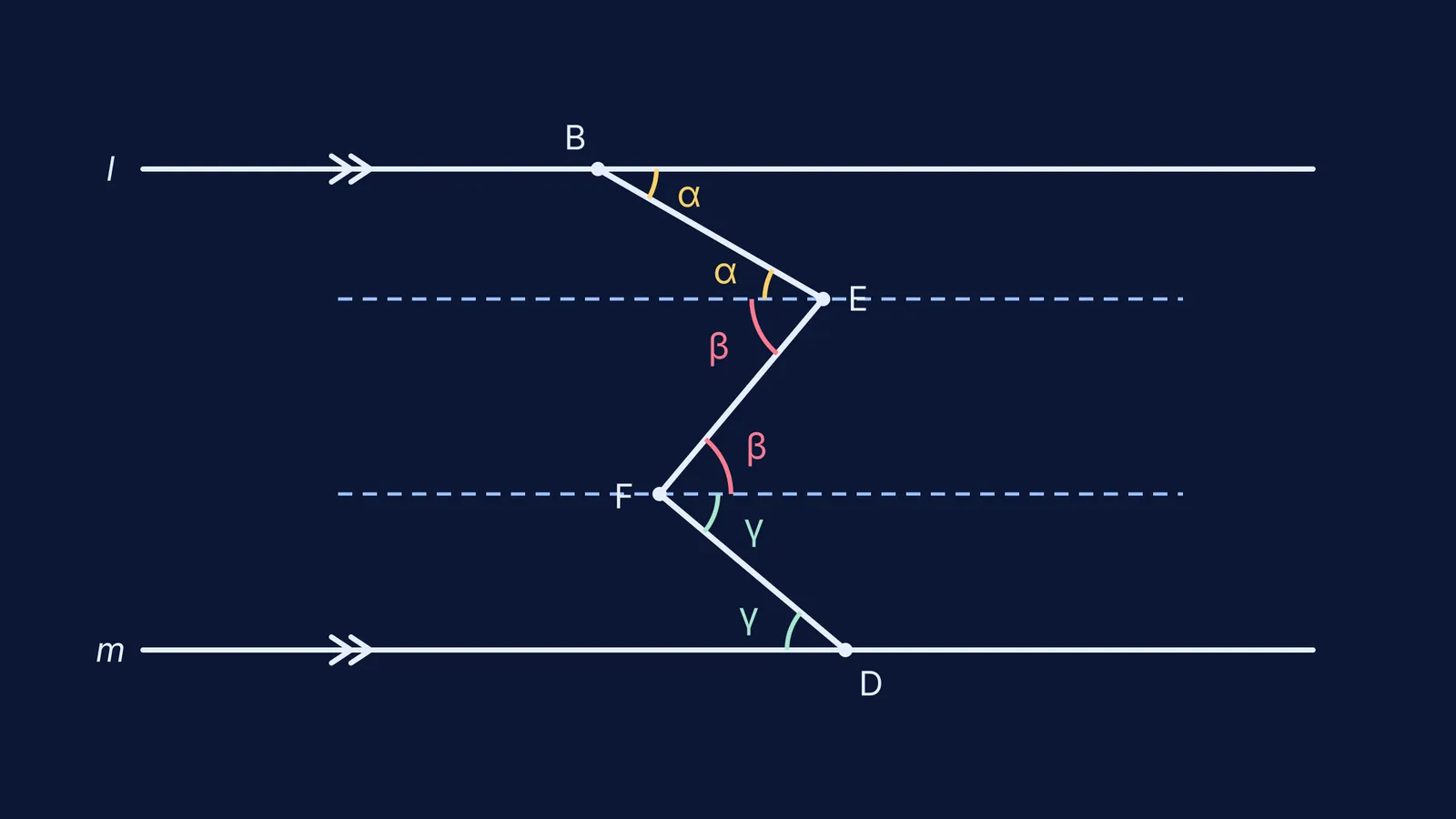
Draw one extra parallel line through every bend, then move down the zigzag one segment at a time. Suppose the path goes B, E, F, D from the top line to the bottom line, with E to the right of B and F to the left of E. Angle B, between BE and the part of l pointing right, is 30°. The bend at E is 80°. Angle D, between DF and the part of m pointing left, is 40°. Find the bend at F.
At E, the extra line splits the 80°. The upper part is alternate to angle B, so it is 30°. The lower part is 80° − 30° = 50°.
At F, the upper part is alternate to that 50°, because EF is a transversal of the two extra lines. So it is 50°.
The lower part at F is alternate to angle D, so it is 40°.
Angle F = 50° + 40° = 90°.
The Ganita Prakash chapter ends its Figure it Out questions with this kind of figure: question 6 asks for angle NOP in a zigzag between parallel lines LM and PQ. Its hint is the method above: "Draw lines parallel to LM and PQ through points N and O."
Which mistakes cost marks in bent-line problems?
Drawing the extra line and not saying so. Write "Draw EF parallel to l through E" as your first line, and mark it with arrow marks.
Pairing angles that are not alternate. Alternate angles sit on opposite sides of the transversal and between the two lines it cuts.
Leaving out reasons. Write "alternate angles, EF parallel to l" beside each step.
Not checking the picture. A bend that looks sharp should not come out at 150°.
How should you practise this?
Redo both examples from a blank page with new numbers.
Draw your own zigzag with three bends and confirm the zigzag check with a protractor.
Attempt NCERT question 6 from the chapter linked above.
Move on to triangles. A common proof that a triangle's angles add to 180° uses the same move, a line through one vertex parallel to the opposite side; see why the angles of a triangle add to 180 degrees, then practise with triangle angle sum problems where you find x.
If your answer keeps disagreeing with the key, the Fermi Problem Library has worked problems with a step-by-step solver that explains the reasoning rather than printing an answer. If transversals themselves feel shaky, the Fermi Concept Library gives each mathematics concept its own lesson.
Next time you see a bend, reach for the ruler first: one extra parallel line, then alternate angles.


