

On this page
Many circle-angle questions turn on one sentence: the angle at the centre is twice the angle at the circumference. Here is why it holds, the case students get wrong, and how it gives you "angles in the same segment are equal" for free.
What does the angle at the centre theorem say?
Euclid's wording, in Book III, Proposition 20 of the Elements, is: "In a circle the angle at the center is double the angle at the circumference when the angles have the same circumference as base."
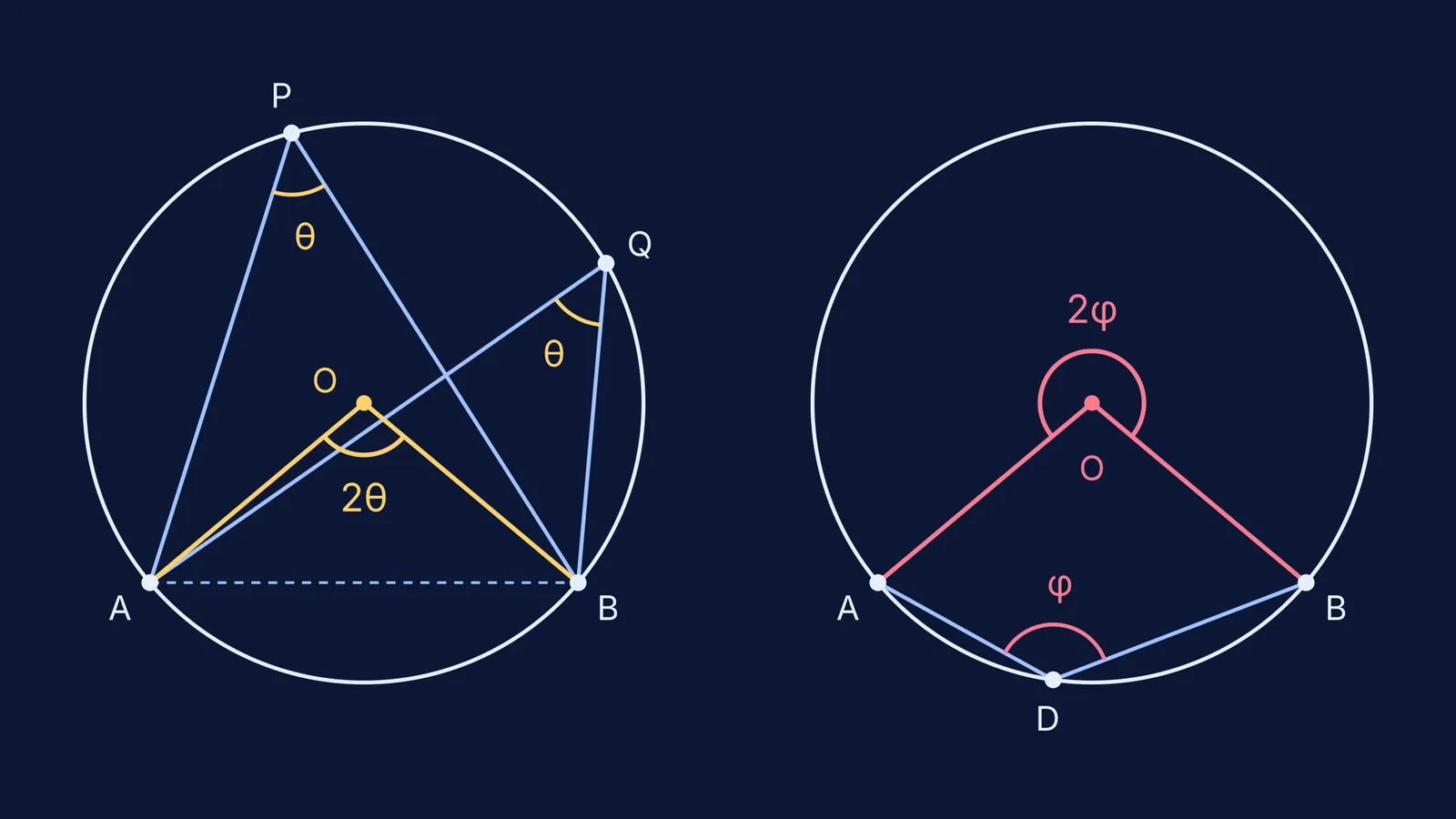
In school language: the angle that arc AB subtends at the centre O is twice the angle it subtends at any point P on the remaining part of the circle.
An inscribed angle is the angle formed at a point on a circle where two chords meet, as defined in this overview of the inscribed angle theorem. The phrase "same circumference as base" is the part students skip: both angles must stand on the same arc.
Why is the angle at the centre twice the angle at the circumference?
You need two facts: radii are equal, and an exterior angle of a triangle equals the sum of the two opposite interior angles. Join P to O and extend the line to meet the circle again at E.
OP = OA, because both are radii, so triangle OPA is isosceles and ∠OPA = ∠OAP. Call each one x.
∠AOE is an exterior angle of triangle OPA, so ∠AOE = x + x = 2x.
On the other side, OP = OB, so ∠OPB = ∠OBP = y and ∠BOE = 2y.
Add them: ∠AOB = 2x + 2y = 2(x + y) = 2∠APB.
The inscribed angle overview splits the full proof into three cases: one chord is a diameter, the centre lies inside the angle, or the centre lies outside it. In the last case you subtract the two pieces instead of adding them, and the answer is still double. If step 1 feels shaky, our post on solving problems with the equal angles of an isosceles triangle covers it.
What happens when the angle at the centre is reflex?
Now put the point at D on the minor arc AB. ∠ADB opens towards the major arc, so the centre angle standing on that same arc is the reflex angle AOB, the one greater than 180°. The proof is unchanged: extend DO to E, which lands on the major arc, and the two pieces 2x and 2y add up to the reflex angle.
Worked example. Suppose ∠AOB = 100°.
P on the major arc: ∠APB = 100° ÷ 2 = 50°.
D on the minor arc: reflex ∠AOB = 360° − 100° = 260°, so ∠ADB = 130°.
Check: 50° + 130° = 180°.
That check is no accident. APBD is a cyclic quadrilateral, and GraphicMaths proves that opposite angles of a cyclic quadrilateral add up to 180° with this exact argument: the two centre angles make a full turn of 360°, so half of them makes 180°.
Why are angles in the same segment equal?
Euclid's next result, Book III, Proposition 21, states: "In a circle the angles in the same segment equal one another." His proof uses Proposition 20 directly.
Take any two points P and Q on the major arc. Both ∠APB and ∠AQB stand on arc AB, so each is half of ∠AOB. Slide P anywhere along the major arc and the angle does not change.
The same idea gives the angle in a semicircle. If AB is a diameter, ∠AOB = 180°, so any angle at the circle standing on it is 90°; the inscribed angle overview lists this (Thales's theorem) alongside the cyclic quadrilateral rule as consequences. To watch these angles stay fixed as a point moves, try our interactive circle theorems post.
How do you use it in an exam question?
A five-step routine for circle-angle questions:
Mark the arc the unknown angle stands on.
Find the centre angle on that same arc, reflex if the point is on the minor arc.
Look for pairs of radii; each pair gives an isosceles triangle.
Halve or double.
Check with angle sums: 180° in a triangle, 180° for opposite angles of a cyclic quadrilateral.
Try it. C is on the major arc AB of a circle with centre O, and ∠ACB = 35°. Find ∠OAB. Step 2 gives ∠AOB = 70°. Triangle OAB has OA = OB, so ∠OAB = (180° − 70°) ÷ 2 = 55°.
If you keep halving the wrong angle, the Fermi Problem Library has worked problems with a step-by-step solver that explains the reasoning rather than printing an answer, so you can spot the step where the arc changed. If the gap is earlier, the Fermi Concept Library gives each mathematics concept its own lesson and its place in the map.
Next, use the same centre angle to find the area of a segment of a circle.


