

On this page
In geometry, an isosceles triangle has two equal sides. The angles opposite to those equal sides are also equal. This means if you know one side is the same length as another, the angles across from them must match.
This fact is widely taught as a core theorem in early mathematics. Its converse states that the sides opposite to equal angles of a triangle are also equal.
This relationship has been taught for over two thousand years. In Euclid's *Elements*, it is Proposition 5 of Book I, famously known as the *Pons Asinorum* (the "Bridge of Asses") perhaps because its diagram resembles a bridge, or because it was difficult for beginners. If you could prove that the base angles of an isosceles triangle were equal, you had crossed the "bridge" and proven your ability to handle logical deduction. Modern exams continue this tradition by using isosceles triangles to test whether students can construct a coherent chain of geometric reasoning, rather than just memorising formulas.
How do you find angles opposite equal sides?
In exam problems, you will rarely be handed a single, simple isosceles triangle. Instead, you will see a larger shape cut into several smaller triangles, and you will need to find a missing angle.
Here is the strategy:
Locate the equal sides: Look for tick marks or statements that two lengths are equal.
Identify the opposite angles: Look across the triangle to the angle facing each equal side. Set those two angles equal.
Use the angle sum property: The three angles of any triangle always add up to 180°.
Trace it through the figure: See if an angle shares a vertex or a line with a neighbouring triangle to carry your known values into the next shape.
Do not assume things: Unless explicitly stated or proven, you cannot assume a triangle is isosceles just because it looks symmetrical.
If you are not sure which triangle to look at first, the Fermi Problem Library has worked problems with a step-by-step solver that explains the reasoning rather than printing an answer.
How do you solve the 36-72-72 triangle problem?
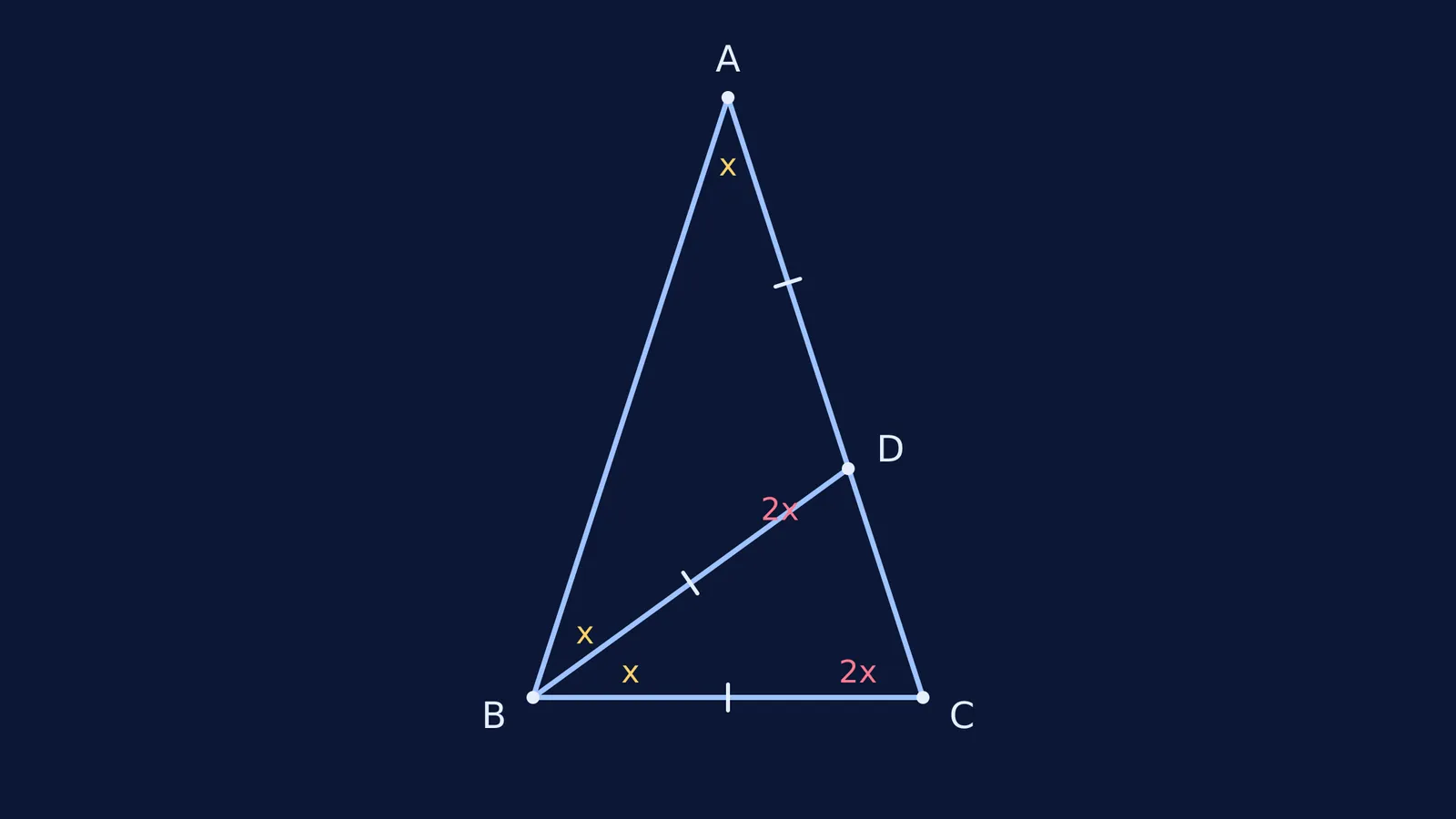
Consider a classic problem: In triangle ABC, side AB = AC. A point D lies on side AC such that AD = BD = BC. If the triangle has these equal segments, what is the measure of angle A?
Let's work through it using the isosceles property:
Let the unknown angle ∠A be *x*.
In △ABD, we are told that AD = BD. The angles opposite them are equal. The angle opposite BD is ∠A (*x*), so the angle opposite AD (∠ABD) is also *x*.
Now look at the exterior angle ∠BDC. The exterior angle of a triangle is the sum of the two opposite interior angles. So, ∠BDC = ∠A + ∠ABD = *x* + *x* = 2*x*.
Move to △BDC. We are told BD = BC. The angle opposite BC is ∠BDC (2*x*), so the angle opposite BD (∠C) is also 2*x*.
Finally, look at the large triangle △ABC. We were told AB = AC. This means the angle opposite AB (∠C) equals the angle opposite AC (∠ABC). Since ∠C is 2*x*, ∠ABC is also 2*x*.
Now we have all three angles of the large triangle △ABC:
∠A = *x*
∠ABC = 2*x*
∠C = 2*x*
The sum of the angles in a triangle is 180°: *x* + 2*x* + 2*x* = 180° 5*x* = 180° *x* = 36°
So, the top angle is 36°, and the two base angles are 72° each. This specific triangle, where the base angles are double the vertex angle, is sometimes called the golden triangle and is key to finding the exact values of sin 18° and cos 36°.
Are problems with angles opposite equal sides hard?
The difficulty in these problems comes from seeing the triangles hidden inside the diagram. When lines cross and create multiple shapes—similar to finding the concurrency of three lines—it is easy to assign an angle to the wrong triangle.
To avoid this, always trace the sides of the specific triangle you are working in with your pencil. If you know that BD = BC, draw over the lines of △BDC so you do not accidentally pull in an angle from △ABD. If you find yourself repeatedly assigning angles to the wrong shape, Fermi's AI tutor notices exactly where you are stuck and decides whether to explain the concept, ask a guiding question, or show you the next step.


