

On this page
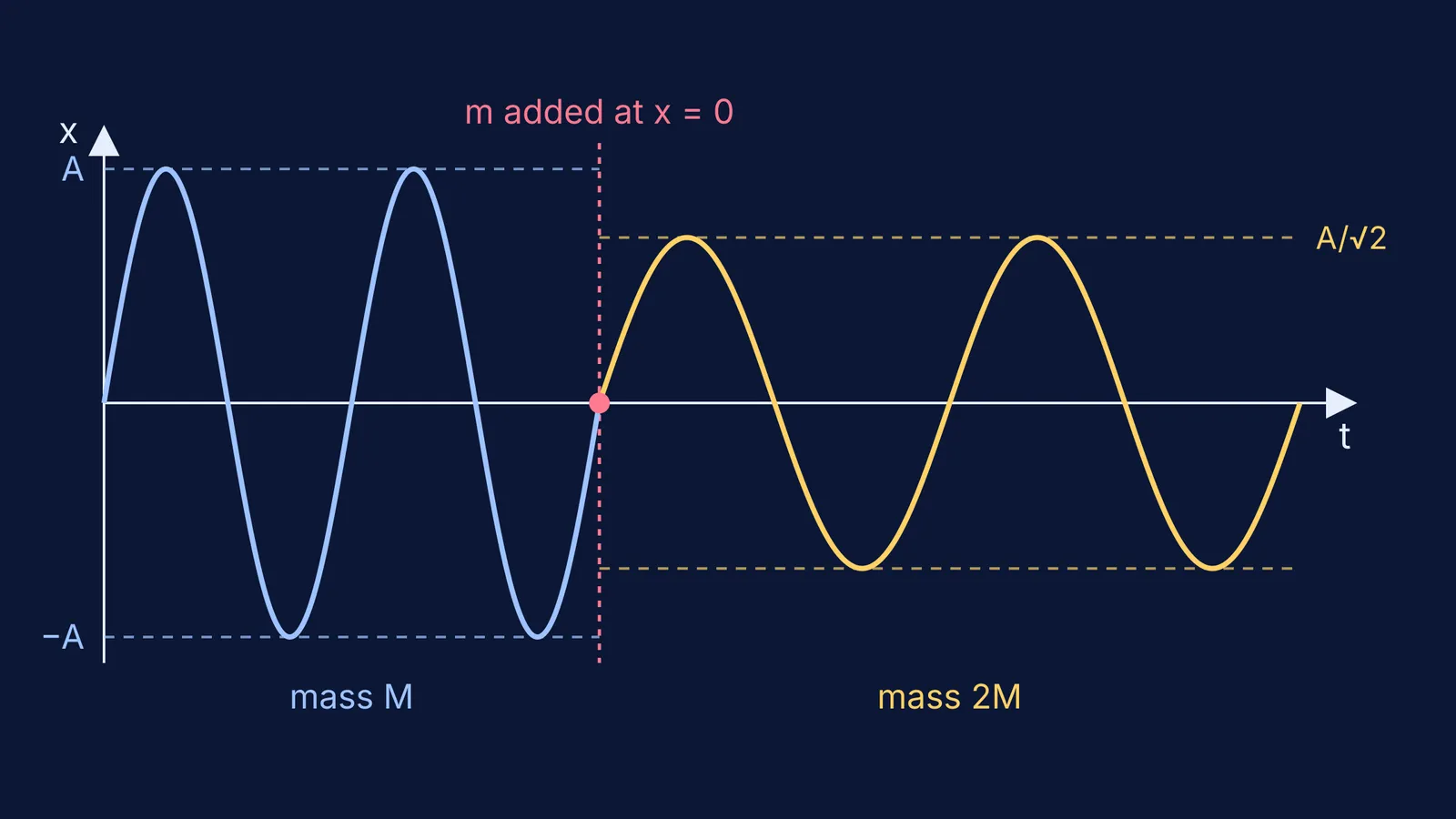
A block of mass M oscillates on a smooth floor at the end of a spring. Just as it passes the mean position, a lump of putty of mass m is dropped on it and sticks. What happens to the amplitude? It is tempting to reach for energy conservation, but that gives the wrong answer. The right tool is momentum at the instant of contact, then energy and the new angular frequency afterwards.
What happens at the instant the mass is added?
At the mean position the spring is at its natural length, so the spring force is zero. Hooke's law gives the spring force as F = −kx, and "at the equilibrium position, the net force is zero", as OpenStax University Physics, section 15.1 puts it. With no horizontal force acting during the very short contact, horizontal momentum is conserved. The putty falls vertically, so it brings no horizontal momentum of its own.
The putty and block stick together, which makes this a perfectly inelastic collision. In such a collision momentum is conserved but kinetic energy decreases, as OpenStax section 9.4 on types of collisions explains. So the speed just after is:
v′ = Mv₀ / (M + m)
How do you find the new amplitude?
For a block on a spring, the angular frequency is ω = √(k/m), and it depends only on the mass and the spring constant, not on the amplitude (OpenStax 15.1). The same section gives the maximum speed as v_max = Aω, and that speed occurs at the mean position.
The total energy of the oscillator is E = ½kA², and at the mean position all of it is kinetic (OpenStax 15.2). Put those facts together in four steps:
Before: ω = √(k/M), so the speed at the mean position is v₀ = A√(k/M).
Collision: v′ = Mv₀/(M + m).
After: the new angular frequency is ω′ = √(k/(M + m)), and v′ is the new maximum speed because the block is still at the mean position.
New amplitude: A′ = v′/ω′ = A√(M/(M + m)).
You get the same answer from energy: ½kA′² = ½(M + m)v′². The new energy is M/(M + m) times the old energy; the rest goes mainly into heat and deformation of the putty. The period grows by a factor √((M + m)/M).
Worked example: how much does the amplitude shrink?
Take M = 2 kg, k = 200 N/m and A = 10 cm. A 2 kg lump sticks to the block at the mean position.
Before: ω = √(200/2) = 10 rad/s, so v₀ = 0.10 × 10 = 1.0 m/s.
Energy before: ½ × 200 × 0.10² = 1.0 J.
Collision: v′ = (2 × 1.0)/4 = 0.5 m/s.
After: ω′ = √(200/4) ≈ 7.07 rad/s.
New amplitude: A′ = 0.5/7.07 ≈ 0.0707 m, about 7.1 cm, which is 10 cm × √(1/2).
Energy after: ½ × 4 × 0.5² = 0.5 J. Half the energy is gone.
Period: from 2π/10 ≈ 0.63 s to 2π/7.07 ≈ 0.89 s.
Check the answer makes sense. Doubling the mass halves the speed but only cuts ω by √2, so the amplitude falls by √2, not by 2.
Is it different if the mass is added at the extreme position?
Yes, and the contrast is a common variant of this problem. At an extreme the block is momentarily at rest, so there is no momentum to share and no kinetic energy to lose. The amplitude stays A; only the period changes. We work through that case in new amplitude when a mass is placed on an oscillating block.
A quick decision guide:
Mass added at the mean position: amplitude becomes A√(M/(M + m)), energy drops, period rises.
Mass added at an extreme: amplitude stays A, energy stays ½kA², period rises.
Mass added in between: conserve momentum for the velocity, then use ½kA′² = ½kx² + ½(M + m)v′² at that same x.
How should you practise this?
Use the same four questions on every "mass added" problem: Where is the block? What is conserved during contact? What is the new ω? Which position gives an equation for A′? Then try the in-between case, which tests whether you understood the method or memorised the formula.
If you want to see v_max = Aω and the period change as you vary mass, try the predictions in our simple harmonic motion simulation post. To revise why kinetic energy is lost when objects stick, see elastic vs inelastic collisions in a simulation.
When you get a variant wrong, the Fermi Problem Library has worked problems with a step-by-step solver that explains the reasoning rather than printing an answer, so you can see the exact step where your method went off. If the gap is the idea itself, the Fermi Concept Library gives every concept in physics its own lesson.


