

On this page
In short
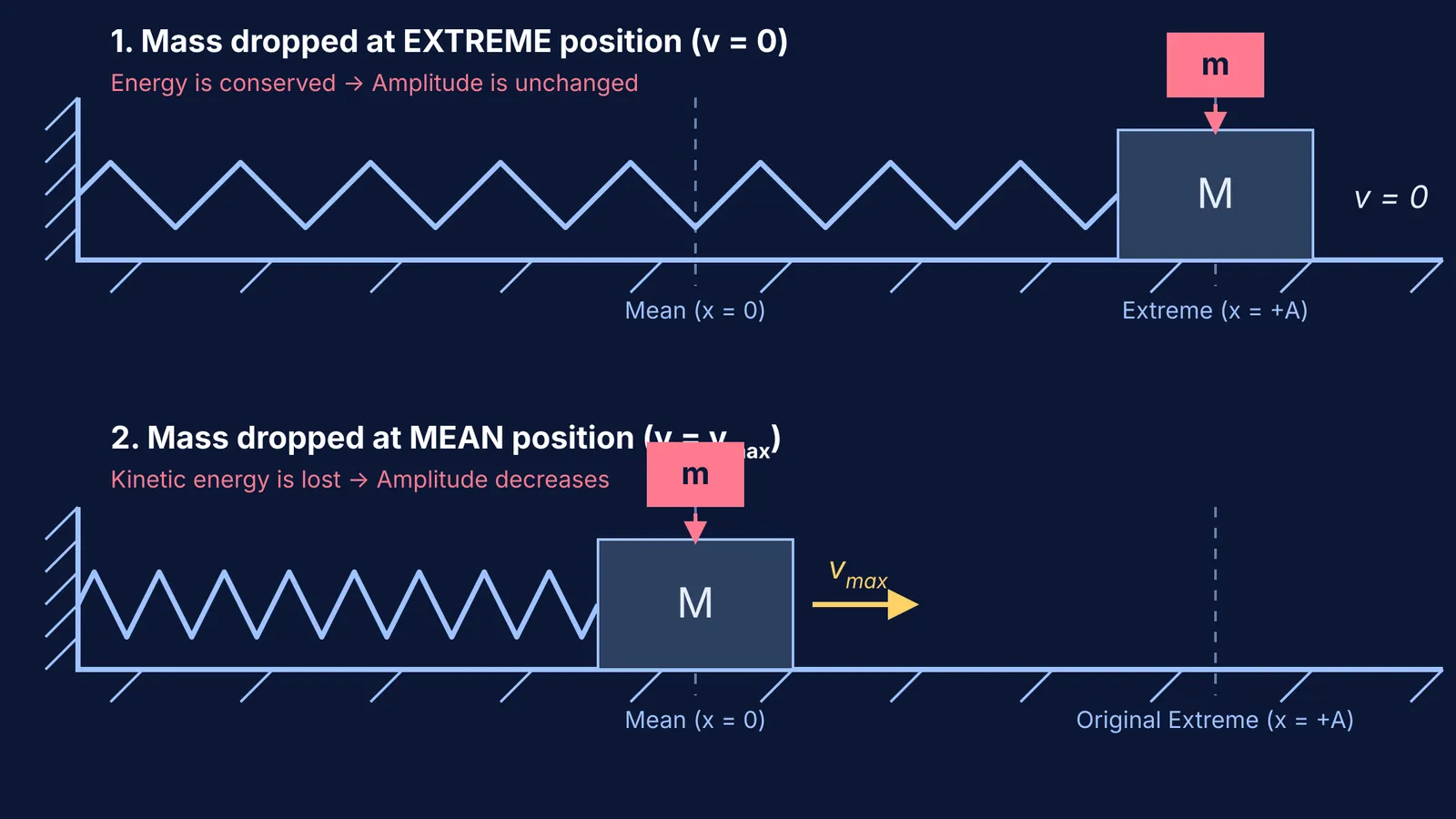
When a mass m is dropped onto a block of mass M oscillating with amplitude A at its extreme position, the amplitude remains unchanged. If the mass is dropped at the mean position, the inelastic collision reduces the system's kinetic energy, decreasing the new amplitude to A√[M/(M+m)].
Dropping a mass onto an oscillating block is a classic test of how well you understand the conservation of energy and momentum in Simple Harmonic Motion (SHM). The resulting amplitude and period depend entirely on the exact point in the cycle where the mass lands.
Here is how the physics shifts depending on where the block is in its path and how it changes the overall mechanical energy of the system.
What happens when mass is added at the extreme position?
At the extreme position (maximum displacement x = ±A), the oscillating block momentarily stops as it reverses its direction.
Because the velocity is zero (v = 0), the system has no kinetic energy. The total energy of the system is equal to the sum of the potential energy stored in the spring plus the kinetic energy of the block, and is proportional to the square of the amplitude: E = ½kA² (OpenStax). Dropping a mass m onto the block M at this exact moment does not involve any horizontal velocity, so no kinetic energy is lost in the process. The spring is fully stretched, and its stored elastic potential energy is unaffected by the added weight.
Since the total energy remains exactly ½kA², the amplitude remains unchanged (A' = A). However, because the total mass of the system has increased to M + m, the block will oscillate more slowly. The new period is T' = 2π√[(M+m)/k], which is mathematically longer than the original period.
What happens when mass is added at the mean position?
At the mean position (x = 0), the block is passing through equilibrium and moving at its maximum speed (v_max = A√(k/M)).
When the mass m drops onto the block M, they stick together and move as one. In a perfectly inelastic collision, kinetic energy is not conserved, but momentum is (OpenStax). Since all the system's energy is purely kinetic at the mean position, this perfectly inelastic collision drops the total energy of the oscillator.
We can find the new amplitude using the conservation of horizontal momentum:
Initial momentum: p_i = M × v_max
Final momentum: p_f = (M + m) × v'_max
Equating them gives the new velocity: v'_max = [M / (M + m)] × v_max
The new kinetic energy (which is the new total energy) is ½(M+m)(v'_max)². Setting this equal to the new potential energy at maximum stretch (½k(A')²) yields the following equation:
A' = A √[M / (M+m)]
Because the fraction M/(M+m) is always less than 1, the amplitude decreases. The period increases just as it did in the extreme position case, as the period only depends on the total mass and the spring constant. You can see similar period mechanics at play in a SHM through a tunnel across the Earth.
What happens when you add one-third of the block's mass?
Let's put concrete numbers to the formulas. Suppose a block of mass M = 3 kg is oscillating with an amplitude of 10 cm. A lump of clay with mass m = 1 kg is dropped onto the block.
Case 1: Dropped at the extreme position
The block is at rest when the clay hits. The total mechanical energy is perfectly conserved. The new amplitude A' is still 10 cm. The period increases by a factor of √(4/3) ≈ 1.15.
Case 2: Dropped at the mean position
The block is moving at maximum speed. Momentum is conserved, but kinetic energy is lost to the collision.
A' = 10 cm × √[3 / (3+1)] A' = 10 cm × √0.75 ≈ 8.66 cm. The new amplitude is 8.66 cm. The period increases by the same factor of 1.15.
If you are stuck on similar momentum and energy questions, the Fermi Problem Library has worked problems with a step-by-step solver that explains the reasoning rather than printing an answer. This setup tests the same core principles as finding the elastic potential energy in a stretched wire—you must track where the energy is stored and when it is lost.


