

On this page
Strictly, amniocentesis is not banned in India. Doctors may use it to look for chromosomal and genetic problems. What the law bans is using it, or any prenatal test, to find out whether the foetus is a girl or a boy.
What is amniocentesis and how is it done?
In amniocentesis, a thin needle guided by ultrasound collects a sample of the fluid around the baby, usually between 15 and 20 weeks of pregnancy, according to the NHS guide to amniocentesis. The NHS puts the risk of miscarriage at 1 in 200 pregnancies, so the test is offered only when there is a reason, such as a higher chance of a condition.
The fluid sits inside the amnion, the innermost membrane around the foetus; see what the amnion, chorion, yolk sac and allantois do.
How does amniocentesis detect chromosomal disorders?
The fluid carries cells shed by the foetus, called amniocytes. The Indiana University genetic testing laboratory grows these cells in culture and examines their banded chromosomes under a microscope, with results in 7 to 10 days. Its test detects trisomies 21, 18 and 13 and abnormal numbers of sex chromosomes.
Human cells normally hold 23 pairs of chromosomes, 46 in all. Most cases of Down syndrome come from three copies of chromosome 21 instead of two, and the condition occurs in about 1 in 700 newborns, according to MedlinePlus Genetics.
In a 2021 Scientific Reports study of amniotic fluid from pregnant women in Iran, 1,077 of 14,968 cultured samples (7.2%) had an abnormal karyotype. Down syndrome was the most common finding, with 659 cases.
Worked example: read a karyotype like a lab report
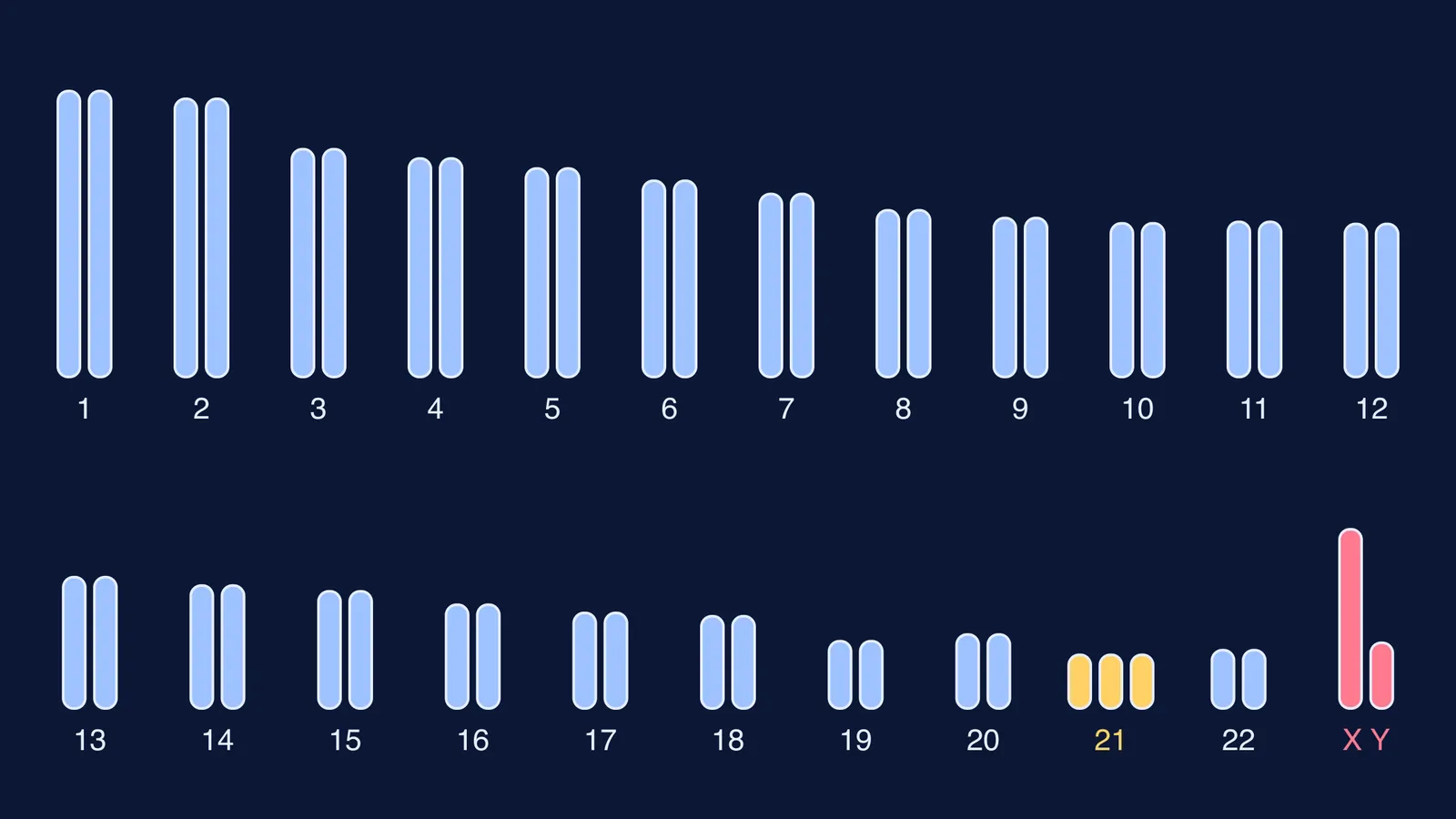
Count the chromosomes. The picture at the top of this post has 47, not 46.
Find the extra one. Pair 21 has three copies (yellow).
Name it. Three copies of chromosome 21 is trisomy 21, the usual cause of Down syndrome.
Ask how a gamete ended up with two copies of chromosome 21. Our post on nondisjunction in meiosis I vs II works out which gametes each error produces.
Look at the last pair. It shows XX or XY. This is the step the law is about.
Why is amniocentesis for sex determination banned in India?
Step 5 is the problem: a karyotype that shows a trisomy also shows the foetus's sex. A Press Information Bureau explainer records that India's child sex ratio (girls per 1,000 boys aged 0 to 6) fell from 976 in 1961 to 945 in 1991, before the Act, and then to 927 in 2001 and 918 in 2011. It blames a low sex ratio at birth, driven by son preference and by the easy availability and misuse of diagnostic tools.
The Pre-Conception and Pre-Natal Diagnostic Techniques (Prohibition of Sex Selection) Act, 1994, known as the PCPNDT Act, draws the line:
Section 4(2) allows prenatal tests only to detect chromosomal abnormalities, genetic metabolic diseases, haemoglobinopathies, sex-linked genetic diseases and congenital anomalies.
Section 5(2) bars anyone, including the person doing the test, from telling anyone the sex of the foetus "by words, signs or in any other manner".
Section 6 bans tests to determine the sex of a foetus and any selection of sex before or after conception.
What are the penalties under the PCPNDT Act?
Section 23 of the PCPNDT Act sets them out:
A doctor or clinic worker who breaks the Act faces up to 3 years in prison and a fine of up to Rs 10,000, rising to 5 years and Rs 50,000 for a repeat offence. A doctor's name is reported to the State Medical Council and, on conviction, removed from the register for 5 years, or permanently for a repeat offence.
Anyone who seeks sex selection faces up to 3 years and a fine of up to Rs 50,000, rising to 5 years and Rs 1 lakh for a repeat offence.
This does not apply to a woman who was compelled to undergo the test, and Section 24 tells courts to presume she was compelled unless proved otherwise.
How do you answer this in a board or NEET-UG exam?
A strong answer to "why is amniocentesis for sex determination banned?" has four parts:
What it is: removing amniotic fluid to study foetal cells and their chromosomes.
Its proper use: detecting chromosomal disorders such as trisomy 21.
The misuse: the same chromosomes reveal XX or XY, which was used for sex selection that lowered the child sex ratio.
The response: the PCPNDT Act, 1994 allows the test only to detect abnormalities and bans revealing the foetus's sex.
If counting chromosomes or tracing nondisjunction is the shaky part, the Fermi Concept Library has a lesson for every concept in biology. For genetics numericals, the Fermi Problem Library solves problems step by step and explains the reasoning instead of printing an answer.
For parents: a doctor who won't tell you the baby's sex is following the law. Questions about a result belong with your gynaecologist or a genetic counsellor, and if the wait feels heavy, you can call Tele MANAS on 14416.


