On this page
Stir a spoonful of ammonium chloride into water and the test tube turns cold in your hand. Heat flows in, so the process is endothermic. Yet the salt dissolves on its own. The answer is one equation from Class 11 thermodynamics.
Why does ammonium chloride dissolve if it absorbs heat?
The NCERT Class 11 Chemistry chapter on thermodynamics says that for most ionic compounds the enthalpy of solution is positive and the process is endothermic. So heat alone cannot decide what happens.
Gibbs energy change is ΔG = ΔH − TΔS, and a process at constant temperature and pressure is spontaneous when ΔG is negative (NCERT, equations 5.21 and 5.22). NCERT also notes that a process with positive ΔH and positive ΔS "can be spontaneous when TΔS is large enough to outweigh ΔH."
Where does the entropy come from? When an ionic solid dissolves, NCERT explains, "the ions leave their ordered positions on the crystal lattice. These are now more free in solution." Hydration also orders water around the ions, so the net ΔS must be measured; here it is positive.
How do you calculate ΔG for ammonium chloride dissolving?
Use standard values at 298 K from the LibreTexts table of standard thermodynamic quantities, which takes its data from the CRC Handbook of Chemistry and Physics (84th edition). The process is NH4Cl(s) → NH4+(aq) + Cl−(aq).
ΔH = [(−132.5) + (−167.2)] − (−314.4) = +14.7 kJ/mol. Heat is absorbed.
ΔS = (113.4 + 56.5) − 94.6 = +75.3 J/(K·mol). Entropy rises.
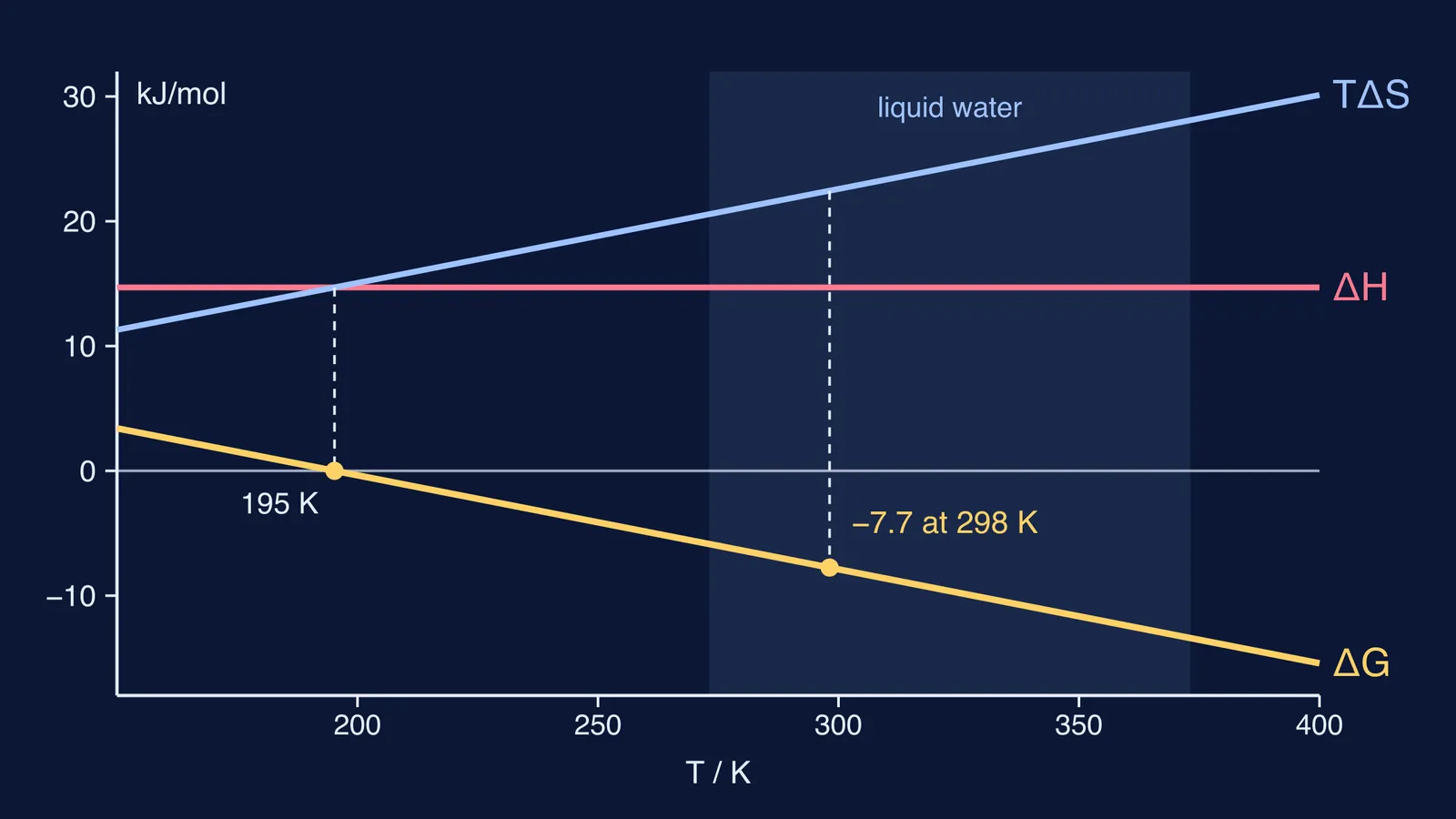
Convert ΔS to kJ: 0.0753 kJ/(K·mol). Then TΔS = 298 × 0.0753 = 22.4 kJ/mol.
ΔG = 14.7 − 22.4 = −7.7 kJ/mol. Negative, so dissolving is spontaneous.
Check with Gibbs energies of formation from the same table: (−79.3 − 131.2) − (−202.9) = −7.6 kJ/mol. The small gap is rounding.
The second law agrees. The surroundings' entropy changes by −ΔH/T = −14,700/298 ≈ −49.3 J/(K·mol). Add the system's +75.3 and the total is about +26 J/(K·mol), which is positive. Our post on why the entropy change of the surroundings is −ΔH/T explains that step.
The crossover temperature, where ΔG = 0, is ΔH/ΔS = 14,700/75.3 ≈ 195 K, about −78 °C. So wherever liquid water exists, TΔS beats ΔH for these standard-state values, if ΔH and ΔS stay roughly constant; see how to find the temperature at which a reaction becomes spontaneous. In a real beaker, dissolving continues until the solution is saturated.
Try it: a cold-pack test tube experiment
Do this in a school lab with your teacher. Ammonium chloride is harmful if swallowed and causes serious eye irritation, according to its GHS hazard statements. Wear goggles, never taste it, and wash your hands afterwards.
Put 20 mL of water in a boiling tube and note its temperature with a lab thermometer.
Weigh 5 g of ammonium chloride.
Add it, stir gently with a glass rod, and record the lowest temperature you see.
Leave the tube for 20 minutes and check again.
Predict first. 5 g is 5/53.5 ≈ 0.093 mol, so with ΔH = +14.7 kJ/mol from the CRC data above the solution absorbs about 1.37 kJ. If all of it came from about 25 g of solution with a specific heat near 4.18 J/(g·K), the drop would be roughly 1370/(25 × 4.18) ≈ 13 °C. Expect less, as the glass and air feed heat back in.
All 5 g should dissolve. Ammonium chloride's solubility is about 383 g per litre at 25 °C and 294 g per litre at 0 °C, according to the ammonium chloride data page.
Step 4 is the key observation. The tube warms back to room temperature, yet the salt stays dissolved. Entropy, not heat, keeps it there. Instant cold packs use the same idea with ammonium nitrate, whose ΔH of solution is +25.7 kJ/mol, according to a LibreTexts chapter on enthalpies of solution.
What are the four sign cases for ΔH and ΔS?
NCERT's Table 5.4 in the Class 11 thermodynamics chapter sums them up. Read each one from ΔG = ΔH − TΔS:
ΔH negative, ΔS positive: ΔG is negative at every temperature. Always spontaneous.
ΔH negative, ΔS negative: spontaneous only at low temperature, below ΔH/ΔS.
ΔH positive, ΔS positive: spontaneous only at high temperature, above ΔH/ΔS. Ammonium chloride dissolving is this case, with a threshold of about 195 K.
ΔH positive, ΔS negative: ΔG is positive at every temperature. Never spontaneous.
NCERT adds that "low" and "high" are relative: high temperature can even mean room temperature, as it does here. To see all four cases on one graph, read Gibbs energy vs temperature for all four ΔH and ΔS cases.
In an exam, a full answer has four parts: why ΔS is positive, the equation ΔG = ΔH − TΔS, the numbers showing TΔS is larger than ΔH, and the conclusion that ΔG is negative.
If you keep mixing up the cases, the Fermi Concept Library gives every chemistry concept its own lesson. The Fermi Problem Library has worked problems with a step-by-step solver that explains the reasoning rather than printing an answer.