

On this page
Diamond and graphite look nothing alike. One is the hardest substance you will meet in a textbook, the other is the soft grey stuff in your pencil. So many students guess they are different kinds of carbon atom, write "isotope" and lose the mark. The difference between the two words comes down to where the change happens: inside the atom, or between atoms.
Is diamond an isotope or an allotrope of carbon?
Diamond is an allotrope of carbon. The NCERT Class 10 science chapter on carbon states that diamond and graphite are both formed by carbon atoms, and "the difference lies in the manner in which the carbon atoms are bonded to one another."
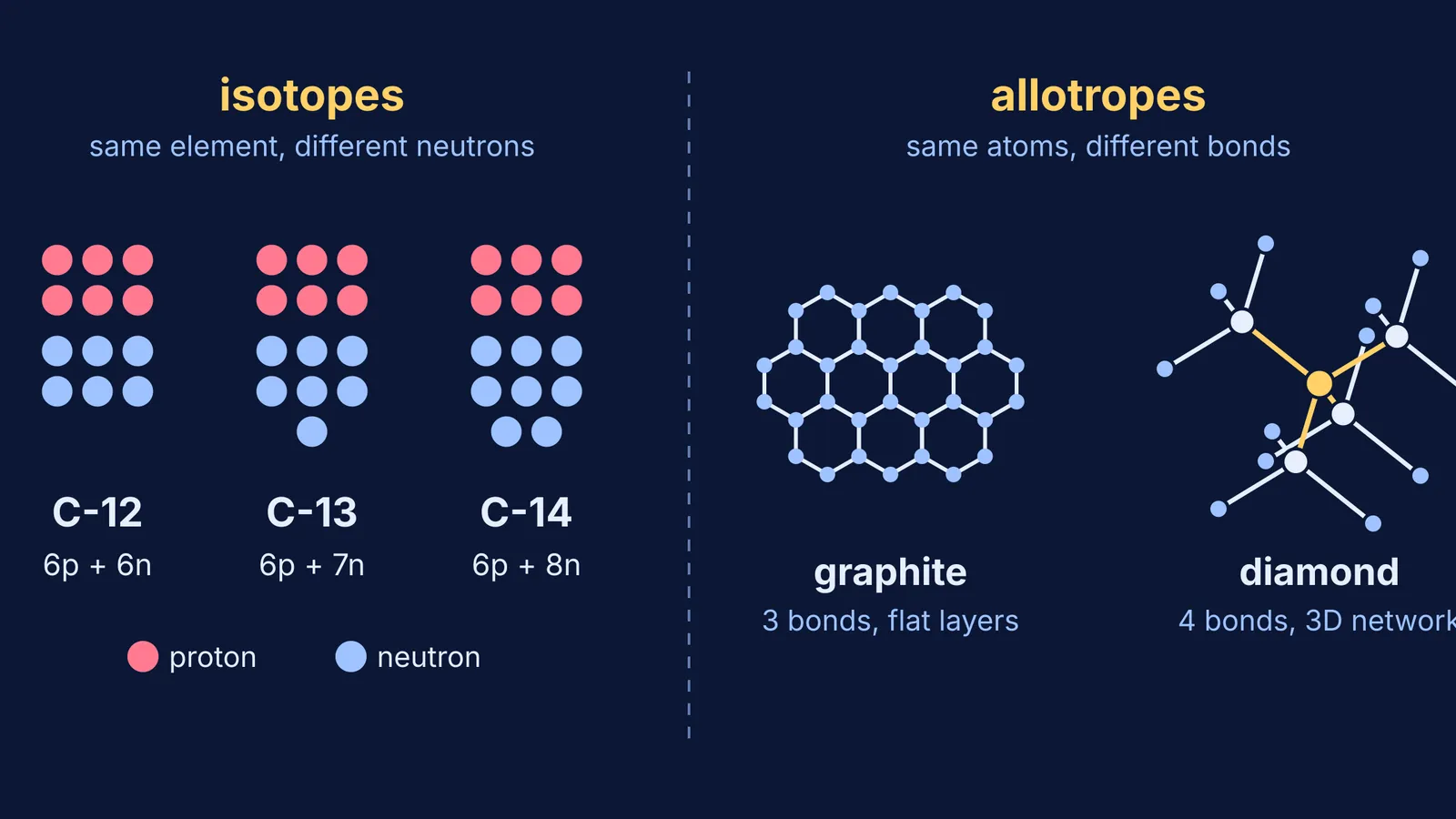
In diamond, each carbon atom is bonded to four other carbon atoms, forming a rigid three-dimensional structure (NCERT Class 10). In graphite, each carbon atom is bonded to three others in the same plane, giving a hexagonal array, and these flat sheets are stacked in layers one above the other.
That difference in bonding explains the difference in behaviour. The same NCERT chapter notes that diamond is the hardest substance known, while graphite is smooth, slippery and a very good conductor of electricity, even though their chemical properties are the same. Fullerenes such as C-60, a football-shaped cage of carbon atoms, are another class of carbon allotropes.
What is the difference between isotopes and allotropes?
Isotopes are atoms with the same atomic number but different mass numbers, which means they have different numbers of neutrons in the nucleus (NCERT Class 11 Chemistry, Structure of Atom). NCERT gives carbon as an example: carbon atoms with 6, 7 and 8 neutrons alongside 6 protons, written as carbon-12, carbon-13 and carbon-14.
Natural carbon is almost entirely carbon-12 and carbon-13, according to the IUPAC Commission on Isotopic Abundances and Atomic Weights. Carbon-12 makes up an amount fraction of 0.9884 to 0.9904 of natural carbon, so roughly 99 of every 100 carbon atoms, and carbon-13 makes up 0.0096 to 0.0116. Radioactive carbon-14 occurs only in traces.
The two ideas side by side:
Isotopes: one element, different numbers of neutrons in each atom. The change is inside the nucleus.
Allotropes: one element, different ways the atoms are bonded together. The change is in the structure between atoms.
Isotopes behave the same chemically because chemistry is controlled by electrons, and isotopes have the same number of electrons (NCERT Class 11).
Allotropes behave differently physically because the bonding network is different, which is why diamond and graphite differ so much in hardness and conductivity.
If you want the full family of look-alike words, our explainer on isotopes, isobars and isotones with examples sets out all three.
How do you tell isotopes and allotropes apart in an exam?
Ask one question about any pair: what exactly is different?
If the two are atoms of the same element and the mass number differs, they are isotopes.
If the two are forms of the same element and the arrangement or bonding of atoms differs, they are allotropes.
If they are different elements, they are neither. Check whether they share a mass number instead.
Try it on five pairs.
Diamond and graphite: same element, different bonding. Allotropes.
Carbon-12 and carbon-14: same element, 6 versus 8 neutrons (NCERT Class 11). Isotopes.
Graphite and C-60 fullerene: same element, sheets versus a closed cage. Allotropes.
Protium and deuterium: both hydrogen, with 0 and 1 neutron respectively. Isotopes. NCERT notes protium makes up 99.985% of hydrogen atoms (NCERT Class 11).
Carbon-14 and nitrogen-14: different elements, same mass number. Neither. NCERT uses this exact pair as its example of isobars.
Carbon is not the only element with allotropes. Sulphur has two crystalline forms that switch at a set temperature, explained in our post on rhombic and monoclinic sulphur.
How should you revise this so it sticks?
The mix-up usually happens because both words start with the idea of "same element". So revise the second half of each definition, not the first. Write the two definitions from memory, then draw what changes: a nucleus with extra neutrons for isotopes, and a 3D network beside a flat hexagonal sheet for allotropes. If you can sketch it, you can explain it under exam pressure.
If the gap is really in atomic structure or bonding, it helps to go back one step. The Fermi Concept Library covers every concept in physics, chemistry, biology, mathematics and computing, each with its own lesson and its place in the map, so you can see how isotopes link to atomic number and how allotropes link to covalent bonding. When you want to test yourself on classification questions, the Fermi Problem Library has worked problems with a step-by-step solver that explains the reasoning rather than printing an answer.
For the story of the scientist who spent a career on carbon's many forms, read what Mildred Dresselhaus discovered about carbon materials.


