On this page
When you write the structure of graphite in a Class 11 answer (flat layers of hexagons, one free electron per carbon), you are using a picture that Mildred Dresselhaus spent decades making precise. Her work explains a strange fact: the same carbon sheet can behave like a metal or like a semiconductor, depending only on how it is rolled.
Who was Mildred Dresselhaus?
She was born on 11 November 1930 in Brooklyn and grew up in the Bronx, New York, according to MIT's obituary. She joined MIT's Lincoln Laboratory in 1960 and became a permanent member of MIT's electrical engineering faculty in 1968.
Physics Today notes that in 1968 she became the first tenured woman in MIT's School of Engineering. MIT records that she co-authored about 1,700 papers and supervised more than 60 doctoral students, and that her research earned her the nickname "queen of carbon science". She died in February 2017, aged 86.
What did Dresselhaus discover about graphite?
Graphite is a stack of flat carbon sheets. To know how electricity moves through it, physicists need its electronic structure: which energies electrons may have as they move in different directions. These allowed energies form bands, explained in our post on how Felix Bloch explained energy bands in solids.
The Kavli Prize describes Dresselhaus as "one of the first researchers to map out the electronic structure of graphite", using magneto-optical techniques. Put simply, she studied graphite in strong magnetic fields with light, and read the electrons' energy levels from how the material responded.
From the early 1970s she applied the same methods to graphite intercalation compounds, where other atoms or molecules slip between the carbon layers, the Kavli Prize notes. David Tománek, a physics professor at Michigan State University, wrote in Physics Today that these compounds are "a key component in today's lithium-ion batteries".
How did she predict which carbon nanotubes conduct?
In 1991 Sumio Iijima reported "helical microtubules of graphitic carbon" in Nature, tubes now called carbon nanotubes. The simplest kind, a single-walled nanotube, is easiest to picture as one graphene sheet, one atom thick, rolled up until its edges meet to form a cylinder.
The open question was what rolling does to the electrons. In a 1992 paper in Applied Physics Letters, R. Saito, M. Fujita, G. Dresselhaus and M. S. Dresselhaus calculated the electronic structure of these tubes as a function of their diameter and twist. Their result: about one-third should be one-dimensional metals and the other two-thirds one-dimensional semiconductors.
Same atoms, same bonds; only the way the sheet is rolled changes. The Kavli Prize notes that experiments later confirmed this prediction.
Worked example: is this nanotube a metal or a semiconductor?
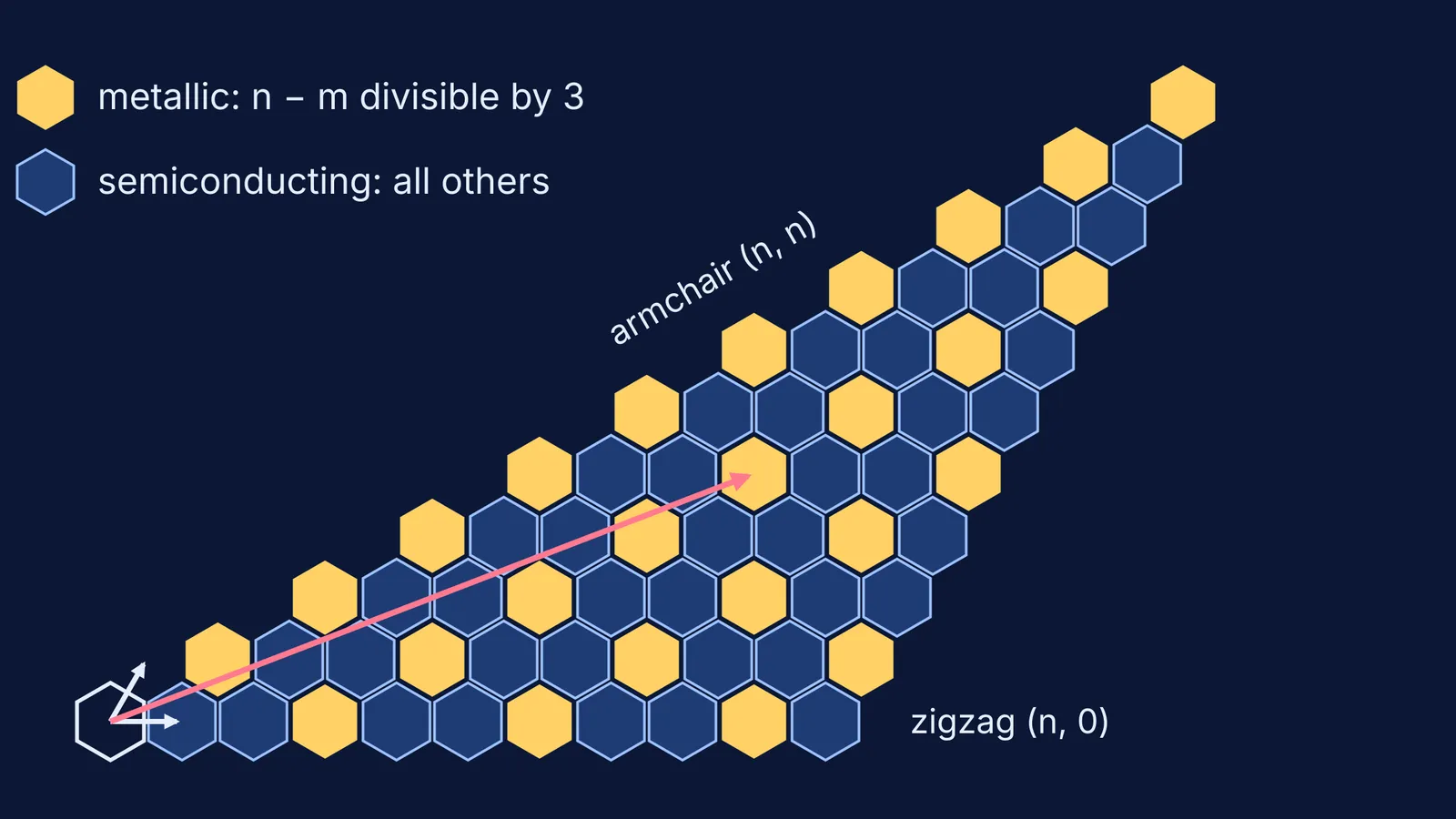
Every nanotube is labelled by two whole numbers (n, m): the steps along the two lattice directions of the graphene sheet that join up when the sheet is rolled. The Maruyama laboratory at the University of Tokyo, citing the 1992 paper, gives the condition: a nanotube is metallic when n − m is divisible by 3.
Write down (n, m). Take (10, 0).
Subtract: n − m = 10.
Divide by 3: 10/3 is not a whole number, so (10, 0) is a semiconductor.
Now try (9, 0): 9 − 0 = 9, which divides by 3, so it is metallic.
Any armchair tube (n, n) gives n − n = 0, so armchair tubes are always metallic.
Your turn: (7, 4), (8, 2) and (6, 5). Answers: metallic (difference 3), metallic (difference 6), semiconducting (difference 1).
Only one of the three possible remainders (0, 1 or 2) gives a metal, which is why roughly a third of tubes conduct. The diagram at the top colours every tube up to n = 10 by this rule.
If the rolled lattice feels abstract, the Fermi Simulation Lab has interactive simulations for ideas that are easier to see than to read, and if bands and gaps are shaky, the Fermi Concept Library gives each physics and chemistry concept its own lesson.
Why does her carbon work matter for graphene and nanoscience today?
Graphene, a flake of carbon just one atom thick, earned Andre Geim and Konstantin Novoselov the 2010 Nobel Prize in Physics, according to the Nobel Prize press release. Physics Today describes Dresselhaus's band-structure studies of graphite as "an innovative line of research that led to the discovery of fullerenes (including buckyballs), carbon nanotubes, and graphene".
From 1996 she pioneered the use of Raman spectroscopy to characterise nanotubes and graphene, the Kavli Prize page notes; she received the 2012 Kavli Prize in Nanoscience. She also received the National Medal of Science in 1990 and the Presidential Medal of Freedom in 2014, MIT reports.
Her story sits right behind your allotropes chapter: revise how diamond and graphite structures differ in 3D, and if the field draws you, read whether a nanotechnology degree after 12th is worth it.