

On this page
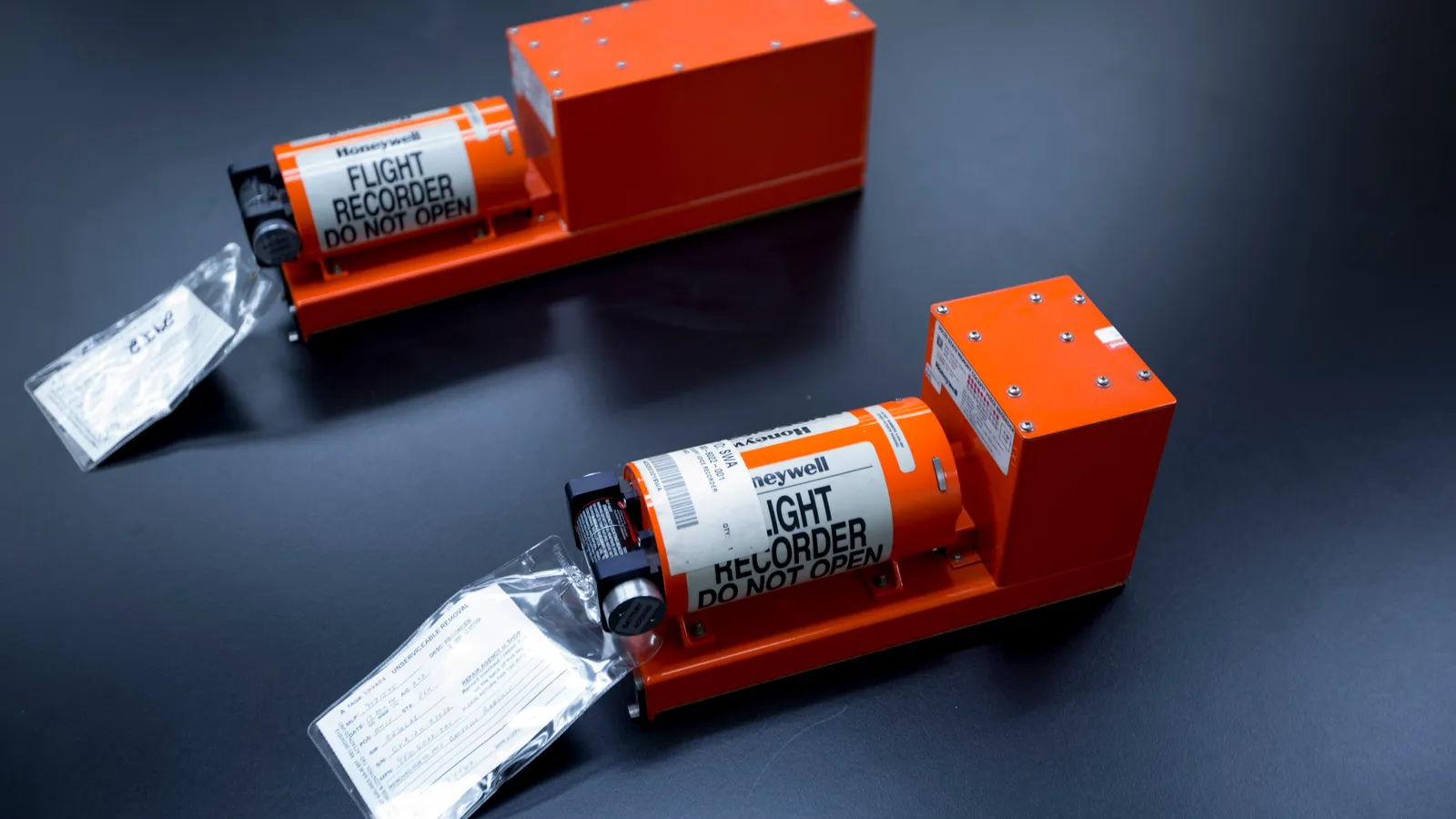
After an air accident, you hear a lot about the black box. Despite the nickname, it is two separate units, and each answers a different question: what did the crew hear and say, and what was the aircraft doing? Below are both, plus two worked examples you can redo with Class 11 formulas.
What does a black box record?
The US National Transportation Safety Board (NTSB) describes the two units like this:
Cockpit voice recorder (CVR): records radio transmissions and sounds in the cockpit, such as the pilots' voices and engine noises. Its cockpit area microphone is usually on the overhead instrument panel between the two pilots.
Flight data recorder (FDR): monitors parameters such as altitude, airspeed and heading. By regulation, newly manufactured aircraft must monitor at least 88 parameters, and some FDRs record more than 1,000.
The two keep different amounts of history. The NTSB lists 25 hours of continuous recording for the FDR, and 2 hours for a solid-state CVR (30 minutes for older units). Older units stored everything on quarter-inch magnetic tape; newer ones use memory chips.
The voice gap is closing for new aircraft. The US Federal Aviation Administration published a final rule on 2 February 2026 raising the minimum CVR recording from two hours to 25 hours for most newly manufactured aircraft in the US, as the NBAA's summary of the rule explains. For now, the FAA has not required existing aircraft to be retrofitted.
How does a black box survive a crash?
Both recorders sit in the most crash-survivable part of the aircraft, usually the tail section, says the NTSB. Its specification table lists what each unit is built to withstand:
an impact of 3,400 g lasting 6.5 milliseconds;
a fire at 1,100 °C for 30 minutes;
being submerged at a depth of 20,000 ft (about 6,100 m).
For more on the casing itself, read how an aeroplane black box survives a crash.
Worked example: what does 3,400 g for 6.5 ms mean?
Take g = 9.81 m/s² and treat the deceleration as steady, the simplest model.
Deceleration: a = 3,400 × 9.81 = 33,354 m/s².
Speed lost: Δv = a × t = 33,354 × 0.0065 ≈ 217 m/s, which is about 780 km/h.
Stopping distance: s = ½ a t² = 0.5 × 33,354 × (0.0065)² ≈ 0.70 m.
So the test is like stopping from about 780 km/h in roughly 70 cm, and the recorder must still hold its data afterwards.
If a step like the stopping distance trips you up, the Fermi Problem Library has worked problems with a step-by-step solver that explains the reasoning rather than printing an answer.
How is a black box found underwater?
Each recorder carries an underwater locator beacon, a pinger that switches on when it is immersed in water. According to the NTSB, it sends an acoustic signal at 37.5 kHz that a special receiver can detect, and it can transmit from depths down to 14,000 ft.
The NTSB page gives the older figure of 30 days of operation. According to one manufacturer, the newer FAA standard, TSO-C121b, calls for beacons to run for at least 90 days. That maker's specification for a 90-day beacon gives a 10 ms pulse once per second and a detection range of 1,800 to 3,600 m depending on conditions; another maker's 90-day beacon lists the same frequency and range.
Worked example: the ping as a wave
Sound travels at about 1,500 m/s in seawater, according to NOAA Ocean Explorer, though the exact speed changes with water temperature and other conditions.
Wavelength: λ = v / f = 1,500 / 37,500 = 0.04 m, or 4 cm.
Travel time to a receiver 3,600 m away: t = 3,600 / 1,500 = 2.4 s. By the time one ping arrives, the beacon has already sent two more.
Pings in 90 days at one per second: 90 × 86,400 = 7,776,000.
If wavelength and frequency still feel abstract, the Fermi Simulation Lab has interactive simulations for ideas that are easier to see than to read.
What should you take away?
Two recorders: the CVR for what the crew heard and said, the FDR for what the aircraft did.
Survival comes from placement in the tail and a unit built to withstand impact, fire and deep water.
The beacon is a sound source, so v = fλ and t = d / v describe the search.
For more flight physics, read what causes turbulence on a flight and how planes land in dense fog using ILS beams.


