

On this page
In June 2025, after Air India flight AI-171 crashed in Ahmedabad, investigators found both of its black boxes. One was on the rooftop of a building at the crash site on 13 June and the other was in the debris on 16 June, according to the government's status report on the black boxes. On 25 June, the memory module from the front recorder's Crash Protection Module was accessed and its data downloaded at the AAIB Lab in Delhi. Three ideas you meet in school physics explain how the recorders survive: strong materials, heat insulation and sound waves.
What is inside an aeroplane black box?
A "black box" is really two recorders. The US National Transportation Safety Board says the cockpit voice recorder captures the crew's voices and other sounds in the cockpit. On newly manufactured aircraft, the flight data recorder must track at least 88 parameters, including time, altitude, airspeed and heading.
They are not black. Italy's air accident investigation agency, ANSV, says recorders are painted orange so they are easier to find after an accident. The part that has to survive is small: solid-state memory chips, packed inside what engineers call a crash-survivable memory unit.
How does a black box survive the impact?
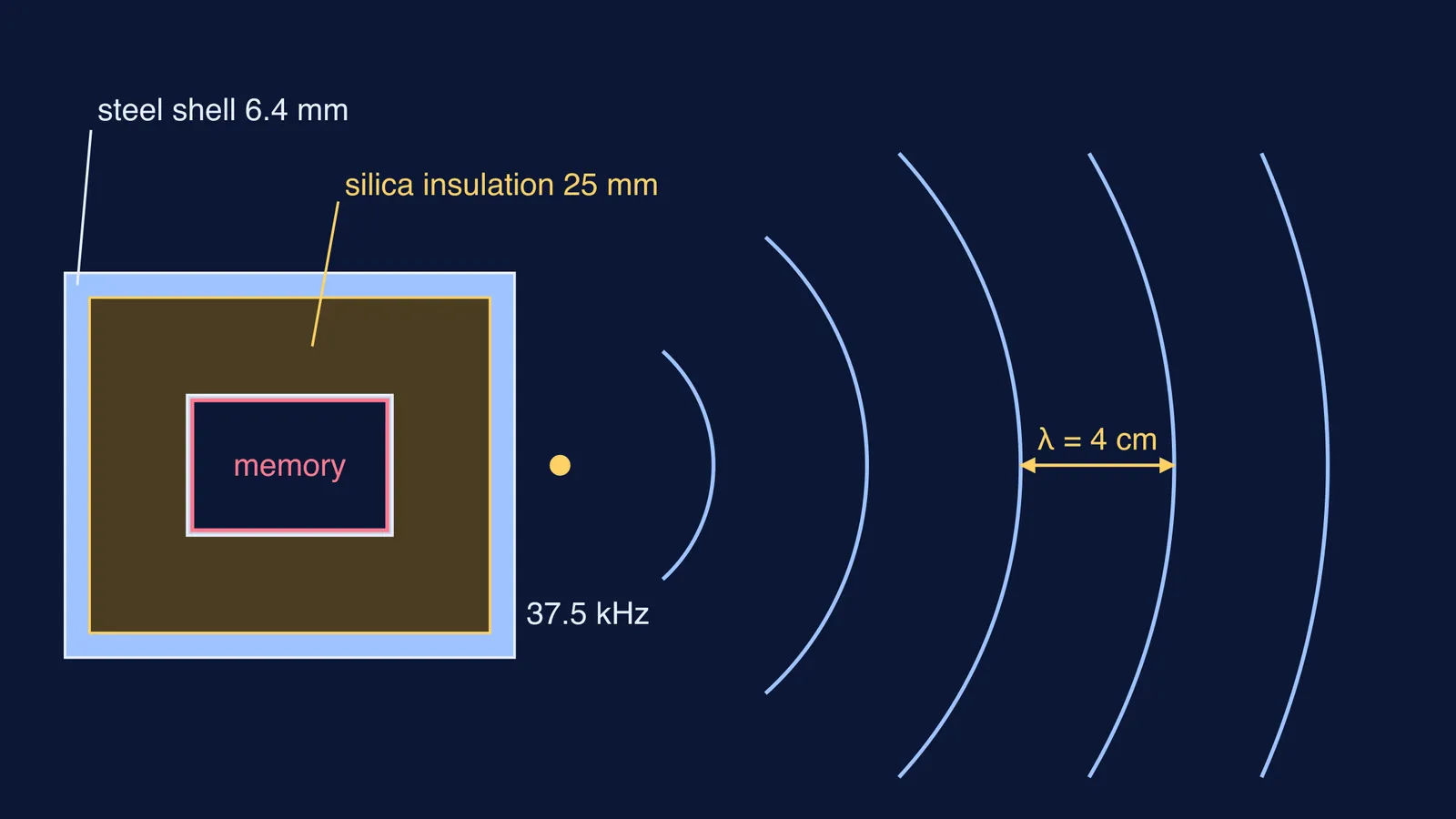
It survives because the memory sits inside layers, each with its own job. A 2008 patent filing by the recorder maker L-3 describes the usual build, from the inside out (patent US20090277683A1):
a thin aluminium housing around the stack of memory boards
about 2.54 cm of dry-silica insulation
a stainless-steel shell about 0.18 to 0.25 inches (up to 0.64 cm) thick, with titanium as an option for the outer armour
The steel shell takes the blow. According to the NTSB, both recorders are built to survive an impact of 3,400 g lasting 6.5 milliseconds, where 1 g is the acceleration due to gravity.
How does a black box survive a fire?
ANSV lists 1,100 °C for one hour as a design requirement (ANSV). The NTSB's specification page gives 1,100 °C for 30 minutes (NTSB).
Steel stops the impact, but heat would still get through it, so the insulation keeps the chips cool. Heat moves through a solid by conduction, and the rate falls as the layer gets thicker or conducts heat less well. Dry silica conducts heat poorly, so 2.5 cm of it buys the chips time. The L-3 patent also proposes a layer that melts in a fire. Melting soaks up latent heat, as ice keeps a drink at 0 °C until it has melted, and then the liquid drains out and leaves an insulating air gap (patent). Try this simple test of heat conductors and insulators at home.
How do searchers find a black box underwater?
They listen for it. Each recorder carries an underwater locator beacon that switches on by itself when it touches water (ANSV). SKYbrary, the aviation safety reference, says the beacon sends an ultrasonic pulse at 37.5 kHz every second, and that its transmission time had to be extended from 30 days to 90 days by 1 January 2020. The NTSB says the recorders survive being submerged at 20,000 feet, about 6,000 m (NTSB).
Sound suits the job because water carries it well. NOAA gives the speed of sound as 1,500 m/s in water and about 340 m/s in air, and notes that low-frequency sound in particular can travel thousands of metres with very little loss. By 1 January 2019, according to SKYbrary, most large aeroplanes on routes more than 180 nautical miles from shore also carry a low-frequency airframe beacon at 8.8 kHz. It can be detected 13 to 22 km away, about four times as far as a standard beacon (SKYbrary). The timing physics is the same as in how sonar measures sea depth.
Can you work out the black box numbers yourself?
Yes, with one formula each, using figures from NOAA, SKYbrary and the NTSB. Try them before you read the answers.
Wavelength of the ping: λ = v ÷ f = 1,500 ÷ 37,500 = 0.04 m, or 4 cm. For the 8.8 kHz beacon, 1,500 ÷ 8,800 gives about 17 cm.
Time for a ping to reach the surface from 6,000 m: t = d ÷ v = 6,000 ÷ 1,500 = 4 s.
Speed lost in the impact test, treating it as a steady deceleration: v = a × t = 3,400 × 9.8 × 0.0065, about 217 m/s.
Convert kHz to Hz and milliseconds to seconds before you divide or multiply. Waves are easier to understand when you can watch them move. The Fermi Simulation Lab has interactive simulations for ideas that are easier to see than to read. If you get stuck partway through a calculation, the Fermi Problem Library has worked problems with a step-by-step solver that explains the reasoning rather than printing an answer.
Next time you see an orange box in a news photo, try working out its three numbers yourself.


