

On this page
This relation turns up whenever a chemistry question shows you an energy profile and gives you two of three numbers: the forward barrier, the backward barrier and ΔH. Once you see where it comes from, you will never need to memorise which way the subtraction goes.
What is the relation between forward and backward activation energy?
Start with the definition. OpenStax Chemistry 2e defines activation energy as "the minimum energy necessary to form a product during a collision between reactants." On a potential energy diagram, the activation energy is the height of the hill between reactants and products, as Chemistry LibreTexts/18:_Kinetics/18.04:_Potential_Energy_Diagrams) puts it.
The top of that hill is the transition state, or activated complex. The forward reaction climbs to it from the reactants. The backward reaction climbs to the same peak from the products. So:
Ea(f) = E(peak) − E(reactants)
Ea(b) = E(peak) − E(products)
Subtracting: Ea(f) − Ea(b) = E(products) − E(reactants)
That last difference is ΔH. On a reaction diagram, OpenStax estimates ΔH as the energy difference between the reactants and products (OpenStax, section 12.5). So Ea(f) − Ea(b) = ΔH.
How do you read it off an exothermic and an endothermic profile?
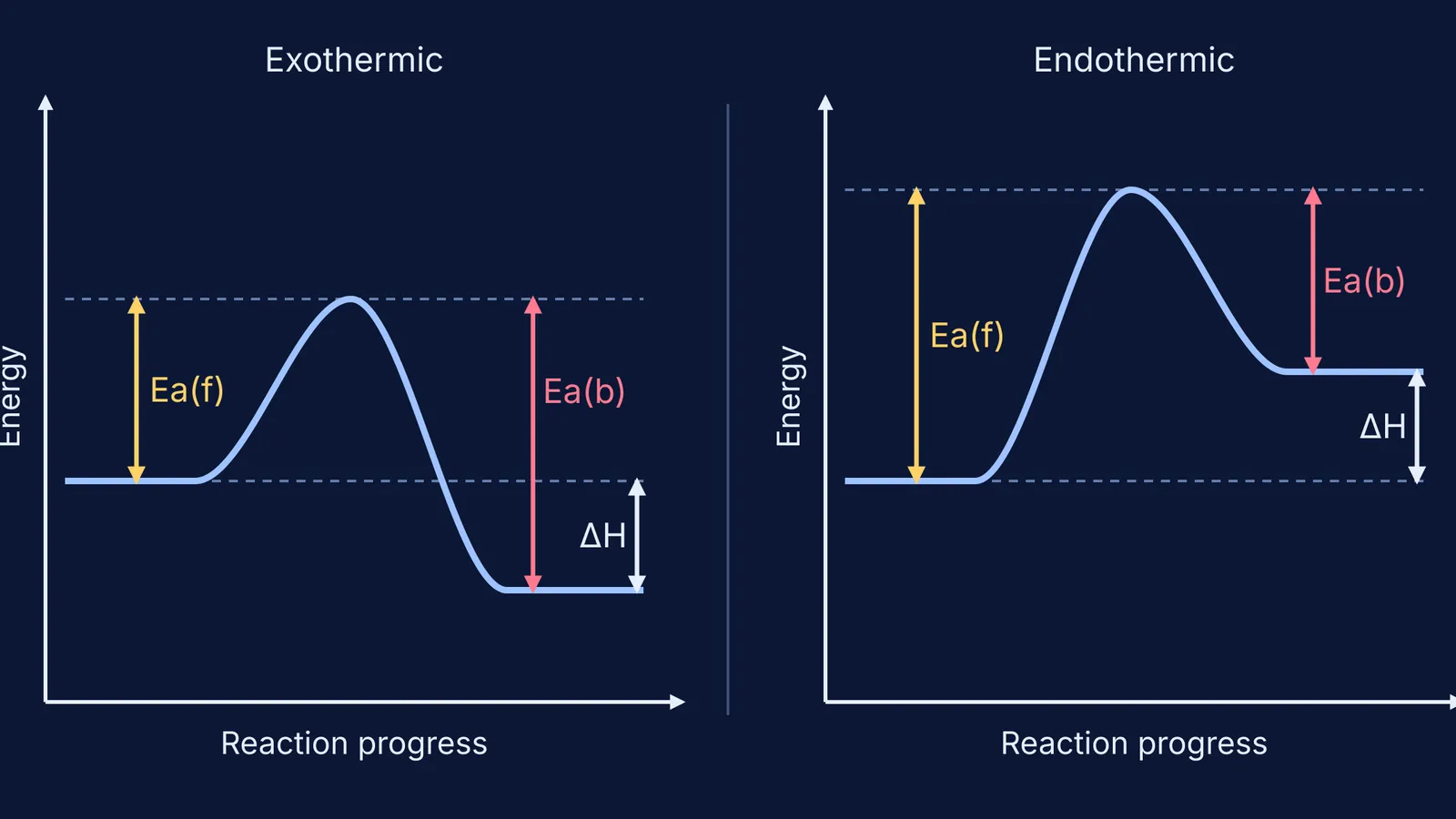
In an exothermic reaction the products sit lower than the reactants and ΔH is negative; in an endothermic reaction the products sit higher and ΔH is positive (LibreTexts/18:_Kinetics/18.04:_Potential_Energy_Diagrams)). That gives you two quick rules:
Exothermic: Ea(b) is bigger than Ea(f). The backward climb starts from the lower valley, so it is longer.
Endothermic: Ea(f) is bigger than Ea(b). And because Ea(b) cannot be negative, Ea(f) must be at least as large as ΔH.
To read any profile, work through it in this order:
Mark three horizontal levels: reactants, peak and products.
Ea(f) is the vertical distance from reactants up to the peak.
Ea(b) is the vertical distance from products up to the peak.
ΔH is the distance from reactants to products, negative if you go down.
Check that Ea(f) − Ea(b) gives the same ΔH, with the same sign.
Worked examples: how do you find the backward activation energy?
The numbers below are made up for practice, in kJ/mol, and match the diagram at the top of this post.
Exothermic. Ea(f) = 50 and ΔH = −30. Then Ea(b) = Ea(f) − ΔH = 50 − (−30) = 80 kJ/mol. Check: the products are lower, so the backward barrier should be the bigger one. It is.
Endothermic. Ea(b) = 50 and ΔH = +30. Then Ea(f) = Ea(b) + ΔH = 50 + 30 = 80 kJ/mol.
Catalyst added to example 1. The catalyst lowers the peak by 20. Now Ea(f) = 30 and Ea(b) = 60, and Ea(f) − Ea(b) is still −30.
Spot the impossible option. An option claims an endothermic reaction with ΔH = +40 and Ea(f) = 25. That would make Ea(b) = 25 − 40 = −15, a negative barrier, so you can strike it out without further work.
If your answers keep coming out with the wrong sign, the Fermi Problem Library has worked problems with a step-by-step solver that explains the reasoning rather than printing an answer, so you can see which level you measured from.
Does a catalyst change ΔH or the backward activation energy?
A catalyst gives the reaction an alternative mechanism with a lower activation energy, and the catalysed and uncatalysed curves begin and end at the same energies (OpenStax, section 12.7). So ΔH does not change.
The lowered transition state gives lower activation energies for both the forward and the reverse reactions, and equilibrium is reached faster without any change in the equilibrium constant (OpenStax, section 13.3). On a simple one-hump profile, both barriers drop by the same amount, which is why example 3 kept the difference at −30.
To put a number on the speed-up, see how many times the rate rises when a catalyst lowers Ea. The same picture for biology is in how enzymes lower activation energy on a graph, and the temperature side is in how temperature changes the fraction of molecules above activation energy.
Which mistakes cost marks on energy-profile questions?
Dropping the sign. Write ΔH with its sign before you substitute. Using magnitudes turns 80 into 20 in example 1.
Measuring Ea(b) from the wrong level. The backward barrier starts at the products, not at the reactants.
Thinking a catalyst helps only one direction. It lowers both barriers and leaves ΔH alone.
Multi-step profiles. Each step has its own Ea(f) − Ea(b), which gives that step's ΔH. The overall ΔH runs from the first reactant level to the final product level.
Mixed units. Convert J/mol and kJ/mol to one unit before you subtract.
If transition states or enthalpy still feel shaky, the Fermi Concept Library has a lesson for every concept in chemistry, each with its place in the map.
Next time you see an energy profile, draw the three dashed levels first; the numbers usually follow.


