

On this page
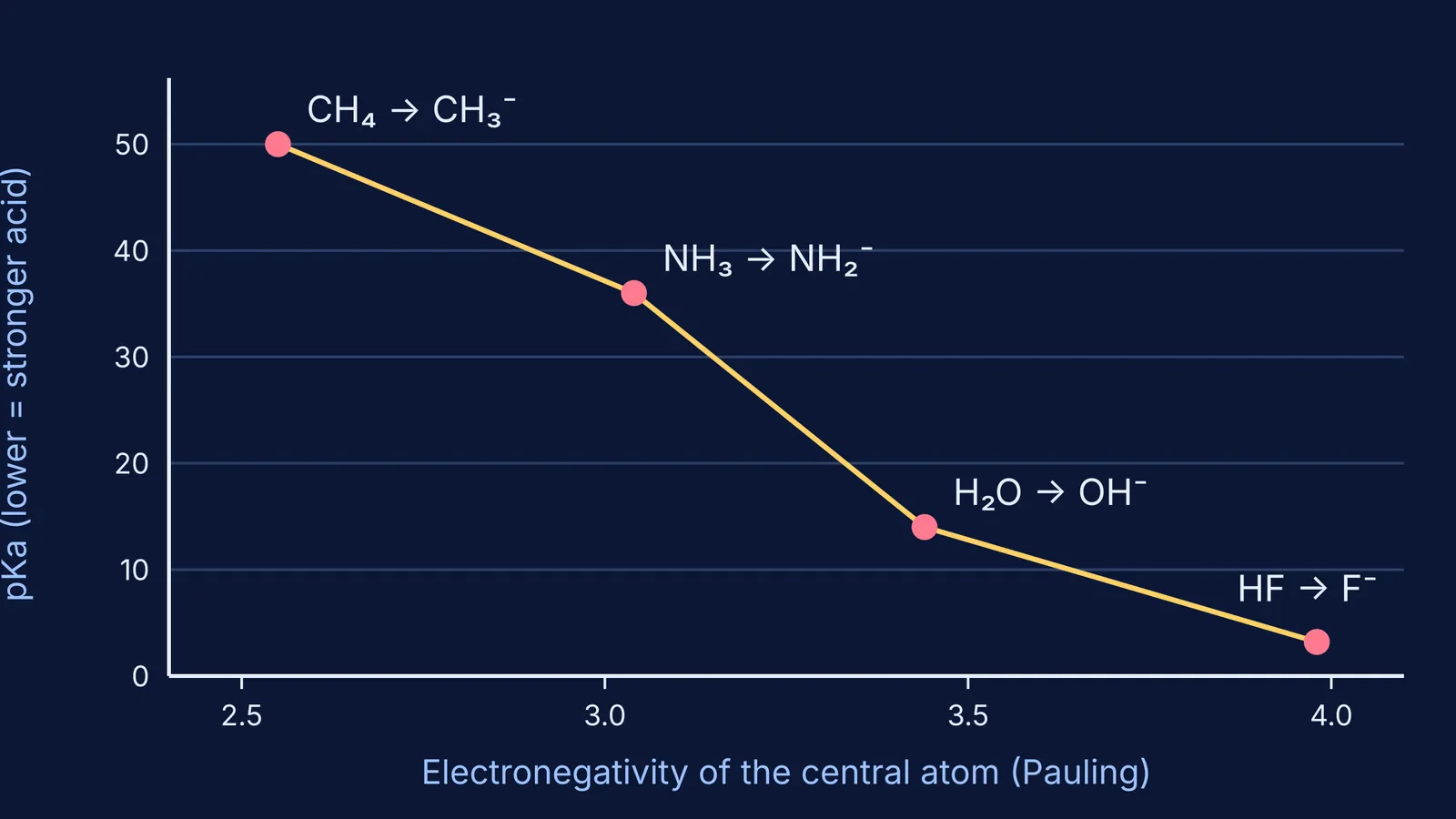
Put CH4, NH3, H2O and HF in a row and ask which one gives up a proton most easily. The answer runs left to right: methane is barely acidic at all, and hydrogen fluoride is a weak but measurable acid. The reason fits in one line. Going across the row, the central atom pulls harder on electrons, so the anion left behind is more comfortable carrying a negative charge.
Below: the numbers, the bond-strength objection, and a worked exam answer.
Why does acidity increase from CH4 to HF across a period?
When an acid HA gives up H+, it leaves behind its conjugate base, A-. Anything that makes A- more stable makes HA a stronger acid. Across period 2, the four conjugate bases are CH3-, NH2-, OH- and F-.
In all four, the extra electron pair sits on an atom from the same row. Atom size changes only a little across the row, so size cannot account for the trend. What changes a lot is electronegativity. According to the Pauling values in the LibreTexts electronegativity table, it rises from 2.55 for carbon to 3.04 for nitrogen, 3.44 for oxygen and 3.98 for fluorine.
A more electronegative atom holds a lone pair closer and more tightly, so the negative charge costs less energy. The LibreTexts chapter on molecular structure and acid strength/Unit_8%3A_Storage/Chapter_13%3A_Aqueous_Acid-Base_Equilibria/Chapter_16.3%3A_Molecular_Structure_and_Acid-Base_Strength) puts it this way: fluorine stabilises the charge on F- much better than carbon can on CH3-. The same source adds a second effect. As the central atom gets more electronegative, the E-H bond becomes more polar, which also favours losing H+.
If you want to see how electronegativity differences shape bonds more generally, read our post on using electronegativity difference to call a bond ionic or covalent.
What are the pKa values of CH4, NH3, H2O and HF?
The same LibreTexts chapter/Unit_8%3A_Storage/Chapter_13%3A_Aqueous_Acid-Base_Equilibria/Chapter_16.3%3A_Molecular_Structure_and_Acid-Base_Strength) gives these values:
CH4: pKa about 50
NH3: pKa about 36
H2O: pKa 14.00
HF: pKa 3.20
A lower pKa means a stronger acid. Since pKa = -log Ka, each step of 1 is a factor of 10. The gap between CH4 and HF is roughly 47 units, so by these figures the Ka of HF is about 10^47 times that of methane. Treat that as an order of magnitude only, because the CH4 value is itself an estimate.
The trend also works backwards for bases. The stronger the acid, the weaker its conjugate base, so the basicity order runs CH3- > NH2- > OH- > F-.
Doesn't the stronger H-F bond make HF a weaker acid?
This is the objection that catches students in exams. The LibreTexts bond energies table/Chemical_Bonding/Fundamentals_of_Chemical_Bonding/Bond_Energies) lists average values of 413 kJ/mol for C-H, 391 kJ/mol for N-H, 467 kJ/mol for O-H and 565 kJ/mol for H-F.
So H-F is the strongest of the four bonds, yet HF is the strongest acid. Across a row, bond strength does not decide the order. The stability of the conjugate base does, and that comes from electronegativity.
Down a group, things flip. Atom size grows a lot, the H-X bond weakens, and the larger anion spreads its charge over more space. That is why the LibreTexts chapter/Unit_8%3A_Storage/Chapter_13%3A_Aqueous_Acid-Base_Equilibria/Chapter_16.3%3A_Molecular_Structure_and_Acid-Base_Strength) gives HF a pKa of 3.20 but HI a pKa of -9.3. Our post on why acid strength rises from HF to HI works through that side in detail.
How do you write this answer in an exam?
Try this question: arrange H2O, CH4, HF and NH3 in increasing order of acid strength, and give a reason.
Spot the pattern. All four central atoms (C, N, O, F) are in period 2, so this is a row comparison.
Write the conjugate bases: CH3-, NH2-, OH-, F-.
Rank the central atoms by electronegativity: C < N < O < F.
Conclude: the more electronegative the atom, the more stable the conjugate base, so the stronger the acid.
A two-line answer that scores: "CH4 < NH3 < H2O < HF. Electronegativity increases from C to F, so the negative charge on the conjugate base is held more stably from CH3- to F-, and H+ is lost more easily."
Three mistakes to avoid:
Using bond strength to argue across a row. It points the wrong way for HF.
Mixing a row with a column, such as comparing HF with H2S, without saying which effect wins.
Calling HF a strong acid. It is the strongest of these four, but its pKa of 3.20 is far above the -6.1 that the LibreTexts acid strength chapter/Unit_8%3A_Storage/Chapter_13%3A_Aqueous_Acid-Base_Equilibria/Chapter_16.3%3A_Molecular_Structure_and_Acid-Base_Strength) gives for HCl.
If you get the order right but can't explain the reason, the gap is the concept, not the method. The Fermi Concept Library gives every chemistry concept its own lesson and shows where it sits in the map, so you can go back to electronegativity before returning to acids. For practice, the Fermi Problem Library has worked problems with a step-by-step solver that explains the reasoning rather than printing an answer.
Next, see where these hydrides sit among everyday acids with our pKa ladder of common organic acids.


