On this page
A Question of Trust is a short crime story with a trick ending, and it is chapter 4 of Footprints Without Feet, the supplementary reader on the CBSE Class 10 English Language and Literature syllabus for 2026-27. Questions on this chapter often ask how such a careful planner slips, so you need the plot turns in order. Below is the story in plain words, the clues most readers miss, and a plan for a 6-mark answer.
What is A Question of Trust about?
The NCERT chapter opens on Horace Danby, a man of about fifty whom everyone thinks of as an upright citizen. He makes locks, employs two helpers and suffers from summer hay fever. His secret: he loves rare, costly books, and to pay for them he robs one safe each year, then buys books through an agent. He has been to prison once, fifteen years earlier.
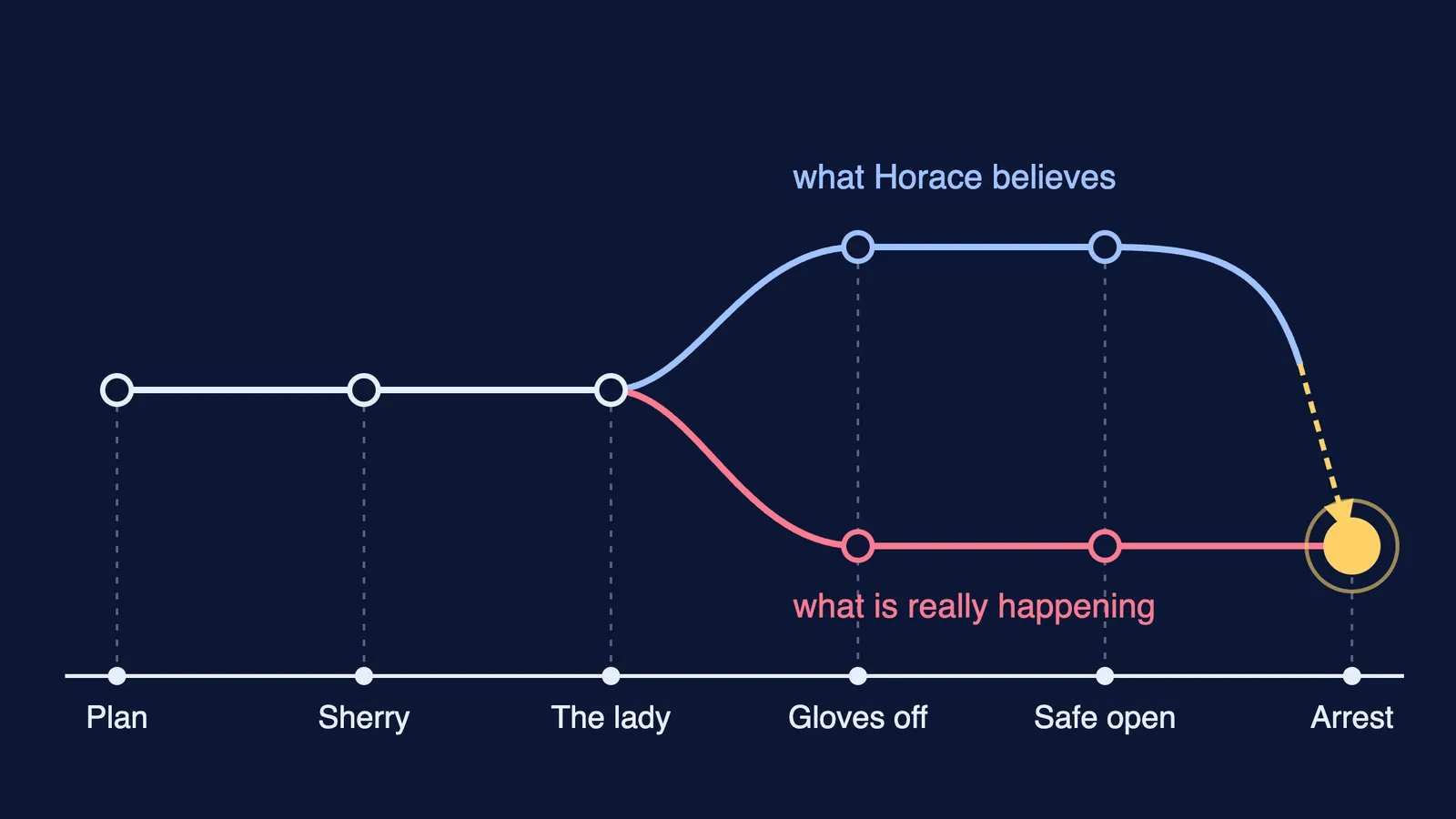
This year his target is Shotover Grange. He has watched the house for two weeks, waits until the family is in London and the two servants have gone to the cinema, and lets himself in with the kitchen key, wearing gloves so he leaves no prints. He calms the dog, Sherry, by using its name. The safe sits behind a painting, and he knows this because a magazine article had printed the house plan and even mentioned the hidden safe. He expects the jewels inside, worth about fifteen thousand pounds, to fetch at least five thousand when sold, enough for a year of books.
Then a bowl of flowers sets off his hay fever, and a young woman in red appears at the door. She acts like the lady of the house, threatens to call the police, and then softens. When she takes a cigarette, Horace, eager to please her, takes off his gloves and offers his lighter. Only then does she agree to let him go if he opens the safe: she wants her jewels for a party, and he guesses she has forgotten the combination. He opens it bare-handed, hands her the jewels and leaves.
He keeps his promise to stop for just two days. On the third day he is arrested, because his fingerprints are all over the room. The real owner's wife turns out to be a grey-haired woman of sixty who calls his story nonsense. Horace ends up as assistant librarian in the prison, and the old saying about honour among thieves now makes him furious.
How does the lady trick Horace Danby?
She never proves who she is; she simply behaves as if the house is hers. Track these moves when you revise:
She talks to Sherry and tidies the ornaments, small acts that look like ownership.
She offers a believable reason: a promise to her husband, a party tonight, a forgotten combination.
She says her husband will be away for a month, which explains why a broken safe will not matter.
Her line that she has always liked the wrong kind of people hints at her real trade.
Horace misses it all because he fears prison and wants to please the one person who can send him there.
What is the irony in A Question of Trust?
Irony means the outcome is the opposite of what a character expects. Here it works three ways:
A man who has worked with locks and safes all his life is caught because he opens a safe.
A thief who plans every detail is beaten by someone who planned better.
A criminal who trusts a stranger is punished for that trust, so the title itself becomes the joke.
What are the main themes of A Question of Trust?
Appearance versus reality: both Horace and the lady look respectable and are not.
Overconfidence: careful planning cannot cover a person you did not plan for.
Ends and means: Horace thinks stealing only from the rich, for books, makes him different from other thieves. The story does not agree.
Compare it with The Thief's Story, which turns on trust in the opposite direction, or with The Necklace, another story with a sting at the end.
How do you write a 6-mark answer on A Question of Trust?
The syllabus says one long question from this reader carries 6 marks and needs about 100-120 words, while short questions carry 3 marks each at 40-50 words (CBSE 2026-27 syllabus). Use this four-step plan:
Claim (one sentence): answer the question directly, for example, "Horace was undone by his own trust, not by the police."
Evidence (two or three sentences): give two events in order, such as the gloves coming off and the fingerprints.
Interpretation (two sentences): say what it shows about his character or the theme.
Close (one sentence): link back to the title or the irony.
English is not a Fermi subject, but if your board preparation also includes science and maths, the Fermi Concept Library covers every concept in physics, chemistry, biology, mathematics and computing, each with its own lesson. The next chapter in the reader is the title story, covered in our Footprints without Feet summary, themes and questions.