

On this page
This integral rewards one good first move. Take a > 0. The root is real only for −a < x ≤ a, and that range decides every sign choice below.
The answer is ∫√((a − x)/(a + x)) dx = a sin⁻¹(x/a) + √(a² − x²) + C.
Both routes land on the standard form ∫dx/√(a² − x²) = sin⁻¹(x/a) + C, which is formula 7.4 (5) in the NCERT Class 12 Mathematics Part II chapter on integrals.
Why multiply top and bottom by √(a − x)?
Multiplying the top and bottom by √(a − x) turns the bottom into a difference of squares:
√((a − x)/(a + x)) = (a − x)/√((a + x)(a − x)) = (a − x)/√(a² − x²).
This uses √((a − x)²) = a − x, which is safe because a − x ≥ 0 on the whole domain. Now split the integral into two pieces:
a∫dx/√(a² − x²) = a sin⁻¹(x/a), straight from the NCERT standard form.
−∫x dx/√(a² − x²): put t = a² − x², so dt = −2x dx, and the piece becomes ½∫t^(−1/2) dt = √t = √(a² − x²).
Add them: a sin⁻¹(x/a) + √(a² − x²) + C. It is the same 'clear the root first' habit as in our guide to integrating 1/((px + q)√(ax + b)) and its three cousins.
How does x = a cos 2θ simplify the root?
The substitution works because identity 14 in the NCERT Class 11 chapter on trigonometric functions, cos 2θ = 2 cos²θ − 1 = 1 − 2 sin²θ, rearranges to 1 − cos 2θ = 2 sin²θ and 1 + cos 2θ = 2 cos²θ. NCERT uses the same move elsewhere: Miscellaneous Exercise 10 of the Class 12 inverse trigonometric functions chapter carries the hint 'Put x = cos 2θ'.
Put x = a cos 2θ with 0 < θ < π/2, so x runs over −a < x < a. Then:
(a − x)/(a + x) = (1 − cos 2θ)/(1 + cos 2θ) = tan²θ, and √(tan²θ) = tan θ because tan θ > 0 in this range.
dx = −2a sin 2θ dθ = −4a sin θ cos θ dθ.
The integrand becomes tan θ × (−4a sin θ cos θ) = −4a sin²θ = −2a(1 − cos 2θ).
Integrate: −2aθ + a sin 2θ + C.
Return to x: 2θ = cos⁻¹(x/a), and sin 2θ = √(1 − x²/a²), positive because 0 < 2θ < π. The result is −a cos⁻¹(x/a) + √(a² − x²) + C.
Step 1 is the sign trap. If θ wanders outside (0, π/2), tan θ can be negative and √(tan²θ) becomes −tan θ. It is the same question as choosing the sign of sin(x/2) in a half-angle formula: fix the range of the angle first, then open the root.
Why do the two methods give different-looking answers?
The derivatives of sin⁻¹(x/a) and cos⁻¹(x/a) are equal and opposite, so their sum is constant; at x = 0 it is 0 + π/2. So −a cos⁻¹(x/a) = a sin⁻¹(x/a) − aπ/2, and the two answers differ by aπ/2, which the + C absorbs.
Two antiderivatives of the same function on an interval differ only by a constant, so an answer that looks different from a solution book's is not automatically wrong.
How do you check your answer in two minutes?
Whichever method you pick:
Differentiate. d/dx[a sin⁻¹(x/a) + √(a² − x²)] = a/√(a² − x²) − x/√(a² − x²) = (a − x)/√(a² − x²), which is the integrand after the first step of the rationalising method.
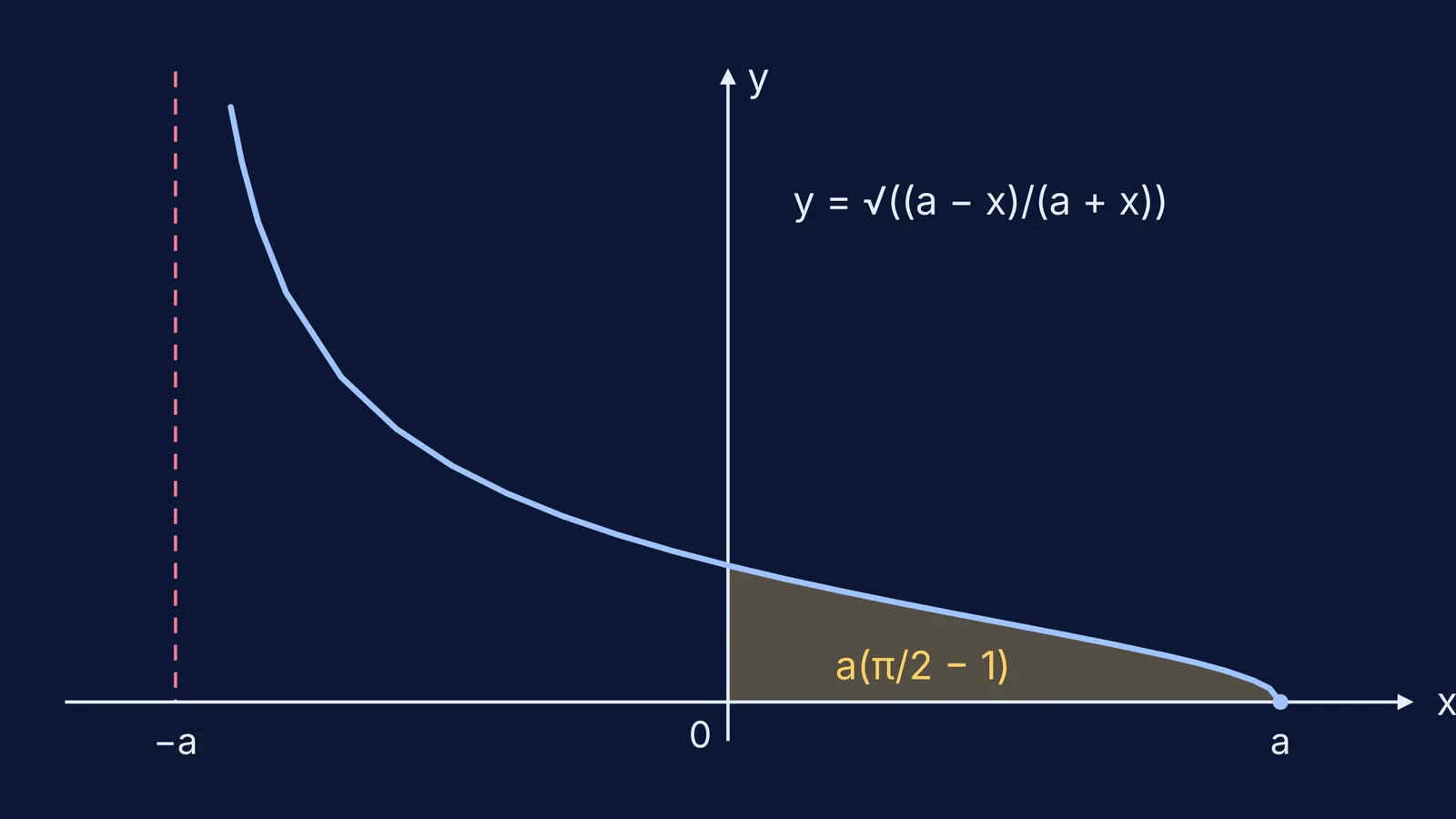
Test a definite value. From 0 to a, your answer gives (aπ/2 + 0) − (0 + a) = a(π/2 − 1), about 0.571a. The integrand falls from 1 to 0 there, so an area between 0 and a is believable.
Check the domain. The integrand is real only for −a < x ≤ a, so an answer that seems to work for x > a has gone wrong.
The guide on checking an integral by differentiating, plugging in and testing limits applies the same three tests to any answer, including one from a chatbot.
If a step such as the sign of tan θ keeps tripping you up, the Fermi Problem Library has worked problems with a step-by-step solver that explains the reasoning rather than printing an answer. For the inverse-trig and double-angle ideas behind step 5, the Fermi Concept Library gives each concept its own lesson and its place in the map.
Try it now on √((a + x)/(a − x)). Multiply top and bottom by √(a + x), and you should reach a sin⁻¹(x/a) − √(a² − x²) + C.


