

On this page
You see depth because your eyes sit a few centimetres apart and each gets a slightly different view. BrainFacts, the Society for Neuroscience's public site, puts it simply: we see the world from two shifted views, and the brain uses the offset between them to triangulate distance. A 3D film copies that trick twice, once with cameras and once with polarised light, which makes it a neat way into polarisation in Class 12 wave optics. (Headsets use the same idea: see how a VR headset tricks your eyes.)
How are 3D movies filmed?
A 3D film is shot with two cameras, one for each eye, held on a 3D rig. The simplest rig puts the cameras side by side, but the 3D rig article on Wikipedia notes that the minimum gap between them is then limited by the size of the lenses. For close shots, and most live-action filming, crews use a mirror rig: the two cameras look through a beamsplitter, so the distance between their optical axes can be smaller than the lenses and even down to zero. The cost is light: the mirror takes away one f-stop because the light is split between two cameras.
Two settings shape how deep the scene feels:
Interaxial distance, the gap between the two lenses. Human eyes are a natural reference: in the 2012 US Army anthropometric survey tabulated on Wikipedia's pupillary distance page, mean interpupillary distance was 64.0 mm for men and 61.7 mm for women. For close-ups crews go far smaller: the 3D rig article says the gap must be no more than a couple of millimetres, while very wide gaps can make a scene look miniature.
Convergence, where the two optical axes meet: the cameras are either parallel or angled so their axes cross at a chosen distance.
How do 3D glasses show each eye a different picture?
Both images land on the same screen, so each needs a label. The label is polarisation: the direction in which the light's electric field oscillates.
OpenStax University Physics gives the two facts you need. A polarising filter cuts the intensity of unpolarised light by a factor of 2. Light already polarised at angle θ to the filter's axis comes through with intensity I = I₀cos²θ, which is Malus's law.
RealD: one projector, circular polarisation
According to Wikipedia's RealD 3D entry, a liquid-crystal modulator called a ZScreen sits in front of the projector lens. It polarises frames clockwise for the right eye and counter-clockwise for the left, switching 144 times per second: 24 frames per eye per second, each shown three times ("triple flash") to reduce flicker. A silver screen keeps the polarisation intact on reflection.
IMAX: two projectors, linear polarisation
BrainFacts explains that digital IMAX theatres use linear polarisation and align two projectors so their images line up. The two projectors' light is polarised at right angles, and each lens matches one projector.
The polarised 3D system article describes the trade-off: linear glasses need a level head, or the left and right images bleed into each other, while circular glasses keep the images apart when you tilt (though a strong tilt still spoils the depth).
What happens if you tilt your head in IMAX 3D?
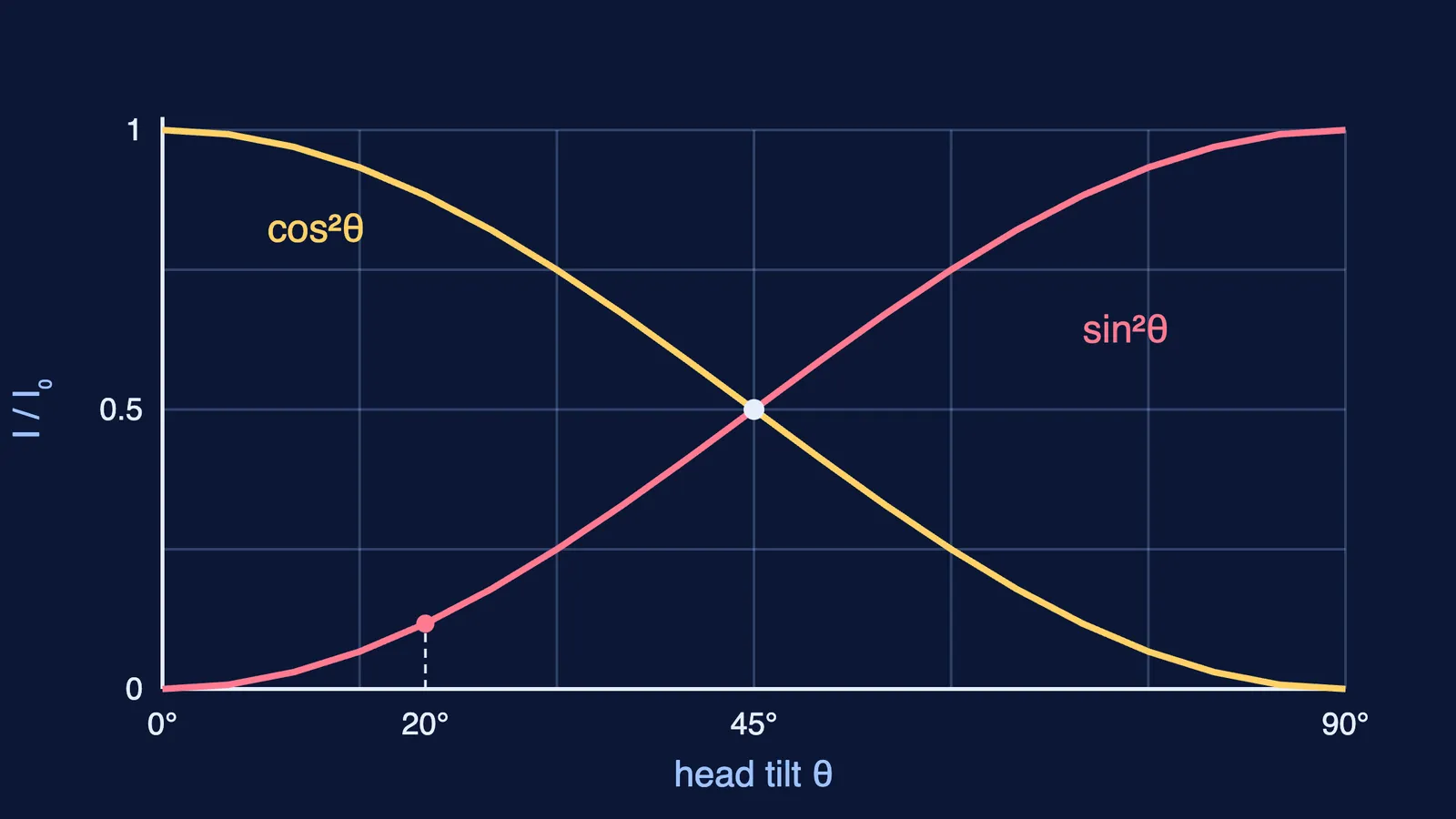
You can work out the leak yourself with Malus's law from the OpenStax chapter. The two images are polarised at right angles; call them 0° (left) and 90° (right), with your left lens along 0°. Now tilt your head by θ.
The left image meets your left lens at angle θ, so it passes cos²θ of its intensity.
The right image meets the same lens at 90° − θ, so it passes cos²(90° − θ) = sin²θ. That is the ghost.
At θ = 10°, sin²θ ≈ 0.03, a faint 3% ghost.
At θ = 20°, sin²θ ≈ 0.117, so about 12% of the wrong picture gets through.
At θ = 45°, both images pass at 0.5. Each eye sees the same mixture and the depth is gone.
The chart at the top plots both curves. The ghost grows as θ² for small angles, so a slight lean is forgiven; resting your head on a friend's shoulder is not. To take Malus's law one step further, try the three-polaroid problem.
How can you test this with glasses you kept?
If you have two pairs of linear-polarised glasses (RealD pairs won't behave the same way), try this at the desk:
Hold a lens from one pair in front of the matching lens from the other against a bright window, and rotate the front pair slowly.
Predict first, with θ the angle between the two lenses' axes: at 30°, cos²θ = 0.75; at 60°, 0.25; at 90°, nearly dark.
Look at a clear blue sky through one lens and rotate it. The sky dims at some angles because scattered skylight is partly polarised, as explained in why skylight is polarised.
If cos²θ still feels like a formula rather than a picture, the Fermi Simulation Lab has interactive simulations for ideas that are easier to see than to read. If you get stuck on a step, Fermi's AI tutor can draw the figure and check your understanding as it goes.
Next time you collect 3D glasses, check which polarisation they use.


