

On this page
You have a few weeks left, dozens of chapters and a mock score that will not move. Studying in textbook order spends your best hours on whatever came first in Class 11. A better order comes from asking two questions about every chapter: how many marks does it usually carry, and how far are you from getting those marks?
Does JEE Main or NEET publish chapter-wise weightage?
No. The JEE Main 2027 Information Bulletin from NTA sets 25 questions each in Mathematics, Physics and Chemistry, 100 marks per subject and 300 in all, with +4 for a correct answer and -1 for a wrong one in both sections. It gives the three subjects equal weight but assigns no marks to individual chapters.
The NEET (UG) syllabus on NTA's site also lists units and topics with no marks against them. Patterns can change, so check the current bulletin.
So weightage is something you estimate yourself. NTA posts recent question papers on the official JEE Main website. Count how many questions each chapter got across a few papers and you have your own weightage list. Our guide on how to use chapter weightage in JEE Main preparation goes deeper into that counting.
How do you rank chapters by weightage and weakness?
Give each chapter two scores from 1 to 3.
Weightage (W): 3 if it shows up in almost every paper you counted, 2 if in some, 1 if rarely.
Gap (G): 1 if you get most of its questions right in mocks, 2 if it is shaky (you know the ideas but drop marks on steps or speed), 3 if you have barely studied it.
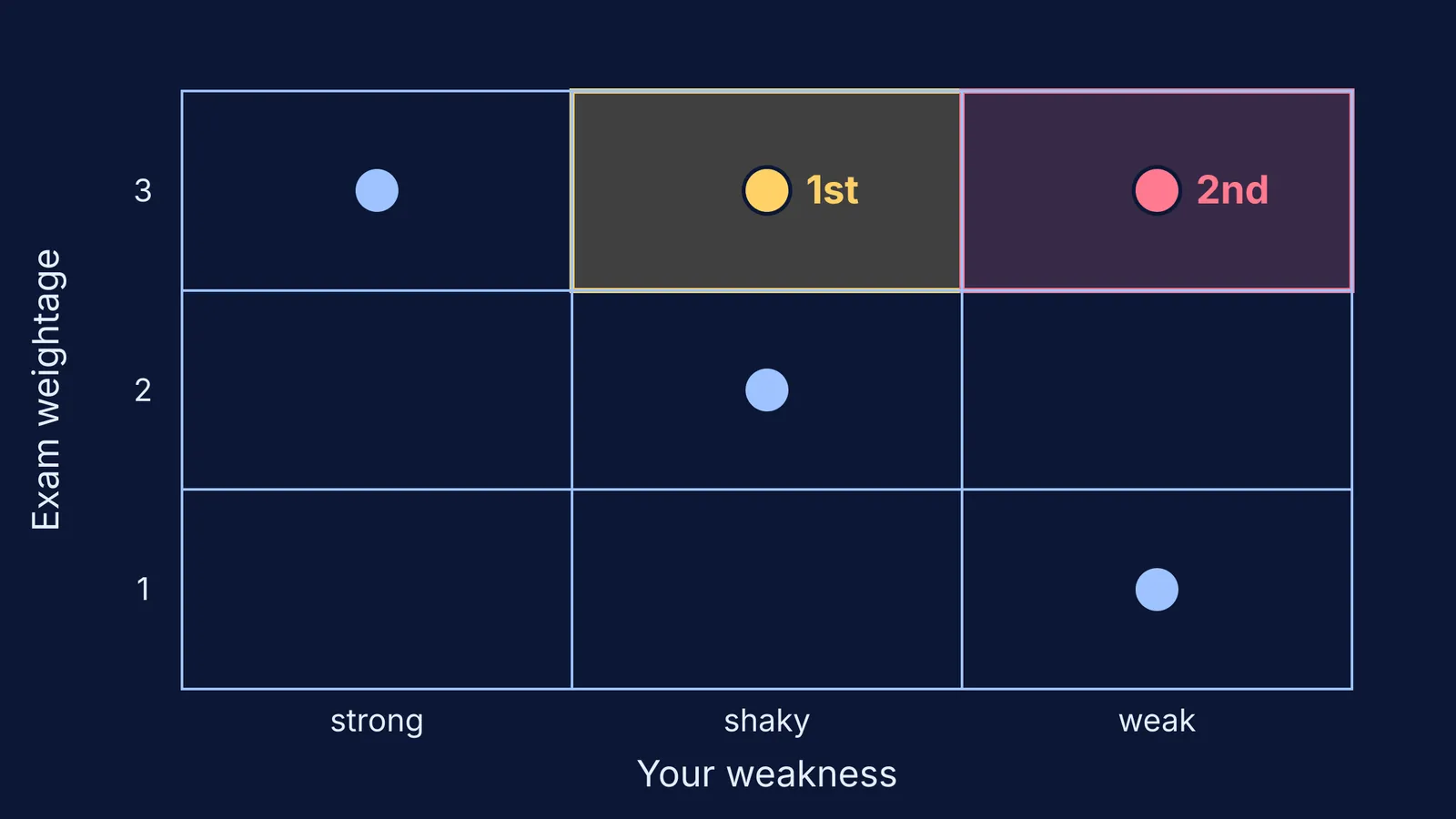
Then put each chapter in one of five boxes:
High weightage, shaky (W3, G2): study first. The marks are close.
High weightage, weak (W3, G3): study second. Start from the basic concepts and give these your longest study blocks.
Lower weightage, shaky (W1 or W2, G2): quick fixes. Short evening sessions on the steps you keep getting wrong.
Any weightage, strong (G1): maintain. Mixed practice questions, not rereading.
Lower weightage, weak (W1 or W2, G3): park it. Come back only if time remains, W2 chapters first.
Why shaky before weak? In 2006 lab experiments by Nate Kornell and Janet Metcalfe, learners did better when they could control what they studied, and when they had to choose among items they had not yet learned, they picked the easier ones and benefited from doing so. They did not test exam chapters, but their region of proximal learning model points the same way: work on what is just beyond your grasp, not furthest from it.
For box 4, a 2013 review by John Dunlosky and colleagues rated practice testing and spaced-out (distributed) practice as high-utility study techniques, and rereading and highlighting as low-utility ones.
What does the grid look like for one subject?
Here is a worked example for JEE Main physics. The ratings are made up for illustration; your own counts from the papers on NTA's site will differ.
Current electricity: W3, G2. Box 1, study first.
Rotational motion: W3, G3. Box 2, study second.
Modern physics: W3, G1. Box 4, maintain with mixed questions.
Units and measurements: W2, G2. Box 3, quick fixes.
Properties of solids and liquids: W1, G3. Box 5, park it.
A plan from this grid:
First block of weeks: box 1 chapters, each ending with a timed chapter test.
Second block: box 2 chapters, concepts first, then problems.
Every evening: one box 3 fix and a few box 4 questions.
Every two weeks: re-score every chapter. A weak chapter that becomes shaky moves to box 1.
Final stretch: full mocks, then back to the grid.
If you are not sure how to split hours between new chapters and revision, see how much time to give revision versus new topics.
When a shaky chapter costs marks through wrong methods, the Fermi Problem Library has worked problems with a step-by-step solver that explains the reasoning rather than printing an answer. For a weak chapter where the ideas themselves are missing, the Fermi Concept Library has a lesson for every concept in physics, chemistry, biology and mathematics. And if you look at the grid and still do not know where to begin, Fermi's AI tutor can work out what you already know and build a plan for the session.
How can parents help without adding pressure?
Ask about boxes, not hours. Instead of "How long did you study today?", try: "Which box is current electricity in now? What moved it?"
If the grid shows many weak chapters, help them choose what to park. Parking a low-weightage chapter on purpose is a plan, not giving up.
If worry about the exam is affecting sleep, food or mood, talk to a school counsellor or doctor. Tele MANAS, the government's toll-free tele mental health helpline, is on 14416.
For a subject that sits mostly in boxes 2 and 5, start with our six-week plan to fix your weakest subject.


