

On this page
The honest answer first: we found no study that has tested a 70:30 split against 60:40 for JEE or NEET aspirants. Research does show how revision timing should change as the exam nears, and which kind of revision works. Below is a ratio for each stage of a two-year preparation, with a worked week you can copy.
Why does the ratio change as the exam gets closer?
In a study of more than 1,350 people, Cepeda and colleagues (2008) taught a set of facts, gave a review after a gap of up to 3.5 months, and then tested again up to a year later. The best gap between first study and review grew as the final test moved further away.
Measured as a share of the time left before the test, the best review gap fell from about 20 to 40% for a test one week away to about 5 to 10% for a test one year away.
With the exam a year away, 5 to 10% is roughly 2.5 to 5 weeks, so revisiting each chapter about once a month fits the finding. With the exam a week away, 20 to 40% is about 1.5 to 3 days, so everything comes round every few days. An earlier meta-analysis of 317 experiments by the same group found the same pattern: the spacing that gave the best retention increased as the time to the final test increased.
That is why revision takes a small slice of your week in Class 11 and most of it at the end. One caution: these studies used verbal material such as facts, not multi-step physics problems, so treat the numbers as a guide to the shape of your plan, not a prescription.
What counts as revision?
Revision works best when it makes you pull the answer out of your own head. A 2013 review of ten study techniques by Dunlosky and colleagues rated practice testing and spaced practice as high utility, and rated rereading and highlighting as low utility.
In Roediger and Karpicke's 2006 experiments, students who restudied a passage did better on a test five minutes later, but students who had tested themselves remembered substantially more after two days and after one week. The restudy group also felt more confident, so rereading notes can feel like revision and still not hold up a week later.
What ratio of new topics to revision should you use at each stage?
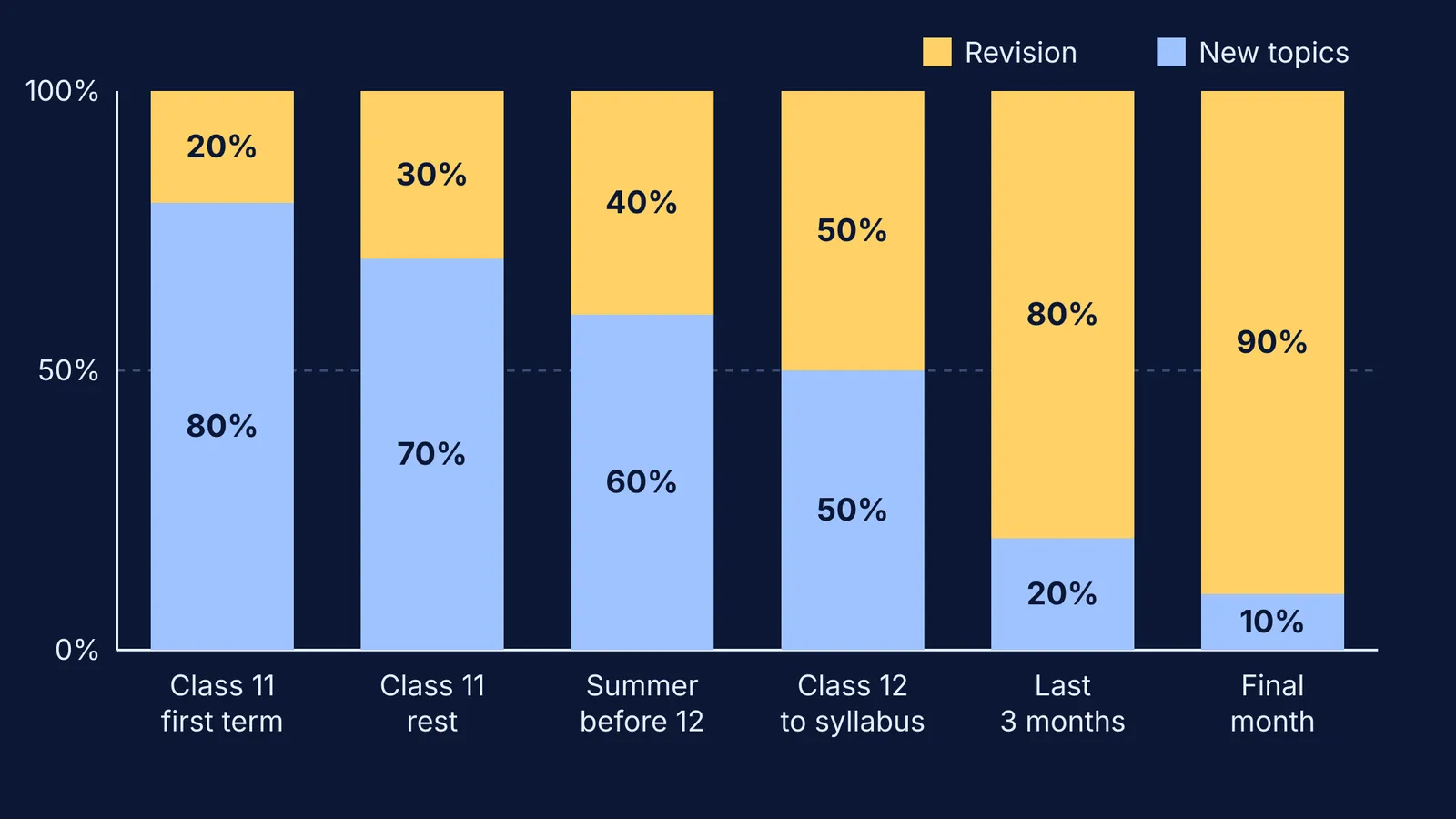
These are our rules of thumb for two-year preparation alongside school, following the spacing pattern in Cepeda and colleagues' study, not tested ratios.
Class 11, first term: 80% new, 20% revision. A short self-test on last week's topics, plus one older chapter each week.
Class 11, rest of the year: 70:30. Each finished chapter comes back roughly once a month.
The summer before Class 12: 60:40. Do one full mixed pass of Class 11 before Class 12 chapters pile up.
Class 12, until the syllabus is done: 50:50. For boards, see balancing Class 12 boards with JEE preparation.
The last three months: 20:80. New work only to close gaps your mock tests expose. Full mocks and their review count as revision.
The final month: 10:90 or less. No new chapters, only small gaps.
If you are already behind, start with a triage plan to clear your chapter backlog before you worry about ratios.
How do you know when to shift the ratio?
Every two weeks, take a 20-minute mixed quiz on chapters you finished more than a month ago, which is itself self-testing. If you solve most of it cleanly, keep your ratio. If you are failing chapters you once knew, move 10 points towards revision for the next fortnight. If it feels easy, move 10 points back towards new work.
When a quiz turns up a problem you cannot crack, the Fermi Problem Library has worked problems with a step-by-step solver that explains the reasoning rather than printing an answer, so you can see where your method went wrong. If you are unsure where to begin, Fermi's AI tutor can work out what you already know and build a plan for the session.
What does an 80:20 week look like?
Say you have 24 hours of self-study a week outside school and coaching. That number is for the example, not a target.
Monday to Friday, 3 hours a day: 2.5 hours on the new topic, then 30 minutes recalling and solving from last week's topic without notes.
Sunday, 9 hours: 6.5 hours of new work and a 2.5-hour mixed test on chapters from a month or more ago.
Total: 19 hours new, 5 hours revision, close to 80:20.
At 50:50 it becomes 12 hours each. In the last three months: about 5 hours fixing gaps, 19 hours of mocks, mock review and spaced problem sets.
To space each chapter's revisits inside these ratios, use our 4-week spaced revision schedule for any chapter.


