

On this page
A weak subject usually has a few missing foundations underneath it. Until you fill them, every new chapter built on top wobbles, and more hours of the same studying rarely helps.
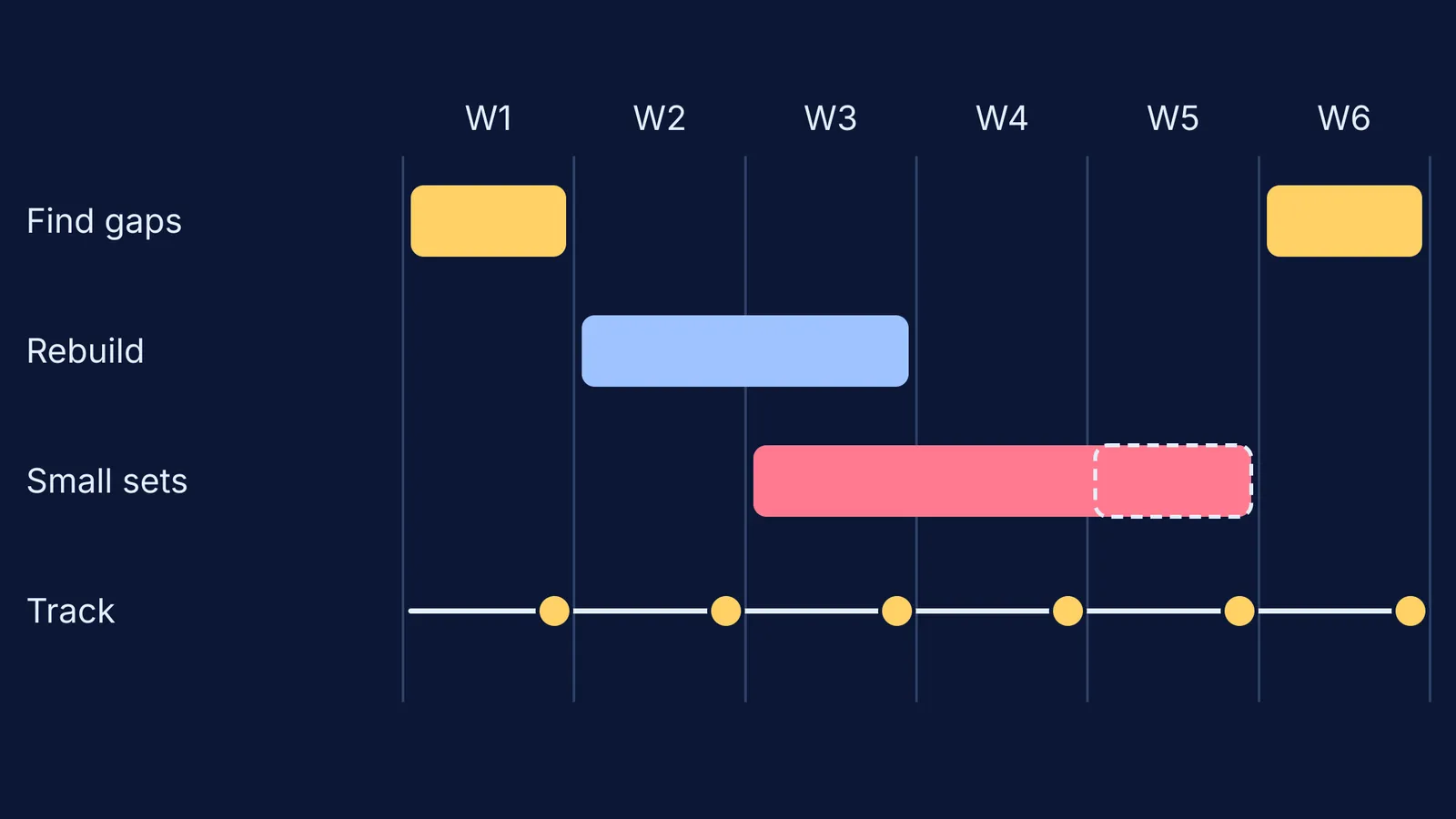
This plan takes six weeks at about 45 minutes a day (our suggestion). Week 1 finds the gaps, weeks 2 and 3 rebuild basics, small practice sets start in week 3 and run to week 5, and week 6 is a retest. You track progress throughout.
Why does more studying not fix a weak subject?
The usual rescue is to reread the textbook and highlight more. That feels productive, but the evidence is poor. A major review of ten study techniques by Dunlosky and colleagues rated rereading and highlighting as low utility. It rated practice testing and spacing your study across days as high utility, because they helped learners of different ages and abilities.
A meta-analysis of practice testing by Adesope and colleagues found the same thing: taking practice tests led to more learning than restudying. So this plan is mostly answering questions.
How do you find the root gaps in your weakest subject?
Spend week 1 on diagnosis, not new study. Collect your last two or three tests or mocks in the subject. Go through every mark you lost and give it one label:
Concept gap: you did not understand the idea the question tested.
Prerequisite gap: you understood the chapter, but an older skill failed (algebra, vectors, unit conversion, the mole).
Method error: you knew the idea but chose the wrong approach or got stuck halfway.
Careless slip: a sign, a copied number, a misread question.
Time: you never reached it.
Then trace each concept gap back: what would you need to know to do this question? Keep asking until you reach something you can do easily.
A worked example: a Class 11 student loses most chemistry marks in stoichiometry. Tracing back, the real gap is converting grams to moles, and under that, rearranging a simple ratio. Their week 1 list, deepest first: ratios, moles, limiting reagent.
Our guide on how to analyse a mock test covers this sorting in more detail.
How do you rebuild the basics without starting from zero?
In weeks 2 and 3, work up your list from the deepest gap. Spend one or two days on each item. Learn it, then test yourself on five fresh questions, and only move up when you get four right.
That rule borrows from mastery learning, where students must master one unit before going on to the next. A meta-analysis of 108 controlled evaluations by Kulik, Kulik and Bangert-Drowns found that mastery programmes improved exam performance, with stronger effects for the weaker students in a class. The four-out-of-five threshold is our suggestion, not a number from that study.
If an idea will not click from your textbook, look it up in the Fermi Concept Library, which covers every concept in physics, chemistry, biology, mathematics and computing, each with its own lesson and its place in the map. For a chapter you have never understood at all, our step-by-step guide to learning a hard chapter from scratch goes further.
What should practice look like in weeks 3 to 5?
Once your basics hold, practise in small sets: 6 to 8 questions in about 25 minutes, closed book, then check every answer in the same sitting.
Weeks 3 and 4: one topic per set, one set a day.
Week 5: mix two or three topics in each set, so you must decide which method fits. Dunlosky's review rated this kind of interleaved practice as moderately useful.
Every set: for each question you get wrong, write one line saying why, using your week 1 labels.
When a method error keeps coming back, work through a similar problem in the Fermi Problem Library, where a step-by-step solver explains the reasoning rather than printing an answer. Then retry your original question unaided.
How do you know the plan is working?
Keep one page in your notebook with five columns: date, topic, set size, number correct, and the main error type. Every Sunday, take a 10-question mixed quiz drawn from your week 1 list and write down the score.
A meta-analysis of 138 studies with 19,951 participants by Harkin and colleagues found that interventions which increased progress monitoring helped people reach their goals. The effect was larger when progress was physically recorded, or reported or made public. Showing your page to a parent or friend each Sunday is a simple way to report it.
In week 6, take a test like the ones you sorted in week 1 and label your mistakes again. Success means concept and prerequisite gaps shrinking, not only a higher score. To keep what you rebuilt, move your hardest topics onto a four-week spaced revision schedule.
If a weak subject is making you anxious or low for weeks at a time, talk to a parent, teacher or school counsellor, or call Tele MANAS on 14416.


