

On this page
I. E. Irodov's Problems in General Physics has about 2,000 problems spanning mechanics to atomic and nuclear physics. Many JEE Advanced and olympiad aspirants pick it up, and it is easy to lose weeks in it: one problem eats an evening, then another, and the book goes back on the shelf.
The right moment to start depends less on your class than on one question: has your current practice stopped stretching you?
When should I start Irodov or another advanced problem book?
Start when your chapter basics are reliable, not before. Two research ideas explain why.
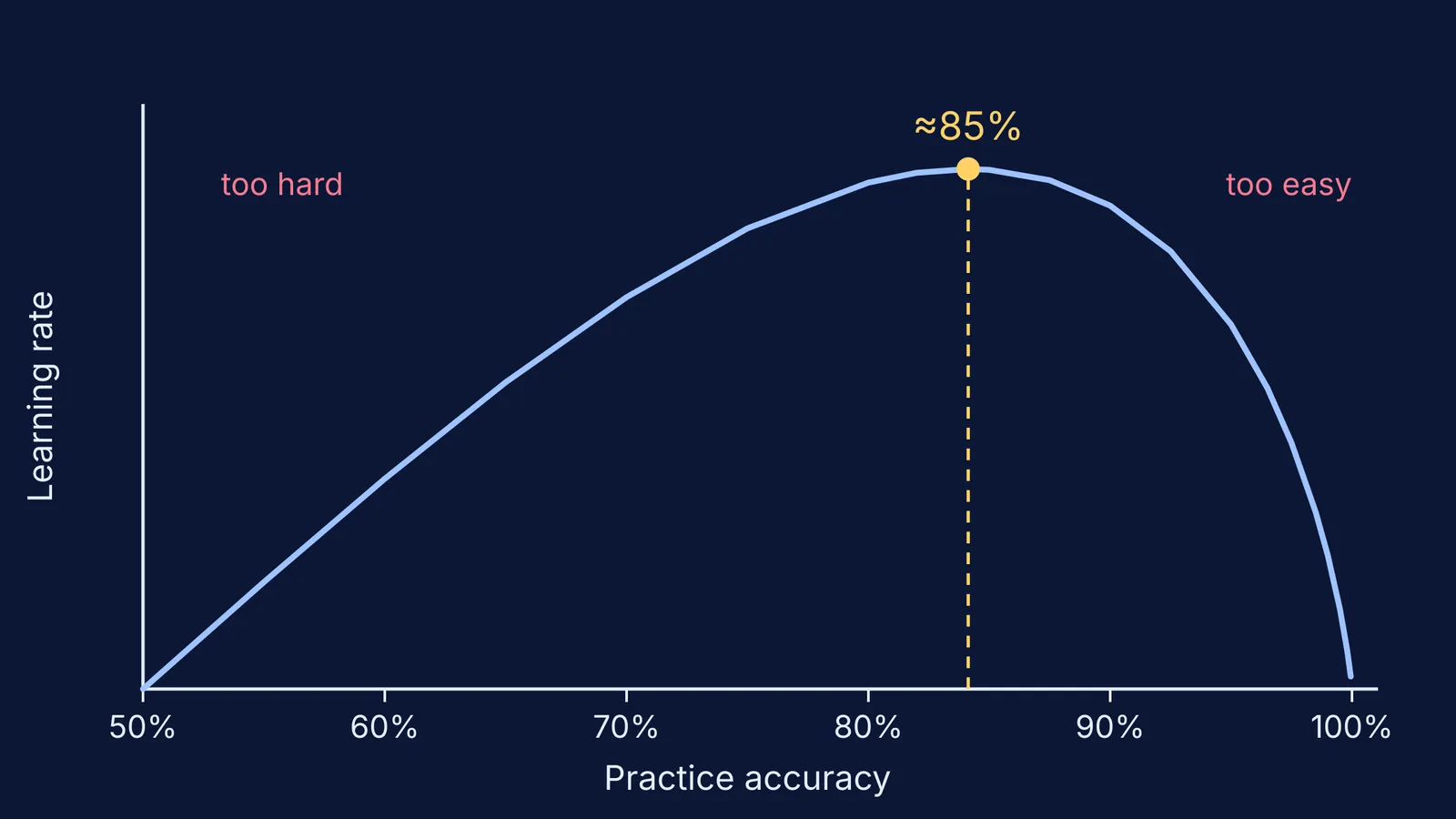
The first is difficulty. Robert Wilson and colleagues modelled how fast learning algorithms improve as training gets harder, and reported in Nature Communications in 2019 that the optimal training accuracy is about 85%. Their maths covers learning algorithms and neural networks thought to describe animal learning, not students, so treat it as a rule of thumb: practice should be hard enough that you miss some and easy enough that you get most.
The second is order. The expertise reversal effect, described by Slava Kalyuga, Paul Ayres, Paul Chandler and John Sweller in 2003, is the finding that techniques which help beginners, such as studying worked examples, can lose their effectiveness or even backfire with more experienced learners. While a chapter is new, worked examples teach you most. Once you know it, open problems do. An advanced book is almost all open problems, so it pays off only after the basics are in place.
What are the signs you are ready for Irodov?
You solve most textbook and intermediate-book exercises for a chapter without the solutions.
You can explain why each step works, not only which formula you used.
When you get one wrong, you can usually find your own mistake.
Standard problems feel routine and quicker than a month ago.
An unfamiliar problem makes you curious rather than anxious.
If two or more are missing, an intermediate set is the better use of your week. Our guide to choosing practice questions at the right difficulty shows how to find that middle level.
How many advanced problems should I do per week?
No study gives a magic number for Irodov. Instead, let your own success rate set the pace, using the roughly 85% sweet spot from the Wilson study as a loose guide. This is our suggested plan, not a research finding. Attempt 10 problems in a week from a chapter you finished recently, and count only the ones you solved fully without help.
10 of 10: too easy. Move to a harder section.
7 to 9: the right zone. Keep the same pace.
4 to 6: mix 5 advanced and 5 intermediate problems on the same chapter.
0 to 3: go back to an intermediate book for a week or two, then retest.
A worked example: a Class 11 student who has just finished Newton's laws tries 10 Irodov problems and solves 3. They spend a week on intermediate friction and pulley problems, retry 10 fresh ones and solve 6, then 8 the week after. That is the moment to hold the pace steady, not triple it.
How do I avoid getting stuck on one problem for days?
Some struggle is useful. A 2021 meta-analysis by Tanmay Sinha and Manu Kapur in Review of Educational Research pooled 53 studies with 166 comparisons and found a moderate advantage (Hedges' g 0.36) for students who tried problems before being taught. It studied first meeting a new concept, and the effect favoured teaching first for second to fifth graders, but it supports an honest attempt before you reach for help.
Honest attempts still need a limit. Try this stuck rule:
Give the problem 20 to 30 minutes: draw the figure, list what you know, ask which law applies.
If still stuck, write one sentence about exactly where, such as "I don't know whether friction acts up or down the incline."
Take one hint only. Our hint ladder for hard problems shows how to ask for the smallest useful nudge.
Try again for 10 minutes.
Still stuck? Read the solution, close it, and rewrite it from memory the next day.
Return to the problem a week later.
If the wall is a method you have not seen, the Fermi Problem Library has a step-by-step solver that explains the reasoning rather than printing an answer, so you can read one step and stop. If the wall is a concept, such as pseudo force, revisit its lesson in the Fermi Concept Library.
What should parents look for when a problem book stalls?
A stalled book looks like long evenings on one page or frustration after every session. Ask "How many did you try this week, and how many did you finish on your own?" rather than "How far have you got?" Our guide on how to use an olympiad problem book has more on working through these books.
If the pressure seems to be affecting sleep, appetite or mood for more than a few days, talk to a school counsellor or call Tele MANAS, the free, 24x7 national mental-health helpline, on 14416.
Pick one chapter this week, try 10 problems, and let your count decide the next step.


