

On this page
Questions that are too easy feel productive but teach little. Questions that are too hard end with you reading the solution and only feeling you understood. The useful zone lies between: questions you get right most of the time, but not every time.
How often should you get practice questions right?
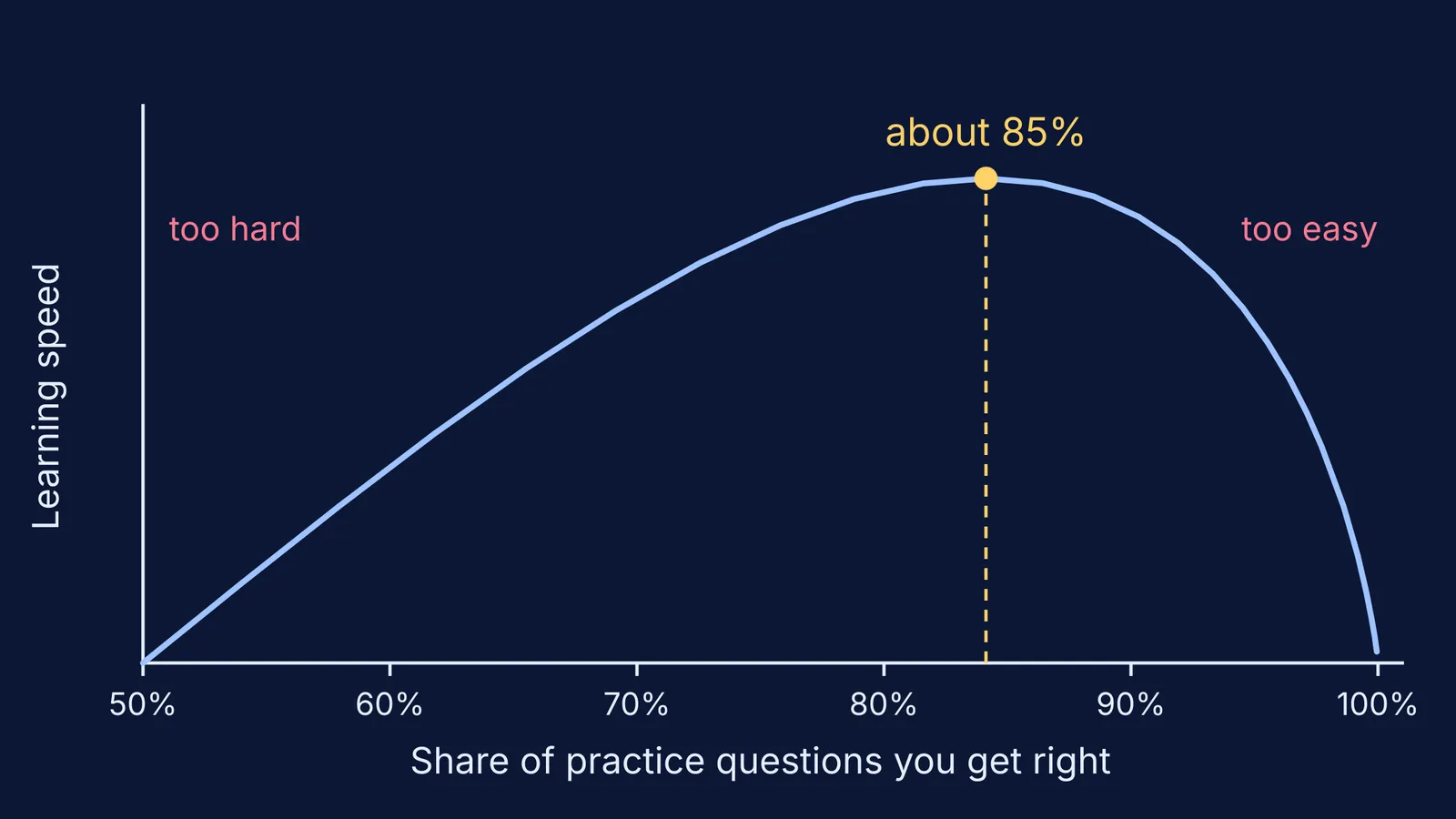
Two different lines of research agree. In a 2012 article for American Educator, Barak Rosenshine, an emeritus professor of educational psychology at the University of Illinois, reviewed classroom research and wrote that the optimal success rate for student achievement "appears to be about 80 percent" (Rosenshine, Principles of Instruction). In one study of fourth-grade maths that he describes, 82% of students' answers were correct in the classrooms of the most successful teachers, against 73% for the least successful.
A 2019 paper in Nature Communications reached a similar number by mathematics. Robert Wilson and colleagues showed that, for a broad class of learning algorithms doing two-choice tasks, learning is fastest when training accuracy is about 85% (Wilson et al., Nature Communications, 2019). Their result was shown in computer models of learning, not tested on students, so treat 85% as a pointer rather than an exact target. The authors connect it to the idea of desirable difficulty in education, which we explain in why learning that feels hard sticks.
The other side matters as much. Rosenshine warns that if practice lacks a high success rate, "there is a chance that students are practicing and learning errors", and that once errors have been learned, they are very difficult to overcome. So the practical target is about 8 out of 10.
How do you know if a question set is too easy or too hard?
Do a set of 10 questions from one level and let the score choose the next set. The thresholds below are our working rule, built around the 80 to 85% range above; they are not numbers from a study.
9 or 10 right, finished quickly: too easy. Move up one level.
7 or 8 right: the right zone. Do one more set here, then move up.
5 or 6 right: a stretch. Stay, but study a worked example of each miss before the next set.
4 or fewer right: too hard for now. Drop one level for one set, or go back to the concept.
A perfect score means move on. Our post on whether to keep practising once you get it right covers when extra repetition still pays off.
How do you step up difficulty within a chapter?
Most chapters have a natural ladder. Here is one for Laws of Motion in Class 11 physics:
Level 1, one idea and one step: find the acceleration of a 5 kg block pushed with 20 N on a smooth floor.
Level 2, one idea and several steps: two blocks in contact are pushed together; find the force between them. Some NCERT exercise questions sit here.
Level 3, two ideas combined: friction on an incline, or a pulley with friction on one block.
Level 4, previous JEE Main questions from the chapter, mixed and timed.
Level 5, multi-concept problems such as pulleys with constraint relations or wedges, including JEE Advanced previous papers.
A worked example: you score 10 out of 10 at Level 1, so you move to Level 2 and score 8, then 9. At Level 3 you drop to 4, and every miss involves choosing the direction of friction. Rather than going back to Level 1, you study a worked example of each friction miss and try fresh Level 3 sets: 6, then 8. Now you are ready for Level 4. Start each new chapter one level below where you think you are, and log the level and score of every set (L3: 4, 6, 8) so you can see where you are stuck.
Your misses tell you what to do next. Slips, such as a sign error, mean slow down. A wrong method means you need to see the reasoning laid out. The Fermi Problem Library has worked problems with a step-by-step solver that explains the reasoning rather than printing an answer, so you can find the step where your method went off.
What should parents ask about practice?
"How many did you finish?" rewards easy questions. Ask "Which level are you on, and how many did you get right on your own?" instead. A child who gets everything right every evening may be practising below their level; one who gets most wrong may be practising errors. Both are fixed by changing the questions, not the hours. If study stress is affecting sleep or mood, talk to the school counsellor or call Tele MANAS on 14416.
For a student who is not sure where to start, Fermi's AI tutor can work out what they already know and build a plan for the session, so they begin at a sensible level. For the idea behind moving on only once you can do a level, read our explainer on mastery learning and adaptive practice.


