

On this page
In short Attempting problems before reading the theory builds greater conceptual understanding. A 2014 study by Manu Kapur found that trying to solve maths problems before receiving instruction leads to better transfer to novel problems, while keeping a solution log helps you revisit the ones you miss.
An olympiad problem book is not a textbook. If you read it cover to cover, you will feel like you understand the ideas, but you will still draw a blank when you face a new question on exam day. The value of a problem book lies entirely in the struggle it provides.
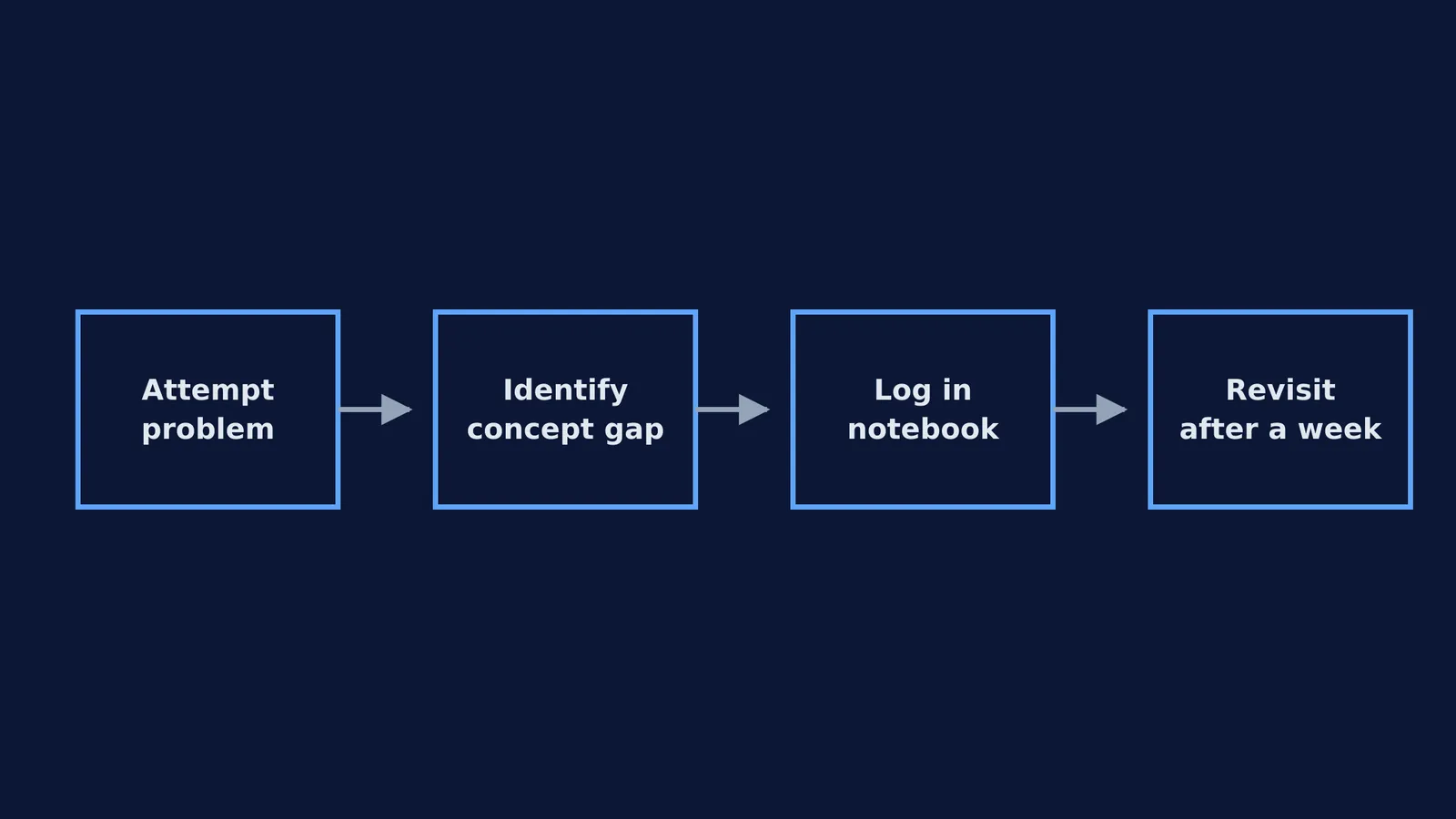
To use an olympiad problem book effectively, you have to treat the problems as the primary way you learn, rather than as a test of what you have already memorised. This means attempting them before you think you are ready, tracking your attempts, and revisiting the ones that beat you.
Why should I attempt problems before reading the hints?
When you read a worked solution or a textbook chapter, your brain recognises the logical steps and assumes it could have generated them. This is the illusion of fluency. The only way to break it is to try solving a problem from scratch.
Research shows that failing to solve a problem is often more productive than being shown how to solve it immediately. A 2014 study by Manu Kapur found that students who engaged in problem solving before being taught demonstrated significantly greater conceptual understanding and ability to transfer to novel problems than those who were taught first.
When you struggle, you explore the limits of your current knowledge. You find exactly which connection is missing. Then, when you finally look up the concept or read the hint, your brain is primed to absorb it because it solves a specific mystery you have just experienced. If you are struggling with a concept gap after an attempt, the Concept Library can help you find your place in the map of ideas.
How do I keep a solution log for maths and physics?
An olympiad book is dense. If you just tick off the problems you solve, you are wasting the information hidden in your mistakes. You need a solution log: a simple notebook where you record not just what you did, but how you failed.
Create a table with four columns: Problem, First Attempt, Missing Concept, and Revisit.
Problem: Write the question number.
First Attempt: Be honest. Did you solve it entirely on your own? Did you need a hint? Did you make a calculation error, or were you stuck on the setup?
Missing Concept: If you failed, what was the exact idea you were missing? Write it down in one phrase (e.g. "direction of friction on the top block" or "angular momentum conservation").
Revisit: Leave this blank to tick off later.
This log becomes your personal syllabus. When you sit down to study, you no longer have to guess what to work on. If you repeatedly get stuck on the setup of mechanics problems, Fermi's AI tutor can work out what you already know and build a plan for the session, so you sit down to a clear next step.
When should I revisit unsolved problems?
It is tempting to read the solution, nod, and move on to the next chapter. But understanding a solution today does not mean you can produce it next week.
A 2006 study by Roediger and Karpicke found that prior testing produced substantially greater retention than repeated studying when students were tested a week later. You have to test yourself again.
Use the "Revisit" column in your solution log. Several days after you fail a problem, attempt it again on a blank sheet of paper, without looking at your previous notes. If you still cannot solve it, update the log and try again the following week.
If you want to read more about scheduling these reviews, we have a guide on how to build a study routine that lasts longer than a week.
When should I use a step-by-step solver?
Sometimes a book's printed solution skips algebraic steps, leaving you more confused than before. You know the final answer, but you cannot bridge the gap.
In these moments, a full worked solution can be a tool for learning, provided you use it to check your logic. The Fermi Problem Library has worked problems with a step-by-step solver that explains the reasoning rather than printing an answer. Use this not to bypass the struggle, but to understand exactly where your path diverged from the correct one.
This approach takes time. You might only solve five problems in an afternoon. But those problems, attempted honestly and logged properly, will do more for your understanding than reading fifty solutions. If you find yourself stuck at the same score despite solving hundreds of problems this way, it might be worth reading about why some JEE aspirants plateau despite studying every day.


