On this page
Students often apply for virtual internships hoping for a quick resume boost, but recruiters see a sharp divide. While some online programs provide genuine experiential learning, others are simply "certificate mills" that offer a PDF badge in exchange for a fee. If you are investing your time, it pays to know the difference.
Are virtual internships worth it?
A real internship provides a taste of the professional world and teaches you how to collaborate in a high-stakes environment. A 2024 study published in the *International Journal of Entrepreneurship and Management Practices* surveyed 113 internship coordinators from the public sector to understand what they value most in early-career candidates. The researchers found that teamwork ability was the single most dominant factor affecting a student’s employability, outranking even technical literacy and individual leadership skills.
Traditional, in-person internships naturally foster this teamwork through daily office interactions. High-value virtual internships simulate it through collaborative tools like shared code repositories, live project management boards and regular video meetings. By contrast, a "certificate mill" is often an automated portal where a student passively clicks through pre-recorded videos to earn a digital badge. Because these platforms involve no collaboration or feedback, they fail to develop the crucial teamwork skills that employers actually look for.
How can you spot a certificate mill?
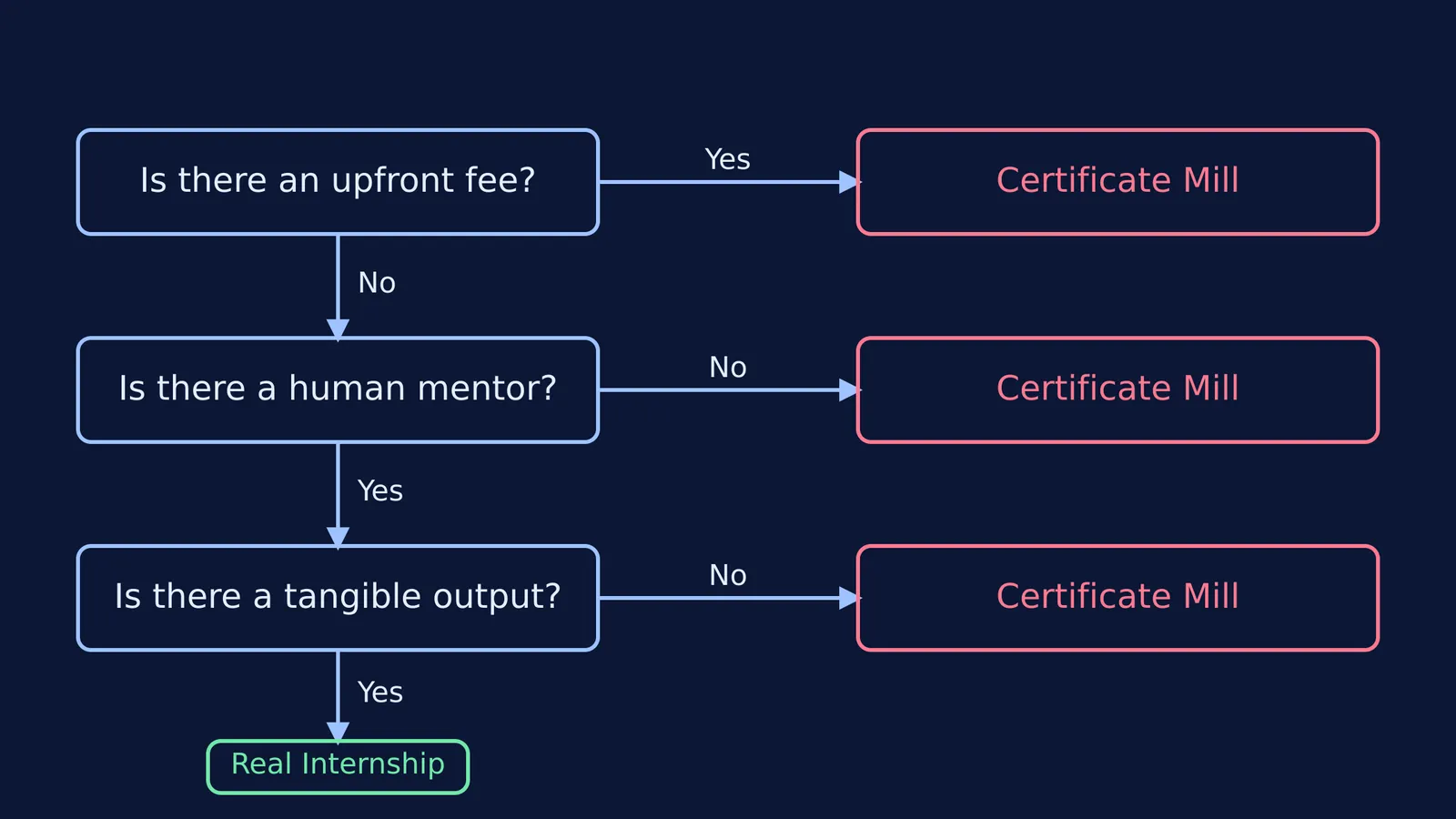
If an online internship program lacks human interaction or relies entirely on automated grading, it carries almost no weight with hiring managers. Look out for these three red flags before you commit your time or money:
Upfront fees: Legitimate companies pay their interns, or at the very least, offer their structured training programmes for free. If you are asked to pay a "registration fee", an "administrative cost" or a "training fee" to guarantee a spot, it is almost certainly a certificate mill profiting off students rather than a real company recruiting talent.
No human feedback: According to research published in the *International Journal of Multidisciplinary Research and Analysis* (2022), the learning outcomes and overall satisfaction of virtual internships are influenced by the virtual facilitator's supervisory style. A true internship involves active mentorship. If an automated system marks your work and there is no professional mentor to review your progress, answer questions or provide constructive criticism, you are not gaining professional experience.
Vague or absent output: A real internship results in a tangible product, such as a deployed piece of software, a comprehensive marketing report, or a finalised design file. A certificate mill provides only a certificate of completion without requiring you to build, write or analyse anything of substance.
If you are struggling with a concept during an online task and have no human mentor to ask, Fermi's AI tutor can step in. It works out what you already know and builds a plan for the session, teaching you through the block so you can return to the project with a clear next step.
What should you show for your virtual internship?
When you list a virtual internship on your resume, employers want to see evidence of the work rather than just the name of the programme. They are looking for signals that you have applied theoretical knowledge to a practical problem.
Link your portfolio: If you wrote code, link the GitHub repository directly on your resume. For a software engineering internship, proving you understand the analysis of algorithms through a well-documented, clean repository is far stronger than a generic completion badge. Give the recruiter something they can read and evaluate.
Describe the collaboration: Use bullet points to explain how you communicated with your remote team. Did you use issue trackers to log your progress, manage code merges, or present your findings on a video call? Highlight the teamwork skills and communication tools that coordinators explicitly look for.
Focus on the deliverable, not the badge: Recruiters are far more interested in the problem you solved than the certificate you received. If you were analysing data for a remote project, showing that you can spot real-world errors like survivorship bias carries more weight than a printed piece of paper from an unrecognised platform. Focus your resume bullets on the impact of your project and the tools you used to build it.
If you want to practice real problems that mirror industry tasks, you can explore the Fermi Problem Library. It features worked problems with a step-by-step solver that explains the reasoning rather than just printing an answer, helping you build the exact analytical skills that a high-value internship requires.