

On this page
Study leave is the stretch between the end of school classes and your first board paper, plus the gaps between papers on the datesheet. It feels long on day one and gone by day six, unless each day has a shape before it starts.
What should you actually do with study leave?
Use it to rehearse, not to learn chapters for the first time. What most students have not done enough of is pulling answers out of memory against the clock, which is what the exam asks.
In a 2006 experiment, students who took recall tests on a prose passage remembered more of it a week later than students who restudied it the same number of times, even though restudying made students more confident (Roediger and Karpicke, Psychological Science). A 2013 review of 10 common study techniques rated only two as high utility, practice testing and distributed practice, and rated rereading and highlighting low (Dunlosky and colleagues, 2013).
So the core of every study-leave day is one timed paper. CBSE posts sample papers with marking schemes on its Class 10 sample paper page and Class 12 sample paper page. Past board papers and your school's pre-boards work too.
What does a good study-leave day look like?
Keep the same skeleton every day:
Morning: one timed paper. Sit it at your real exam's start time, phone in another room. If a full paper still tires you out, build exam stamina for a three-hour paper first.
After lunch: mark it against the marking scheme. Be strict. Put every lost mark on a mistake list with one word for the cause: concept, method, careless or time.
Late afternoon: fix the list. Re-learn the idea behind each concept mistake, then redo the question without looking.
Evening: short recall. Close the book, write out the formulas and definitions from today's mistakes, then check.
Night: stop on time. The American Academy of Sleep Medicine recommends that teenagers aged 13 to 18 sleep 8 to 10 hours per 24 hours (Paruthi and colleagues, 2016).
If your mistake list keeps saying method, the Fermi Problem Library has worked problems with a step-by-step solver that explains the reasoning, so you can see where your approach went wrong. If it says concept, the Fermi Concept Library has a lesson for each concept in physics, chemistry, biology and mathematics.
How do you plan study leave day by day?
Start from your datesheet, not your syllabus. Give weaker subjects more papers, and finish with the subject you sit first.
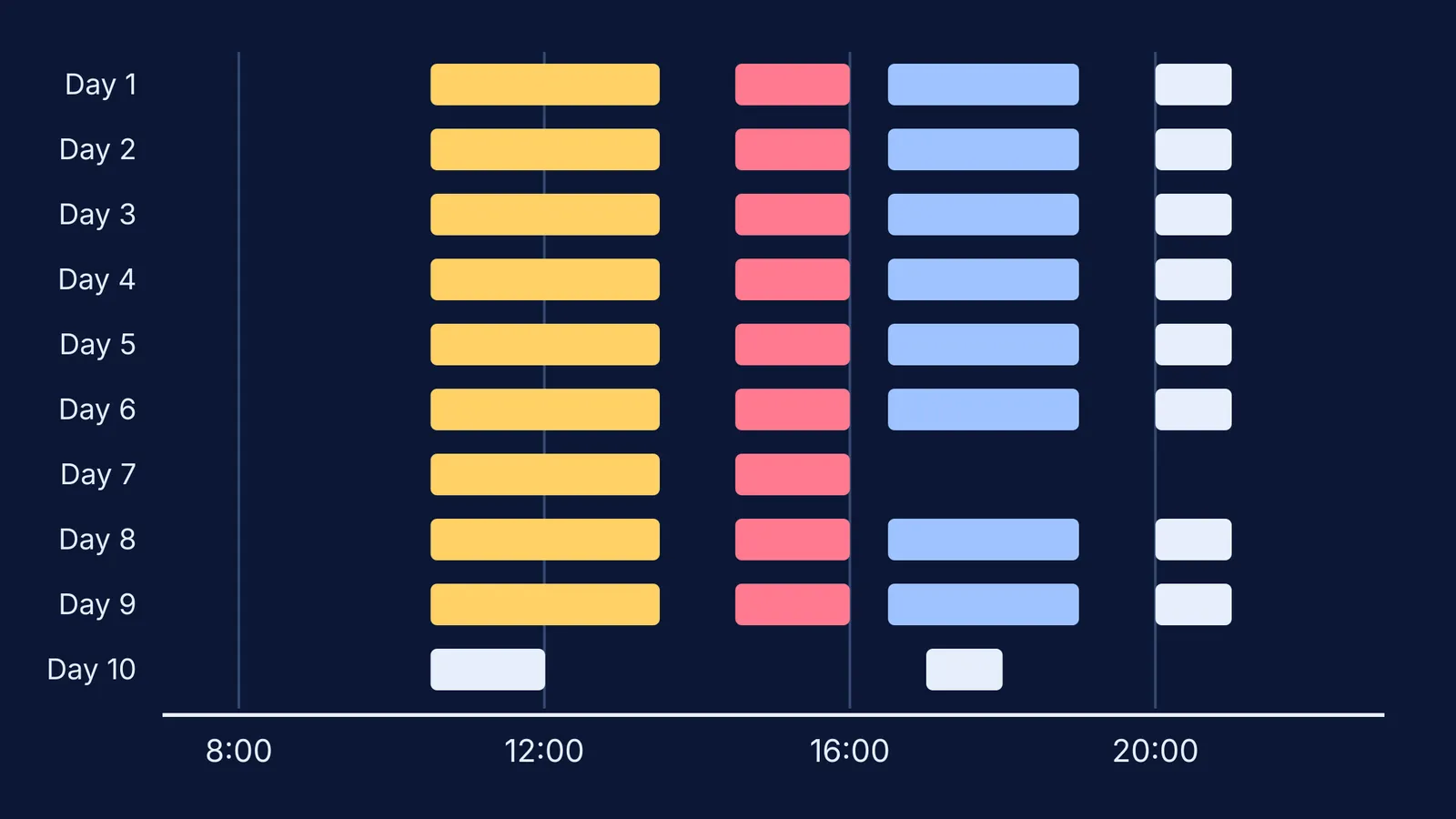
A worked example: you are in Class 12 with physics, chemistry and maths, you have 10 days before Physics, your first paper, and chemistry feels weakest.
Days 1 to 3: one paper each in Physics, Chemistry and Maths, to see where you stand.
Days 4 to 6: two Chemistry papers and one Maths paper, because those mistake lists were longest.
Day 7: a Physics paper in the morning and its marking, then the rest of the day off.
Days 8 and 9: Physics papers, fixing only Physics mistakes.
Day 10, the day before: no full paper. Recall formulas, derivations and diagrams from your mistake list, pack your kit and sleep early.
Coming back to each subject over several days is distributed practice, the other technique the 2013 review rated high. After Physics, run a shorter version in each gap. For a dress rehearsal, see how to simulate real exam conditions at home with a full mock.
How do you stop study leave from drifting?
Drift starts small: a late start, a quick phone check, a paper paused halfway. Decide in advance what you will do when it happens. Across 94 independent tests, if-then plans (if a set situation comes up, then I will do a set action) had a positive effect of medium-to-large size on reaching goals (d = 0.65), according to a meta-analysis by Gollwitzer and Sheeran, 2006.
Copy these onto your plan:
If it is paper time, then my phone goes to another room before I sit down.
If I wake up late, then I still sit the paper and drop the evening recall instead.
If I am stuck on a question, then I mark it and come back at the end.
If an errand or random thought pops up, then I write it on a parking-lot sheet and keep going.
If I lose a whole day, then tomorrow runs the normal plan. I do not try to do two days in one.
Parents can help by keeping the paper slot quiet and asking what was on today's mistake list, not how many hours were studied.
If you cannot sleep, eat or stop worrying for several days, tell a parent or teacher. You can also call Tele MANAS, the free 24x7 national mental-health helpline launched by the Ministry of Health and Family Welfare, on 14416 or 1800-891-4416 (Tele MANAS details, IIT Kanpur counselling service).


