

On this page
A three-hour paper is a long time to think hard. Most students practise in short bursts, then find the last hour of the real exam feels like someone else's brain. Stamina can be trained like running distance: lengthen the sitting each week, plan what you do in the dips, and rehearse the final stretch. Check your admit card or official bulletin for exact timings, since these change.
Why does focus fade during a long exam?
Effort drops as a test goes on, and researchers can measure it. In an analysis of 467,819 students from 65 countries who took the 2009 PISA reading test, examinee effort decreased with item position consistently across countries (Debeer and colleagues, Journal of Educational and Behavioral Statistics, 2014). The authors call this change in effort across a test "persistence", and it differed between students and between schools. PISA carries no marks for students, so the drop may differ when marks count.
Fatigue also builds across a day. Using test data from all children in Danish public schools between 2009/10 and 2012/13, one study found that scores fell by 0.9% of a standard deviation for every hour later in the day the test was taken, and that a 20- to 30-minute break improved average scores (Sievertsen, Gino and Piovesan, PNAS, 2016).
How do you build exam stamina week by week?
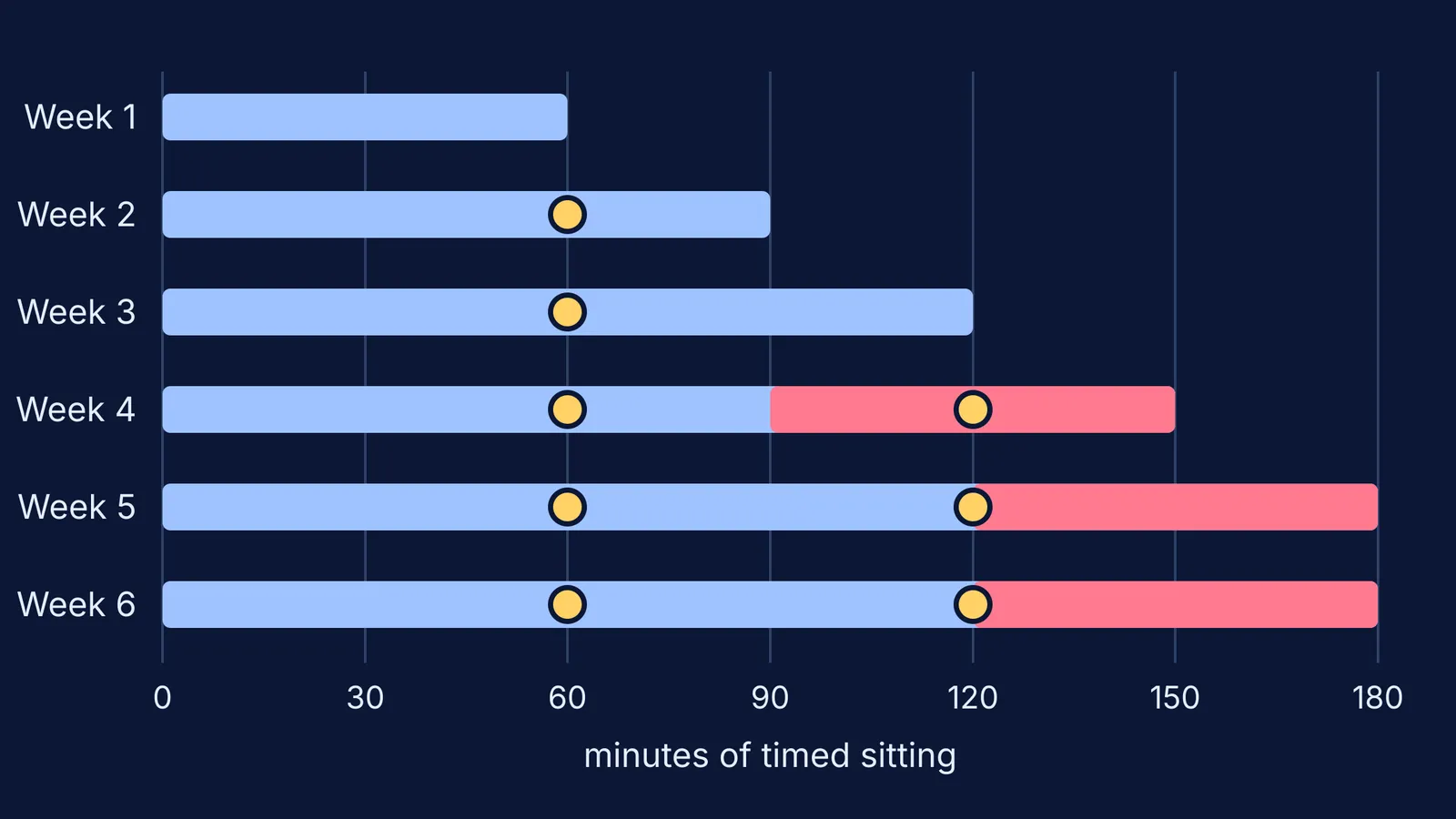
Pick two fixed slots a week at the same time of day as your real exam. Use full mixed papers, not chapter sets. Then grow the sitting:
Week 1: 60 minutes, timed, no phone, no breaks.
Week 2: 90 minutes, with one planned reset at the 60-minute mark.
Week 3: 120 minutes, reset at 60.
Week 4: 150 minutes, resets at 60 and 120. Treat the final 60 minutes as a last-hour drill (below).
Week 5: a full 180-minute paper with both resets and a last-hour drill.
Week 6: a second full paper like week 5, with your exam-morning routine and real start time.
Only move up a step if your accuracy held in the final half hour. If it collapsed, repeat the week.
What should you do in a mid-paper reset?
A reset is a planned pause of under a minute, not a break. You cannot leave the hall, so it has to work at your desk. A 2022 meta-analysis of 22 study samples found that micro-breaks of up to 10 minutes gave small boosts to vigour and reduced fatigue, but did not significantly improve overall performance (Albulescu and colleagues, PLOS ONE, 2022). Those studies tested breaks between work tasks, not exams. So a reset may help you feel fresher, but its real job is to stop drift and re-plan.
A 45-second reset script for the 60- and 120-minute marks:
Pen down. Sit back. Three slow breaths, longer out than in.
Roll your shoulders and unclench your writing hand.
Look at the clock and tell yourself: "This many minutes left, this many questions left. Next I do..."
Name one skipped question you will come back to.
Pen up, and read the next question from the top.
Use it in every practice sitting so it is automatic in the hall.
How do you practise the last hour of an exam?
The last hour is where marks leak: misread signs, dropped units, rushed easy questions. Practise it as its own skill, while tired.
Worked example: your week 4 sitting starts at 9:00. From 9:00 to 10:30 you work normally. At 10:30 the last-hour drill begins: a fresh set of medium questions from the subject you usually leave until last, then a 10-minute checking pass. Afterwards, label every error from that hour "didn't know", "misread" or "careless". If careless errors dominate, you have a stamina problem, not a syllabus problem.
Pair the drill with a fixed order for tackling the paper, like our two-pass time management plan for JEE and NEET, and a routine for checking your answers in the last 10 minutes.
When a last-hour error turns out to be a method you never fully understood, rework it slowly in the Fermi Problem Library, whose step-by-step solver explains the reasoning rather than printing an answer, so you can see where your approach broke.
How can parents help build exam stamina?
Protect the two weekly slots: a quiet room, no errands mid-paper, phones away for everyone nearby. Afterwards, ask "how did the last hour feel?" before "what did you score?". Guard sleep in the final week, because sleep before an exam beats an all-nighter.
If long papers bring panic, sleeplessness or dread that does not ease, talk to a school counsellor or a doctor. Tele MANAS, the government's free 24x7 mental-health helpline, is on 14416 or 1800-891-4416 (IIT Kanpur counselling cell).
Not sure which subject belongs in your last-hour drill? Fermi's AI tutor can work out what you already know and build a plan for the session, so you sit down to a clear next step. Start this week with one 60-minute timed sitting at your exam's start time.


