

On this page
If your family's income is modest and you are heading into engineering counselling, one option on the registration form deserves your attention: the Tuition Fee Waiver (TFW) seat. The rules sit in clause 6.42 of the AICTE Approval Process Handbook 2024-25 to 2026-27, which makes the scheme mandatory for every institution AICTE approves. It covers diploma, post-diploma and undergraduate programmes in engineering and technology, computer applications, planning, applied arts and crafts, and design and management, including lateral entry.
Who qualifies for a tuition fee waiver seat?
Under the AICTE handbook, you are eligible if your parents' annual income from all sources does not exceed Rs 8 lakh. Admission is then on merit: the state admission authority invites TFW applications, makes a separate merit list for the category and admits students from it.
The waiver covers the tuition fee only, as fixed by the State Level Fee Committee for self-financing colleges or by the government for government and aided colleges. Every other fee is paid by the student.
States add their own conditions. Maharashtra's CET Cell information brochure for 2026-27 limits TFW seats to candidates with Maharashtra State Candidature and words the income test as "less than Rs. 8 Lakh". If your income is near the line, check your own state's exact wording.
TFW is not the EWS quota, which is claimed with a separate EWS certificate. Our guide to EWS certificate income and asset criteria explains that paperwork.
How are TFW seats allotted in counselling?
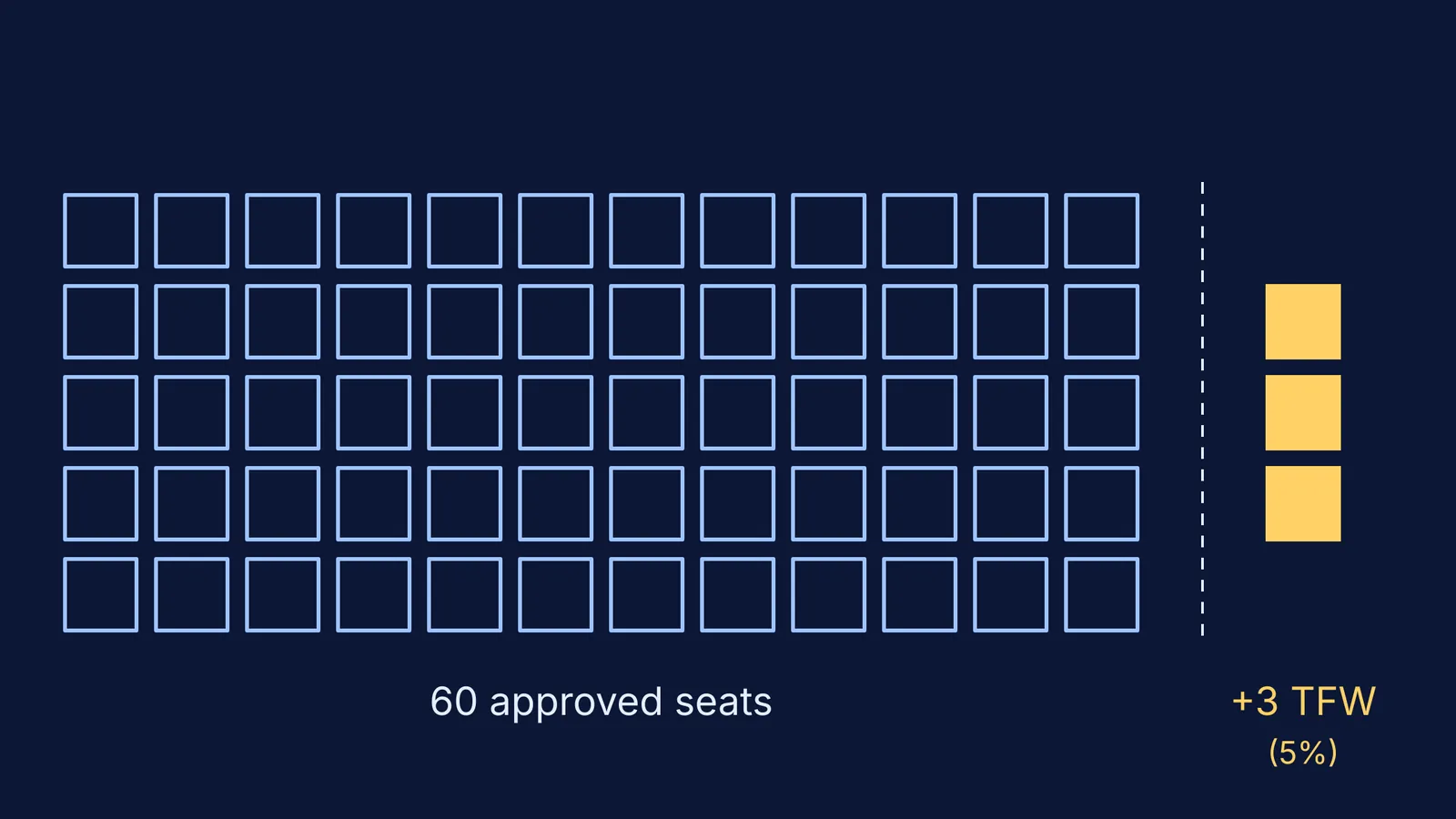
TFW seats are supernumerary, which means they are added over and above a course's approved intake; the AICTE handbook defines approved intake as excluding supernumerary seats. Each course can have TFW seats up to 5% of its approved intake. Those seats exist only in courses where at least 50% of the approved intake was filled in the last academic year.
Three more rules matter when you fill choices:
The state government or its designated authority runs TFW admissions, so you apply through state counselling, not to the college.
If no eligible TFW student takes a seat, it is not given to any other category.
Each TFW student gets a letter from the admission authority and cannot change institution or course under any circumstances.
How many TFW seats will a branch have?
Take an example branch with an approved intake of 60. Under the 5% rule in clause 6.42, it can have up to 3 TFW seats, so the class can grow to 63. If only 25 of its 60 seats were filled last year, below the 50% mark of 30, the branch offers no TFW seats this year. With a handful of seats per branch, keep several colleges with TFW seats on your list, and pick only courses you would be happy to finish, because you cannot move later.
Which income documents do you need for TFW, and when?
Maharashtra's 2026-27 brochure asks TFW candidates for an income certificate stating that the parents' annual income is less than Rs 8 lakh from all sources, issued by the appropriate competent authority of the state. You upload scans with the application form and carry the originals for verification.
Timing matters. The same brochure says that if you are allotted a seat on a claim and cannot produce the supporting document, the allotment is cancelled automatically, and TFW status can be removed at document scrutiny.
A plan to start before results:
Open your state's counselling brochure and note which authority issues the income certificate and which financial year it must cover.
Add up income from all sources for both parents, for example salary, business, farming, rent and pension.
Apply for the certificate before registration opens, so a delay at the office does not cost you the seat.
Check that your name and your parents' names are spelt the same on the certificate, mark sheets and ID.
Tick the TFW option at registration and include TFW courses when you fill choices.
Our scholarship documents checklist covers the other papers worth keeping in the same folder.
What should you ask the counselling helpline?
A short, specific question gets a useful answer. Try: "My parents' total income from all sources is close to Rs 8 lakh. Which office issues the TFW income certificate here, and which financial year should it cover?" Note the answer and the date. The Rs 8 lakh figure comes from the AICTE handbook; your state decides the paperwork.
A TFW seat does not cover hostel, exam or other fees. Our guide to fee reimbursement versus scholarships explains the schemes that can help with the rest.
TFW seats are filled on merit, so your entrance exam result decides your chances. If you are still preparing and unsure where to start revising, Fermi's AI tutor can work out what you already know and build a plan for the session, so you sit down to a clear next step.
Start on the income certificate now, so your paperwork is ready before a TFW allotment depends on it.


