

On this page
Securing funding for your education takes more than just good grades. Whether you are applying through the National Scholarship Portal (NSP) or a state-specific scheme, the process comes down to how well your paperwork lines up.
A single spelling mistake between your Aadhaar card and your school records can halt a Direct Benefit Transfer (DBT). Here is exactly what you need to gather, and how to avoid the common errors that lead to rejection.
What documents are needed for scholarship application in India?
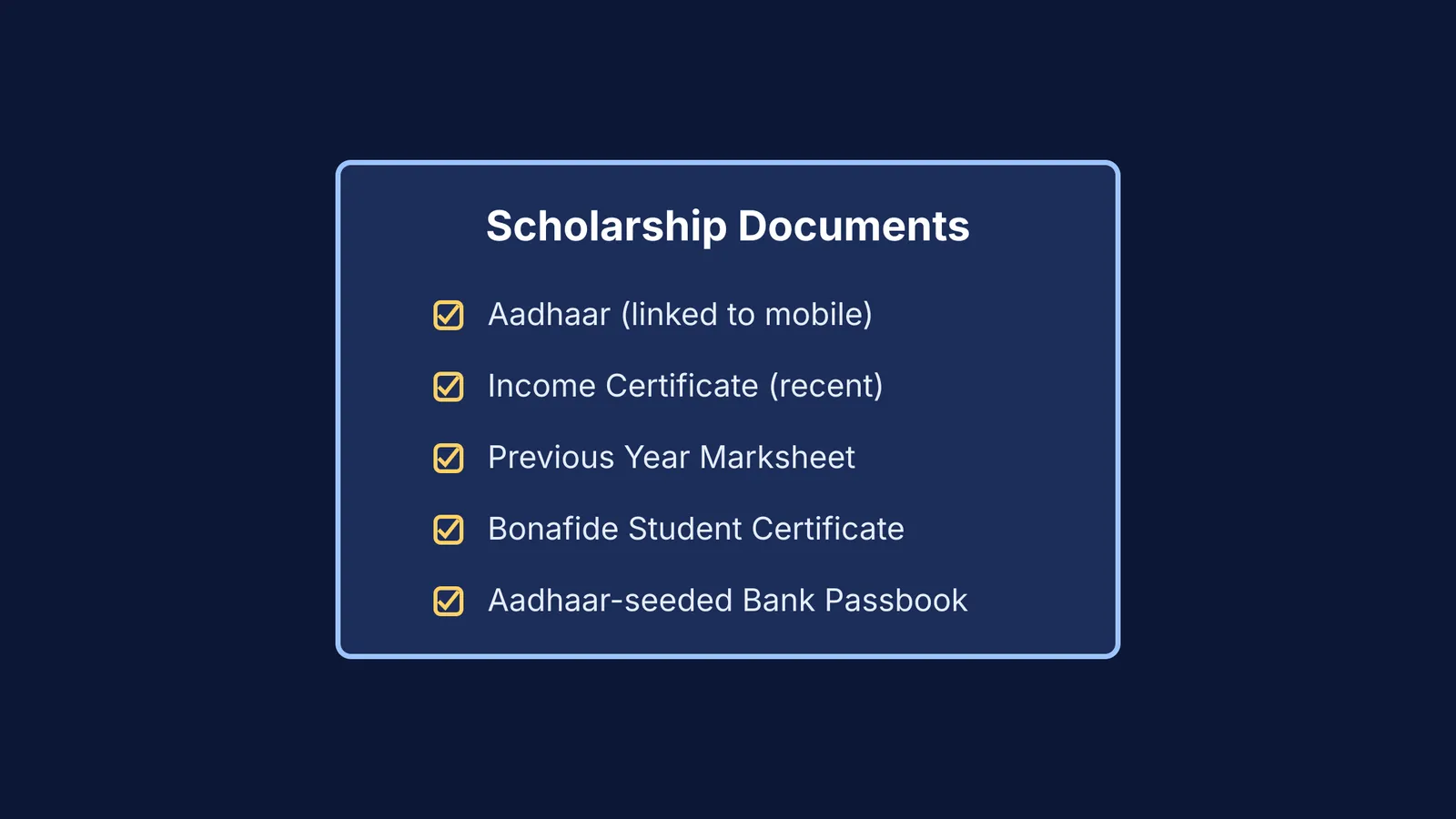
While specific schemes have unique requirements, every government scholarship application relies on the same core set of proofs. You should prepare scanned copies of these documents before you start your application.
Aadhaar Card: Your Aadhaar must be linked to an active mobile number. The NSP now uses Aadhaar for face authentication and One Time Registration (OTR).
Income Certificate: This must be a recent certificate issued by a competent revenue authority, such as a Tehsildar or Sub-Divisional Magistrate (SDM). An employer's Form 16 or a simple affidavit is not accepted.
Previous Year Marksheet: A clear scan of the marksheet from your last qualifying examination (Class 10, Class 12, or your previous college semester).
Bonafide Student Certificate: A document issued by your current school or college. It confirms your active enrollment, roll number, and the course you are studying.
Bank Passbook: The front page showing your name, account number, and the bank's IFSC code.
Caste or Category Certificate: Required if you are applying under SC, ST, OBC, EBC, or minority schemes.
Why do applications get rejected on the National Scholarship Portal?
The government has tightened its verification processes significantly to prevent fraud. In a 2023 investigation, the Ministry of Minority Affairs found that 830 out of 1,572 evaluated minority institutions were fake or non-operational. Because of this scale of leakage, the portal's automated checks are now unforgiving.
Most rejections are not because a student is ineligible, but because their data does not match perfectly across systems.
The most common reason for payment failure is a bank account that is not Aadhaar-seeded. Simply linking your Aadhaar to your bank account is not enough; you must explicitly submit a mandate to your bank branch to map your account with the National Payments Corporation of India (NPCI) for receiving DBT funds.
Another frequent trap is the name mismatch. If your name is spelled "Rahul Kumar" on your Class 10 marksheet but "Rahul Kumar Singh" on your Aadhaar, the system will flag the application as defective.
How can you keep your scholarship documents updated?
The best way to handle applications is to maintain a dedicated physical and digital scholarship folder. Before the application window opens each year, run through this checklist:
Verify your Aadhaar details: Compare your Aadhaar card to your school records. If there is a mismatch in your name, date of birth, or father's name, update your Aadhaar at an enrollment centre immediately. It can take weeks for the changes to reflect.
Check your bank account limits: Ensure your account is active and does not have a minor's deposit limit that the scholarship amount might exceed.
Renew your income certificate: Income certificates are often valid for only one financial year. Apply for a fresh one from the revenue office well before the scholarship deadline.
Gather fee receipts: Keep the official receipt for the current academic year showing the tuition and admission fees you have paid.
What to do if your application is marked defective?
If the portal flags your application as defective, do not panic. A defective status means the verifying officer (at the school, district, or state level) has found a minor error, such as a blurred upload or a missing signature on the bonafide certificate.
You will receive an SMS alert, and the application will be pushed back to your dashboard. You typically have a short window to re-upload the correct document and submit the form again. However, if an application is marked "Rejected," it is permanently disqualified for the current academic year, and you cannot revive it. Checking your portal dashboard weekly after submission is the only way to ensure you do not miss a defect notice.
How do you maintain the scholarship alongside your studies?
Getting the paperwork right secures your funding for the year, but renewing it requires you to maintain a minimum attendance record and academic percentage.
A scholarship covers the fees, leaving you to focus on the learning. Whether you rely on coaching, online classes or self-study, falling behind can put your renewal at risk. It helps to build a study routine that lasts longer than a week so you can keep up with the syllabus steadily.
If you find yourself stuck on a difficult topic and your grades are slipping, Fermi's AI tutor can work out what you already know and build a plan for the session. If you keep making wrong-method mistakes in your physics or chemistry assignments, the Fermi Problem Library has worked problems with a step-by-step solver that explains the reasoning rather than printing an answer, helping you fix the gaps before your exams.


