

On this page
The Government of India provides a 10% reservation for the Economically Weaker Section (EWS) in central educational institutions, which includes IITs, NITs and medical colleges (Wikipedia). If you are applying for JEE Main, JEE Advanced or NEET-UG under the GEN-EWS category, you must prove your eligibility during counselling.
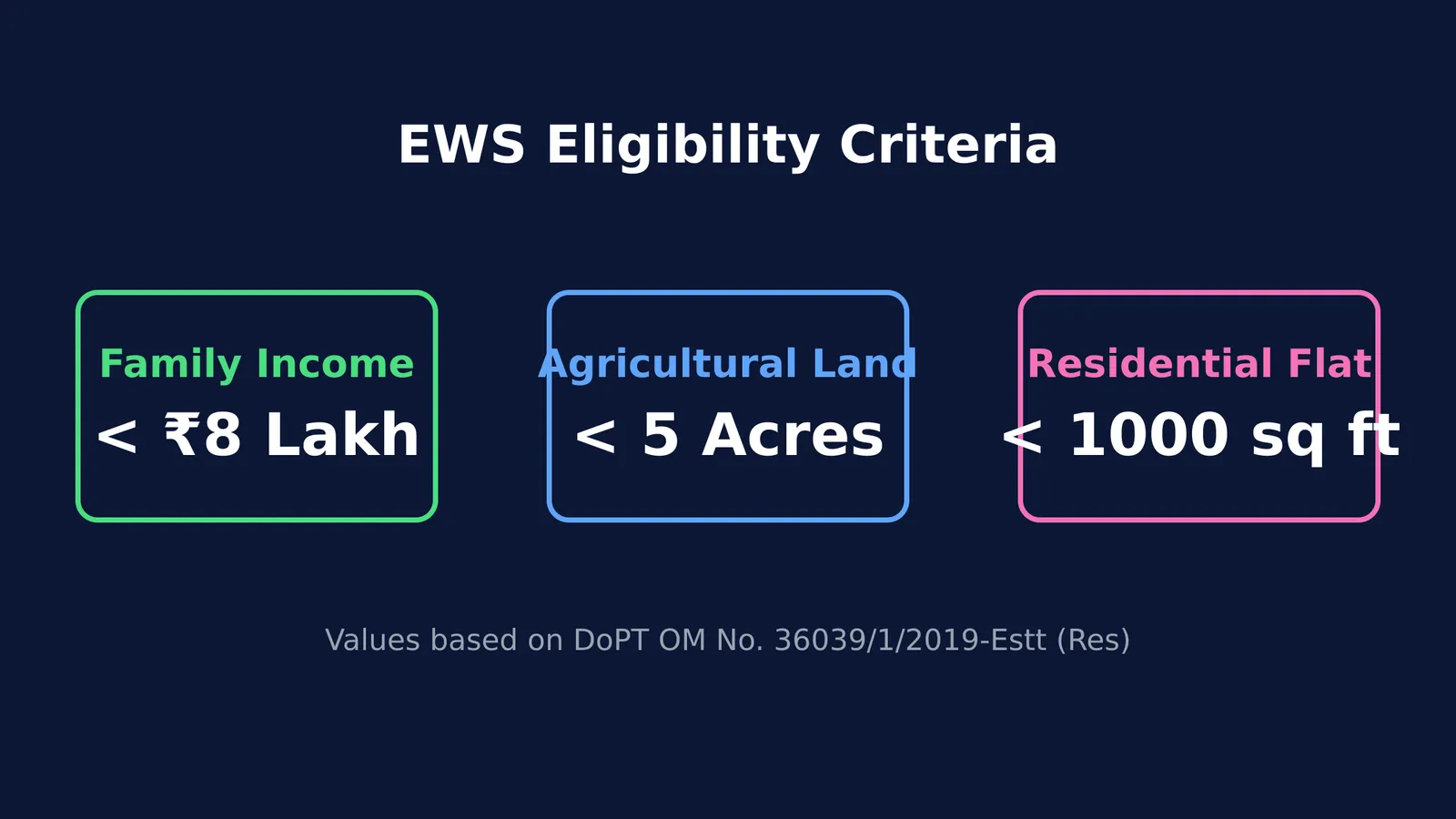
According to the Department of Personnel and Training (DoPT) Office Memorandum No. 36039/1/2019-Estt (Res) dated 31 January 2019 (Wikipedia), you qualify if your family's gross annual income is below ₹8 lakh and you do not own certain assets.
What counts as family income for EWS?
The income limit is strictly below ₹8 lakh for the financial year before the year of your application (Wikipedia). For exams held in 2024 (and counselling in the 2024-25 academic year), the income assessed is for the 2023-24 financial year. This ₹8 lakh limit includes income from all sources: salary, agriculture, business and profession.
Your "family" for this certificate includes you, your parents, siblings below the age of 18, as well as your spouse and children below the age of 18. The income of all these members is added together to calculate the gross family income.
Which assets disqualify you from the EWS category?
The DoPT OM dated 31 January 2019 (Wikipedia) states that even if your family income is below ₹8 lakh, owning certain assets will exclude you from the EWS category. You are not eligible if your family owns or possesses any of the following:
5 acres of agricultural land and above.
A residential flat of 1000 square feet and above.
A residential plot of 100 square yards and above in notified municipalities.
A residential plot of 200 square yards and above in areas other than notified municipalities.
If your family holds property in different locations, all parcels are clubbed together to check if you cross these limits.
When should your EWS certificate be issued?
The timing of your certificate is crucial. EWS certificates are valid for only one financial year. For JEE Advanced and NEET-UG 2024 counselling, the certificate must have been issued on or after 1 April 2024 (JEE Advanced Information Brochure).
During the initial registration for JEE Main or NEET, you might not have the new certificate ready. In such cases, the National Testing Agency (NTA) usually allows you to upload a "Declaration in Lieu of GEN-EWS Certificate". This buys you time to take the test and prepare for the NEET-UG paper pattern or JEE, but you must produce the actual certificate during the JoSAA or MCC counselling.
If you are stuck on a difficult topic while waiting for forms, Fermi's AI tutor can build a plan for the session and teach through it.
Who issues the EWS certificate?
The certificate must be in the exact format prescribed by the Government of India, often found in the information brochures of the exams. It must be issued by a competent authority. According to the DoPT guidelines, the officer must not be below the rank of Tehsildar (Wikipedia). Authorized officers include:
District Magistrate, Additional District Magistrate, Collector, or Deputy Commissioner.
Chief Presidency Magistrate or Additional Chief Presidency Magistrate.
Revenue Officer not below the rank of Tehsildar.
Sub-Divisional Officer of the area where you normally reside.
A checklist for getting your certificate
To avoid running around the Tehsildar's office just before counselling begins, gather your documents early. You will typically need:
Proof of identity (Aadhaar card or PAN card).
Proof of residence (domicile certificate or electricity bill).
Income proof (Income Tax Returns, Form 16, or salary slips of your parents).
Property documents or an affidavit declaring you do not exceed the asset limits.
A recent passport-size photograph.
Getting the paperwork right is as much a part of your JEE Advanced eligibility as meeting the academic cut-offs. While ties are decided by JEE Main percentiles, your category rank depends entirely on presenting a valid EWS certificate on the day of counselling. If you fail to produce it, your seat allocation will automatically convert to the General (unreserved) category.
What are the common mistakes to avoid?
Many candidates face issues during document verification because of simple errors. Ensure you check for the following:
Financial year mismatch: The certificate must explicitly state the financial year for which the income is assessed (e.g., 2023-24 for the 2024 exam) and the year for which it is valid (2024-25).
Format variations: State governments sometimes issue EWS certificates for state-level counselling in their local language or a different format. For central counselling like JoSAA (for IITs and NITs) and MCC (for All India Quota medical seats), the certificate must be in the central format (Annexure-V or Form-GEN-EWS) and ideally in English or Hindi.
Missing photographs or seals: The certificate is invalid if it lacks your passport-size photograph attested by the issuing officer, or if the official seal is missing.
Holding a valid EWS certificate gives you access to a dedicated seat pool across central government colleges. Getting your documents ready early means one less thing to worry about. Focus on your revision, ensure you understand the core concepts clearly, and keep your paperwork organized well before the counselling dates are announced. If you struggle with the syllabus while handling these applications, the Fermi Problem Library has worked problems with a step-by-step solver that explains the reasoning rather than printing an answer.


