

On this page
Navigating financial aid in India can feel like learning a new language, especially when schemes use terms interchangeably. Whether you are filling out forms on the National Scholarship Portal (NSP) or applying for a state-specific scheme, knowing what each term means ensures you secure the right funding.
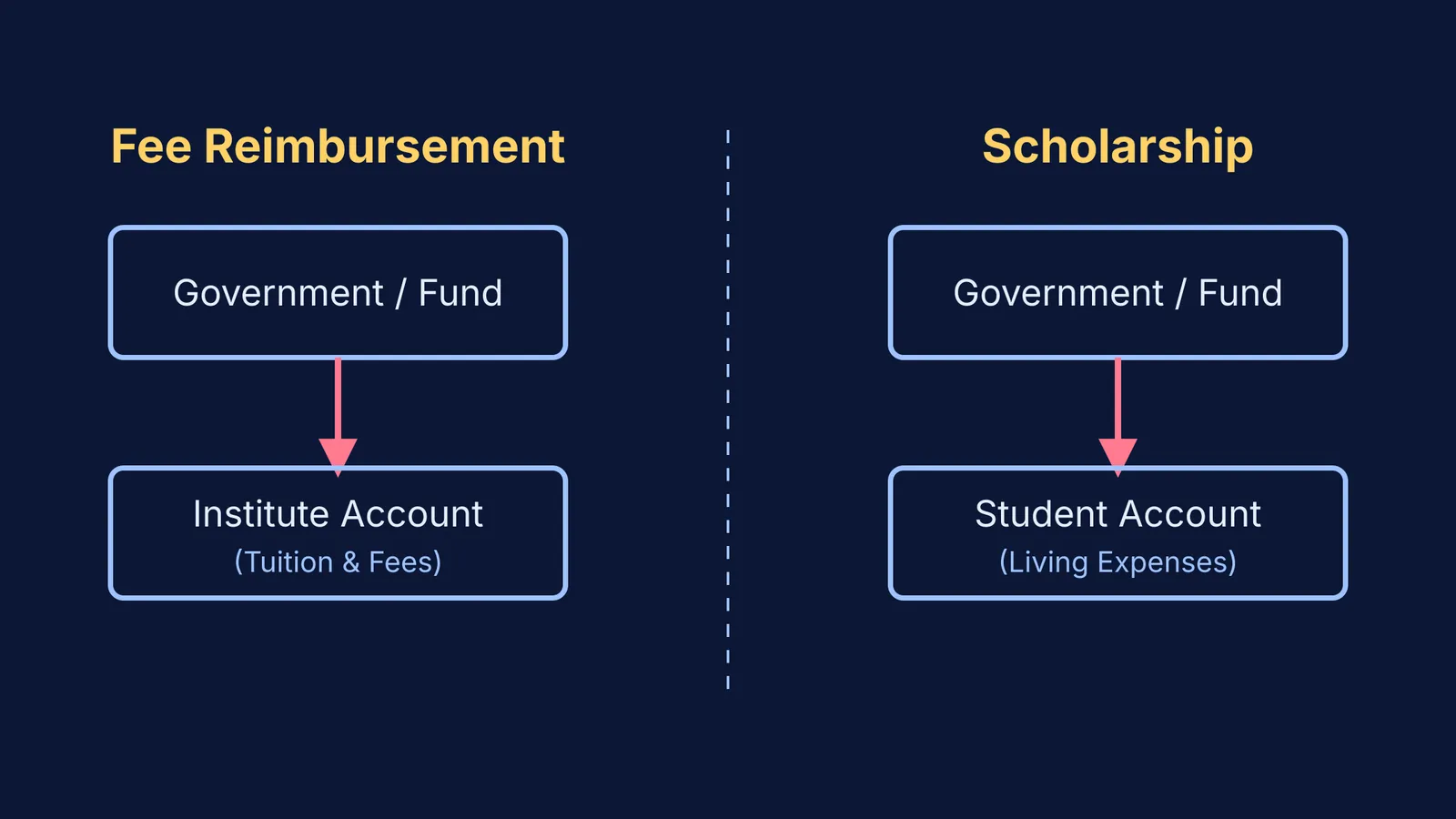
While both ease the financial burden of higher education, they serve different purposes. A fee reimbursement repays the exact amount charged by your college for tuition, whereas a scholarship provides a fixed grant to support your overall living expenses.
What is the difference between fee reimbursement and scholarship?
Under the Ministry of Social Justice and Empowerment (MoSJE) guidelines for the Post Matric Scholarship, financial aid is divided into two distinct components.
Fee reimbursement (often called Component II) is the repayment of the actual costs charged by your educational institution. This includes tuition fees, admission fees, and other compulsory, non-refundable charges like library and laboratory fees. The amount varies entirely based on what your college charges, though the government may place a ceiling on the maximum amount.
A scholarship (Component I, or the Academic Allowance) is financial assistance provided directly to the student for personal and living expenses. This is typically a fixed monthly or annual stipend intended to cover costs outside of the classroom, such as hostel fees, meals, books, and stationery.
How do fee reimbursement and scholarship appear in your bank statement?
Because the two components serve different purposes, they are disbursed differently. According to recent NSP guidelines, the government pays the scholarship component directly into your Aadhaar-seeded bank account using the Direct Benefit Transfer (DBT) system.
Fee reimbursement is typically released to the institute's account first via the Public Financial Management System (PFMS). If you have already paid your tuition fees to secure admission, your college is expected to refund this amount to you once the government funds arrive. Some state schemes, however, process both payments directly to the student or their family. For example, Andhra Pradesh's Jagananna Vidya Deevena fee reimbursement scheme credits the tuition fee directly into a joint bank account of the student and their mother.
When checking your bank statement, you can often identify the type of aid by the payment narration. A scholarship or maintenance allowance frequently appears as PFMS/DBT/SCHOLARSHIP, while a tuition refund might show up as PFMS/DBT/FEE REIMB.
Can you get both at the same time?
Yes, many comprehensive schemes provide both at once. The Post Matric Scholarship for SC students, for instance, includes both compulsory non-refundable fees (the reimbursement) and an academic allowance (the scholarship).
While recent NSP guidelines allow students to combine one merit-based scheme with welfare-based schemes, a strict "no double-dipping" rule still applies to core costs. You cannot receive two different government grants for the exact same expense. If you receive a full state fee reimbursement, you are ineligible for a central scholarship that covers the same tuition component.
How can you track your financial aid status?
If you see a "PFMS Credit" in your bank statement but are unsure what it covers, you can check the exact breakdown online.
Go to the official PFMS portal at pfms.nic.in.
Click on the "Know Your Payments" link.
Enter your bank name and account number.
The portal will display the scheme name and the purpose of the payment, explicitly listing whether the amount is for "Maintenance Allowance" or "Tuition Fee".
Organising your financial aid can take time, particularly during your first semester at college. Worrying about funding can add to the pressure you face during exams, and recognising when to get help for exam stress is crucial for both students and their parents. While you track your applications and follow up with your college's accounts department, keeping your studies on track is just as important. If you find yourself missing lectures or falling behind while handling paperwork, Fermi's AI tutor can help you catch up by working out what you already know and building a plan for the session, so you sit down to a clear next step.


