

On this page
How many times you revise matters less than what you do each time. Here is a three-pass system, with a worked 90-day plan at the end.
How many times should you revise the syllabus before exams?
Three spaced passes is a good target, as long as each one tests you instead of showing you the page again.
The plan draws on research on successive relearning: you recall material until you get it right, then come back to it in later sessions. In a 2011 paper, Rawson and Dunlosky ran three experiments in which 533 students practised concepts, then tested them one to four months later. Relearning sessions had large effects on long-term retention for relatively little extra practice. The researchers recommend recalling a concept correctly three times at first, then relearning it three times at widely spaced intervals. The three-pass plan applies that idea to a whole syllabus; the study did not test it.
Rereading feels like revision, but it works poorly. In a 2006 experiment by Roediger and Karpicke, restudying did better on a test 5 minutes later, but students who took recall tests remembered more after 2 days and after 1 week. A 2013 review of ten study techniques rated practice testing and spaced practice as high utility, and rereading and highlighting as low utility.
What should you do on the first pass?
Goal: understand every chapter well enough to explain it, and find your gaps.
Close the book and write down what you remember from a chapter. Then open it and mark what you missed. The blurting method walks you through this.
Solve the NCERT examples and a handful of standard problems from each topic.
Keep one running error list: every concept you could not explain and every problem you got wrong.
Skip: making beautiful notes, highlighting, and the hardest problems in the book.
If a chapter still will not make sense, the Fermi Concept Library has a lesson for each concept and shows its place in the map, so you can see what it depends on.
What changes on the second pass?
Goal: fix what pass 1 exposed, and practise mixed questions.
Start each chapter with a five-minute recall from memory. Only reopen the parts you could not recall.
Work through your error list first. Then do mixed problem sets that switch between topics instead of finishing one topic at a time.
Skip: full sessions on chapters where your recall was complete and your problems were right. Give those ten minutes of recall, not an hour.
When the answer key does not say why a numerical went wrong, the Fermi Problem Library has worked problems with a step-by-step solver that explains the reasoning, so you can find the step where your method went wrong.
What is the third pass for?
Goal: perform under exam conditions.
Sit full, timed papers. For CBSE, the board publishes sample question papers and marking schemes. Mark your paper against the marking scheme, not just the final answer.
After each paper, add any new mistakes to your error list and fix them the next day.
Run one last quick recall of formulas, reactions and diagrams.
Skip: new books, new topics and anything you have never seen before. The four-signal readiness checklist helps you decide when you have done enough.
How long should each pass take?
Each pass should be shorter than the one before. Pass 1 covers everything, pass 2 covers what went wrong, and pass 3 is mostly papers.
How far apart should the passes be? Cepeda and colleagues taught facts to more than 1,350 people, gave them a review after a gap, and found the best gap depends on how far away the final test is. For a test a week away, the best gap was about 20 to 40% of that week. For a test a year away, it was about 5 to 10% of the year, roughly 18 to 36 days. So when the exam is months away, space reviews of a chapter weeks apart, not days.
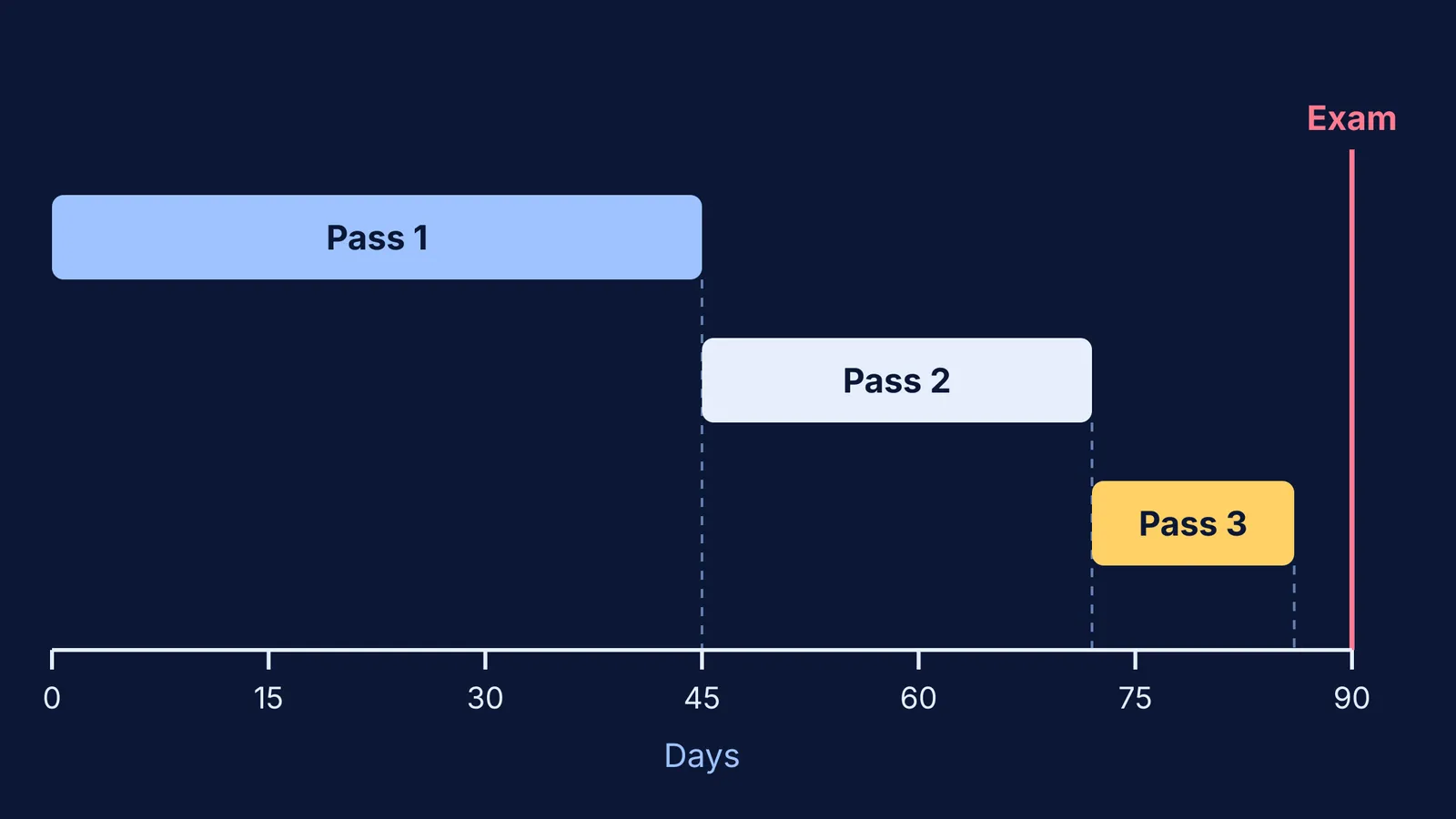
Here is a worked plan for 90 days, at about two to three hours of revision a day. The split is our suggestion, not a research figure.
Days 1-45, pass 1: about half your time. Every chapter gets one recall-and-problems session.
Days 46-72, pass 2: about 30%. Error list first, then mixed sets.
Days 73-86, pass 3: about 15%. A timed paper every other day, with the next day spent fixing its mistakes.
Days 87-90, buffer: light recall, rest and proper sleep.
Only 45 days left? Halve every block and keep all three passes. If you are still finishing new chapters, first read how to split time between revision and new topics.
If exam stress is affecting your sleep or eating, talk to a parent, teacher or school counsellor, or call Tele MANAS on 14416.
Tonight, write your three pass dates on the first page of your error list, and start pass 1 with the chapter you trust least.


