

On this page
Most study sessions end with one last glance over the page and the feeling that it went in. The last three minutes are the cheapest place to change that: stop reading and start writing from memory.
Why should you end a study session with recall instead of rereading?
Pulling information out of memory strengthens it more than looking at it again. Henry Roediger and Jeffrey Karpicke showed this testing effect with prose passages in a 2006 study in Psychological Science.
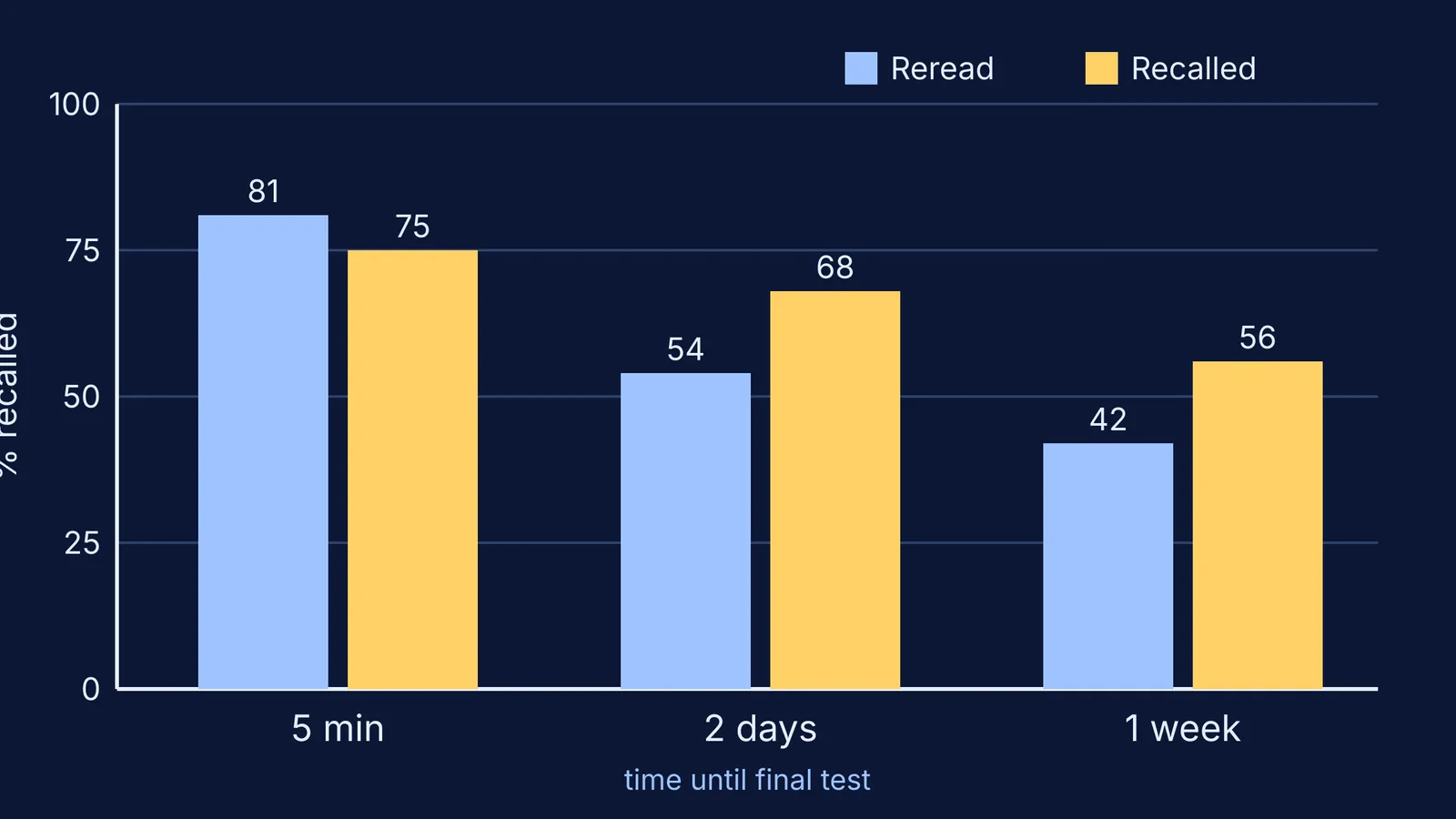
In their first experiment, students read a passage and then either read it again or wrote down everything they could remember, with no feedback. A week later, the students who had recalled remembered 56% of the passage; those who had reread remembered 42%.
The catch is that rereading wins in the short run: on a test 5 minutes later, the rereaders were ahead, 81% to 75%. In the second experiment, students who spent four study periods reading the passage predicted they would remember it best, and after a week they remembered the least. The feeling of "I know this" is not a reliable guide.
A review of ten study techniques by John Dunlosky and colleagues rated practice testing high utility and rereading, highlighting and summarising low. So the review below asks for points from memory, not a summary copied from your notes.
What goes into the three-minute review?
Close the book and the notes. Take a blank page or the back of your notebook and write three things.
Three key points (about 90 seconds). The three most important ideas from the session, in your own words, from memory. A formula counts only if you also write when it applies.
One doubt (about 45 seconds). The single thing you are least sure of. Write it as a question you could ask someone.
The next step (about 45 seconds). One specific action for the next session, with when and where.
Only then open your notes and check the three points. Anything you got wrong or left out goes on the doubt line.
What does a three-minute review look like in practice?
Here is one for a Class 11 student who has just spent 50 minutes on projectile motion.
Point 1: Horizontal and vertical motion are independent; horizontal velocity stays constant because gravity acts only vertically.
Point 2: Time of flight depends only on the vertical part: T = 2u sin θ / g, for launch and landing at the same height.
Point 3: Range R = u² sin 2θ / g is largest at 45°, and angles that add up to 90° give the same range.
Doubt: Why does the range formula fail when the ball is thrown from the top of a building?
Next step: Tomorrow, 7 pm, at my desk: solve two projectile problems with different launch and landing heights before reading any theory.
On checking, this student finds they first wrote sin θ instead of sin 2θ in point 3. That slip goes on the doubt line too; rereading would have hidden it.
Why write down a doubt and a next step?
The doubt turns a vague feeling of "some of this is shaky" into a question you can answer, and over a week the doubt lines become a list of your real gaps. Our post on keeping a structured doubt log shows how to sort and clear them.
In experiments by E. J. Masicampo and Roy Baumeister, unfinished goals kept intruding on people's thoughts, and making a specific plan for them removed that interference. Plans with a when and a where also help you start: a meta-analysis by Peter Gollwitzer and Paschal Sheeran of 94 independent tests found that these if-then plans had a medium-to-large effect (d = .65) on reaching goals. A written next step lets you put the book down and gives tomorrow a starting line.
If the doubt is a concept gap, the Fermi Concept Library has a lesson for each concept in physics, chemistry, biology, mathematics and computing. If it is a problem you could not crack, the Fermi Problem Library works problems step by step and explains the reasoning rather than printing an answer.
How do you make it a habit?
Use the last pages of each subject notebook, so the reviews stay together.
Set your study timer three minutes short, so the review is part of the session.
Start the next session with yesterday's doubt and next step, and try the three points again from memory.
Rest quietly for a few minutes before reaching for your phone. In one lab study, 10 minutes of quiet wakeful rest after a new story improved memory for it a week later, compared with playing a spot-the-difference game.
For a longer brain dump on weekends, try the blurting revision method, and use a five-minute recall before each class to open sessions the way this review closes them.
Tonight, set the timer three minutes short and write your first three points.


