On this page
You have paid two years of coaching fees, spent a year as a dropper, or chosen PCM and now dread physics. What keeps you going is often not "this is still right for me" but "I have already put so much in". Psychologists have measured that pull.
What is the sunk cost fallacy?
A sunk cost is money, effort or time that is already spent and cannot be recovered. In their 1985 paper The psychology of sunk cost90049-4), Hal Arkes and Catherine Blumer of Ohio University define the sunk cost effect as "a greater tendency to continue an endeavor once an investment in money, effort, or time has been made." What you spent is gone whether you continue or stop, so only the costs and benefits still ahead should decide what you do next.
Their first test asked college students to imagine holding a $100 ski-trip ticket and a $50 one for the same weekend, expecting to enjoy the $50 trip more, and able to use only one. In the Arkes and Blumer study90049-4), 33 students picked the $100 trip and 28 picked the one they would enjoy more: only 46% chose enjoyment over the sunk cost.
What did the theatre ticket experiment find?
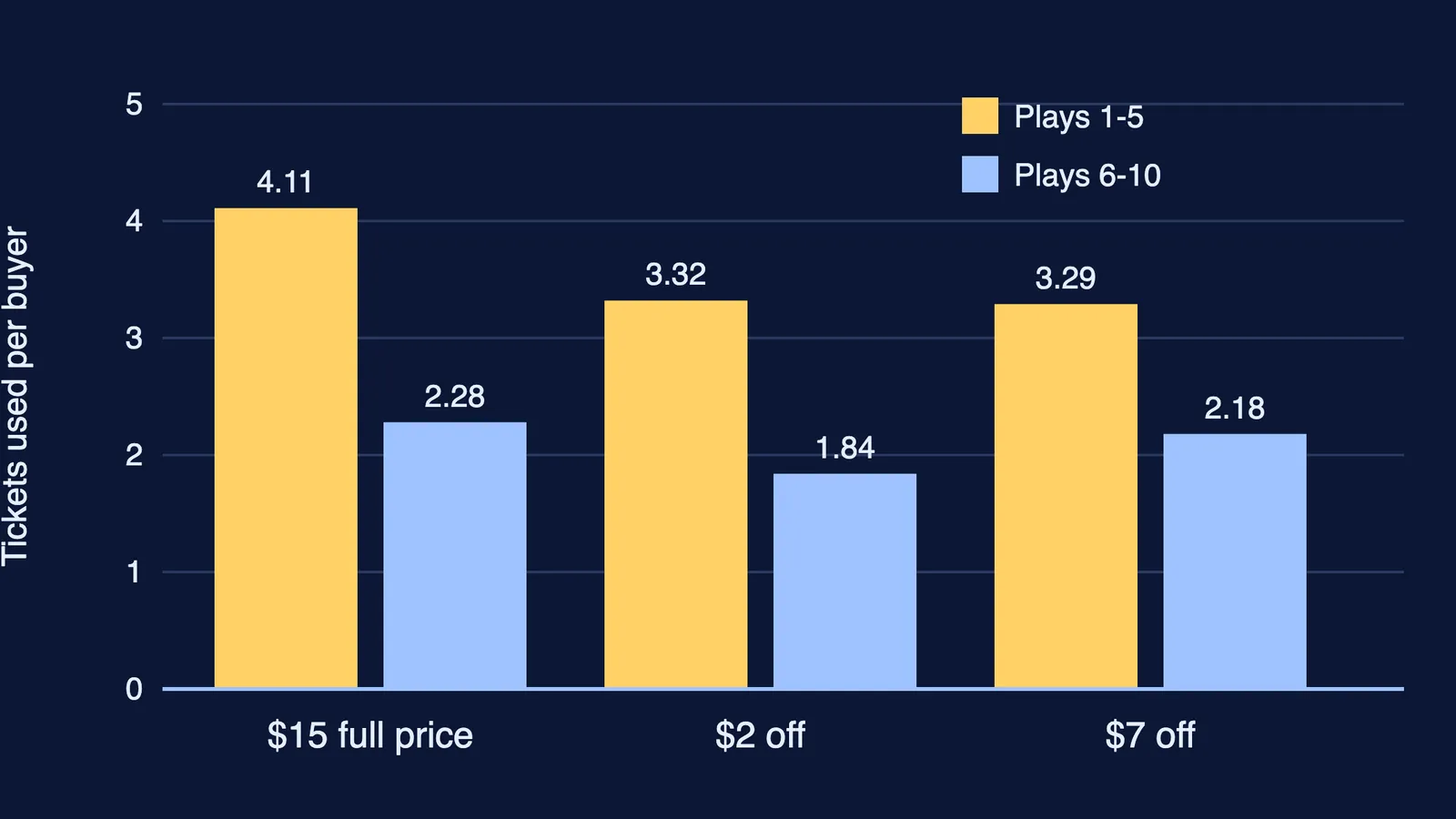
Questionnaires are not real money, so Arkes and Blumer also ran a field experiment at the Ohio University Theater's 1982-1983 season, described in the same 1985 paper90049-4). The first 60 people buying season tickets were sold one of three ticket types, in an order randomised beforehand: full price ($15), $2 off or $7 off. After dropping couples, 54 buyers remained, and colour-coded ticket stubs showed how many tickets each group used at each play.
In the first five plays, the full-price group used 4.11 tickets each on average, against 3.32 for the $2 group and 3.29 for the $7 group. The discounts were assigned at random, so the main difference between the groups was what they had paid. In the second half of the season the gap was no longer significant: the effect lasted about six months.
Why do people throw good money after bad?
Arkes and Blumer argued that the main driver is a wish not to appear wasteful, and found that having taken economics courses did not reduce the effect, according to their paper's abstract90049-4).
A second reason is self-justification. In Barry Staw's 1976 study90005-2), 240 business school students played the role of a corporate executive allocating research and development funds. Those who were personally responsible for an earlier choice that went badly committed the most new money to that same course of action. Staw called this escalating commitment. The FORRT replication atlas90005-2/) records two later replication attempts, one with mixed results and one that failed, so treat escalation as a real risk rather than a law. Once you have committed, confirmation bias also makes you notice evidence that you were right.
How does it show up in streams, coaching and drop years?
Streams: "A year of PCM would be wasted." The year is gone either way; ask which next two years suit you.
Coaching: "We paid the full fee, so attend every class." If a batch is not helping, self-study may be worth more.
Drop years: "I gave up a year, so I must drop again." A second year must be justified by what it can still add.
Seats: a family weighing a BDS seat against another drop year for MBBS faces the same trap.
Persistence is not the fallacy when the future still looks good. It is the fallacy when past spending does the arguing.
How do you decide without counting what is already spent?
Use the fresh-start test. Imagine you are starting today with no history: no fees paid, no year spent.
Write the choice as two options going forward, for example "stay in PCM" or "move to commerce with maths".
For each, list only future costs: fees still to pay, time still to spend.
List only future benefits: the subjects, exams and courses it keeps open.
Ask: if I had spent nothing so far, which would I choose?
Cross out every reason that starts with "we already".
Worked example: Riya, in Class 11, wants to stay in PCM because "we paid two years of coaching fees". In the fresh-start test the fee vanishes from both columns. What remains: she enjoys maths but has struggled with mechanics since the first test. So the real question is whether mechanics is a gap she can close. She can check the exact concepts she is stuck on in the Fermi Concept Library, which covers every concept in physics, chemistry, biology, mathematics and computing. If focused work closes the gap, staying is a choice about the future.
A script for parents: "The fees are paid, and that is fine. If you were choosing today, what would you pick, and why?" It tells your child the money will not be held against them. If they stay, Fermi's AI tutor can work out what they already know and build a plan for the session.
If the decision is weighing on you or someone at home, talk to a counsellor, or call Tele MANAS on 14416, the free national mental health helpline listed by the Directorate General of Health Services.