On this page
You followed every step in class. Then the paper comes back and the marks do not match what you know. The fix is not choosing between understanding and marks. It is treating exam-style practice as part of how you learn, not a separate job you start in February.
Why do students who understand a topic still lose marks?
Usually for one of two reasons. Either the idea is there but you cannot pull it out of memory under time pressure, or you can pull it out but do not write the points the examiner is looking for.
Board papers test exactly this. The CBSE Class 10 Science sample paper for 2026-27 asks how digestion is affected if the bile duct is narrowed, and gives an assertion that 1% of energy passes from one trophic level to the next. Neither can be answered by reciting a definition.
Does practising in exam format actually build understanding?
Yes, if you practise by recalling rather than rereading. The testing effect is the finding that taking a test on material improves how well you remember it later, not just measures what you know (Roediger and Karpicke, Psychological Science, 2006).
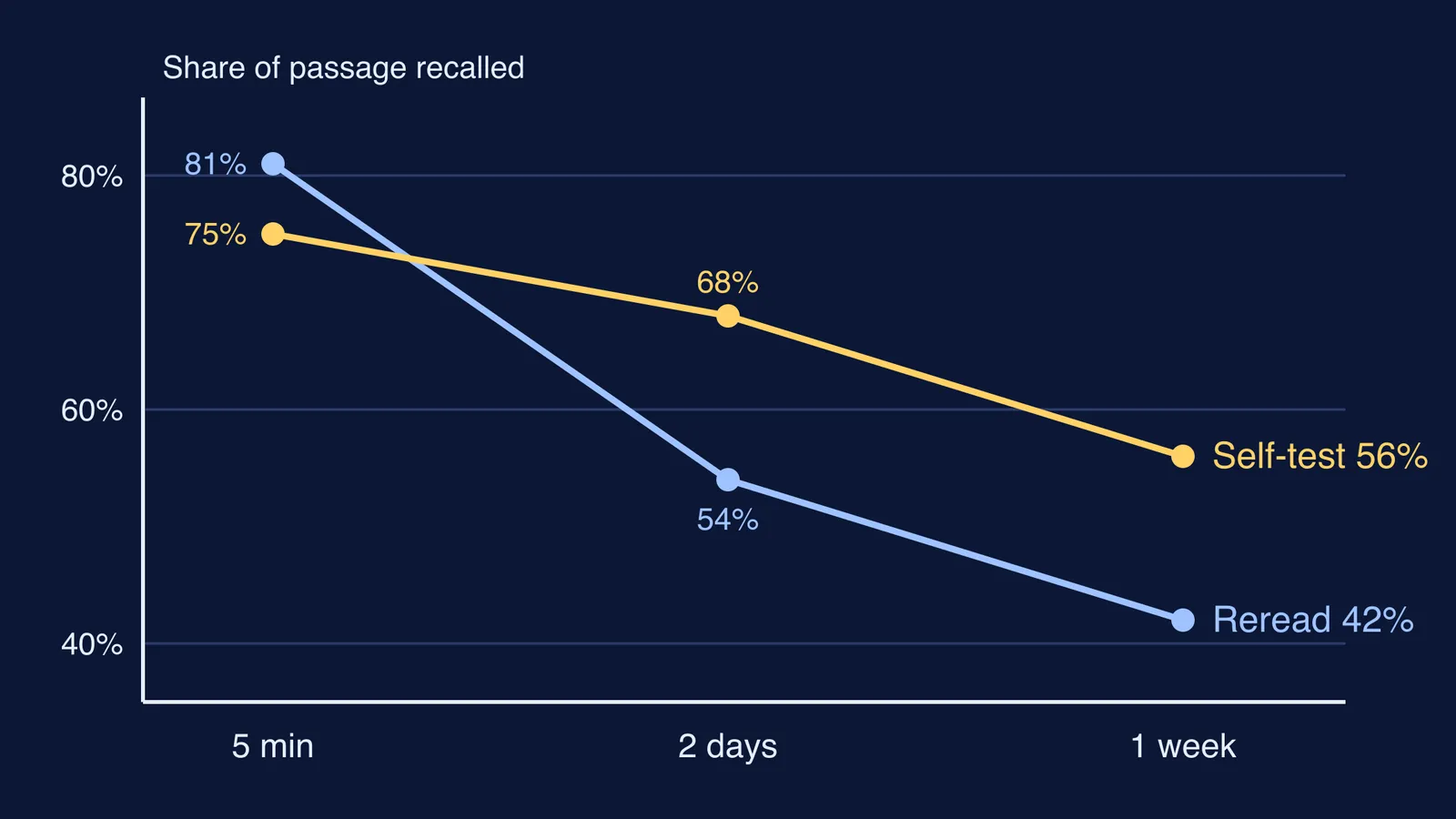
In their first experiment, 120 university students each read two short prose passages, then reread one and wrote down everything they could recall of the other. Five minutes later the reread passage did better, 81% against 75%. One week later the order flipped: students recalled 56% of the passage they had been tested on and 42% of the one they had reread (Roediger and Karpicke, 2006). In a second experiment, students who only reread felt more confident they would remember, yet remembered less.
A 2013 review of ten common study techniques rated practice testing and spaced-out practice as high utility, and rereading and highlighting as low utility (Dunlosky and colleagues, Psychological Science in the Public Interest).
Does it carry over to new questions, not just the ones you practised? A meta-analysis of 122 experiments found that testing produces learning that transfers, with an average effect size of d = 0.40, and that transfer is greatest to application and inference questions (Pan and Rickard, Psychological Bulletin, 2018). The same review found transfer depended on conditions, including elaborated retrieval (explaining, not just naming) and doing reasonably well on the practice test itself. That is why the plan below asks you to say why, not only what.
A worked example: same knowledge, different marks
Take the bile duct part of Question 10 in that sample paper, worth one of the question's two marks. Two students both “know” bile.
Answer A: “Bile is needed for digestion, so digestion will be affected and food will not be digested properly.”
Answer B: “Bile makes the food alkaline so pancreatic enzymes can act, and bile salts break fats into smaller globules. If the duct is blocked, fats will not be digested properly.”
The official marking scheme splits the mark for this part into two halves, and its model answer names both jobs bile does before concluding that fats will be improperly digested. Answer A restates the question. Answer B names the mechanism and collects the points.
How should you split time between concepts and exam practice?
Run this loop for each chapter, spread across a week, because spaced practice was one of the two high-utility techniques in the Dunlosky review.
Learn (day 1): read the NCERT section, then close the book and explain each idea aloud with a why attached. The review rated this, elaborative interrogation, moderate utility.
Recall (day 2 or 3): on a blank page, write everything you remember, draw the diagrams, derive the formulas. Check against the book and mark the gaps.
Format (end of the week): a short timed set of past-paper or sample-paper questions, mixed with one older chapter. Our guide to interleaved practice and why mixing problem types works explains why.
Mark and sort: grade yourself with the official marking scheme and tag every lost mark as a concept, method, expression or speed gap.
The tag decides what you do next:
Concept gap: back to step 1. The Fermi Concept Library gives each concept in physics, chemistry, biology, mathematics and computing its own lesson and its place in the map, so you can see what it rests on.
Method gap in numericals: work it through in the Fermi Problem Library, whose step-by-step solver explains the reasoning rather than printing an answer, then redo it alone a day later.
Expression gap: rewrite the answer as cause-and-effect points, with the marking scheme as your model. For longer application questions, see how to answer HOTS questions in three steps.
Speed gap: more timed sets. The understanding is already there.
What can parents do?
Ask about one question, not the total. “Explain why this answer got one mark and not two” tells you more than the score. If marks are high but explanations are thin, our piece on high marks but weak understanding has checks you can try at home.
Start this week with one chapter: learn it, recall it, then do one timed set marked against the CBSE sample papers and marking schemes.