

On this page
Plenty of students revise for boards from one thick notebook: the teacher dictated it, you copied it, and it feels complete. Class notes can be enough, but only after you have checked them. A notebook is a copy of the lesson, and the lesson was itself a summary of the textbook.
Are class notes enough for CBSE board exams?
Start with what the board says. CBSE's Physics curriculum for 2026-27 lists the NCERT Physics textbooks for Class XI and XII as the prescribed books. The same document says content marked as excluded in NCERT textbooks for 2026-27 will not be assessed in the board exams. So the textbook, not your notebook, defines what can be asked.
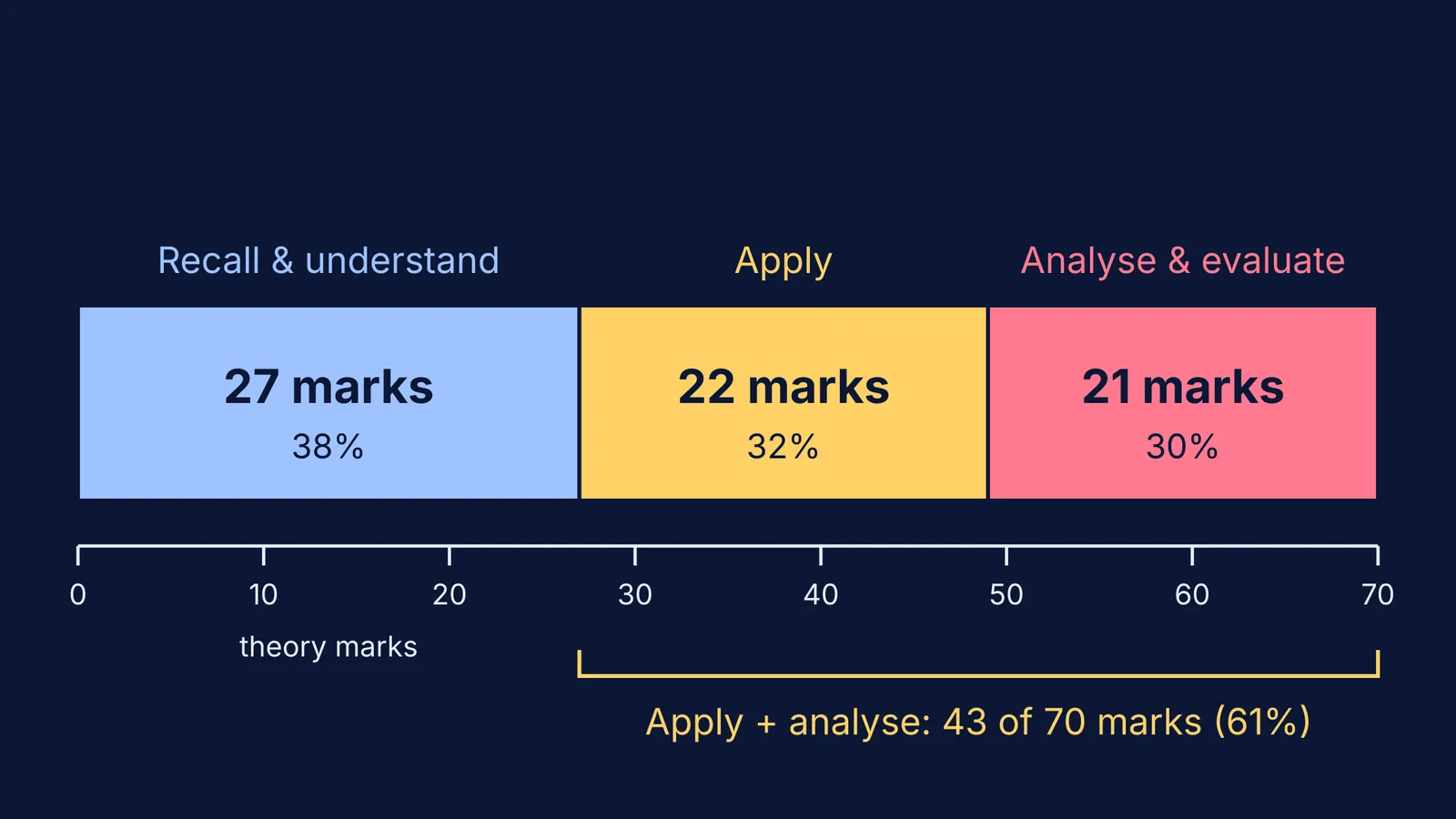
That curriculum also sets out how the 70-mark theory paper is built. Questions on remembering and understanding carry 27 marks, about 38%. Applying carries 22 marks (32%), and analysing, evaluating and creating carry 21 marks (30%). Dictated notes tend to be strongest on the first kind, definitions and formulas, and thinner on the other two. Each subject's design is in its file on the CBSE curriculum page.
What do class notes usually miss?
Note-taking research explains why gaps are normal. In a 2016 paper in Instructional Science, Luo, Kiewra and Samuelson summarise earlier studies: students normally record just one third of important lecture points. The same paper notes that when key points are left out of notes, there is only about a 5% chance of students recalling them on a test. These studies looked at college lectures, not Indian classrooms, so treat them as a warning rather than a measure of your notebook.
In board subjects, the gaps tend to fall in the same places:
Steps in derivations and numericals, where the notebook jumps from formula to answer
NCERT diagrams, or diagrams without all their labels
The exact NCERT wording of definitions, laws and statements
In-text questions, solved examples and boxed points from the chapter
The second half of an answer: the significance, reason or example part
Syllabus changes, especially in notes borrowed from a senior or written in an earlier year
How do you check class notes against NCERT and the marking scheme?
Do this once per chapter, with the NCERT book, your notes and a pencil, in about 30 minutes.
Headings (10 minutes). Go through the NCERT chapter heading by heading. Tick each one your notes cover. Put a question mark beside any heading with no matching notes.
Diagrams and definitions (5 minutes). For every figure and every bold term in the chapter, check that your notes have it, with the labels and the NCERT wording.
Marking scheme (10 minutes). Open the latest sample paper and marking scheme for your subject on the CBSE Class XII sample paper page or Class X sample paper page. For each question from this chapter, write an answer using only your notes, then compare it with the marks the scheme gives to each step.
Blank page (5 minutes). Close everything and write what you remember. Testing yourself is study too: Roediger and Karpicke (2006) found that students who took recall tests remembered more of a passage two days and one week later than students who restudied it.
Patch. Add each missing point with its NCERT page number, or annotate the NCERT margins so the book becomes your revision book.
A worked example from the 2026-27 Physics marking scheme
Question 19 in the Class XII Physics marking scheme asks for the potential at the midpoint between two charges +q and the work done to bring a charge q there. The scheme gives ½ mark for each of four lines: the distance d/2, the potential 2kq/d from one charge, the total 4kq/d, and the work 4kq²/d. Notes that read "V = kq/r, W = qV" hold the formulas, but the marks sit in the steps.
Question 20(B), on Gauss's law for magnetism, gives 1 mark for the statement and ½ mark each for two points of significance: magnetic monopoles do not exist, and field lines form continuous loops. A notebook line with only the equation covers half of it.
When should you go back to the full NCERT chapter?
Read the whole chapter again, rather than patching, if:
several headings got a question mark in step 1
the notes came from a senior, a coaching module or an older syllabus
you missed classes while the chapter was taught
you can follow the solved numericals but cannot start one on your own
If you are rebuilding notes, here is how making notes from NCERT compares with coaching modules.
Where the check exposes a concept you never understood, the Fermi Concept Library has a lesson for each concept in physics, chemistry, biology and mathematics. Where it exposes a missing method, the Fermi Problem Library has a step-by-step solver that explains the reasoning rather than printing an answer.
Once a chapter passes the check, test it under exam conditions with this guide to practising a full board paper at home, timed and marked.


