

On this page
Most NCERT books end the year either spotless or yellow on every page. Neither helps in the last month: a clean book gives you nothing to revise from, and a fully highlighted one says everything is important.
The fix is a small set of margin codes you use the same way in every subject, so the margins become a second, shorter book to revise from.
Why do margin notes beat highlighting in NCERT?
Highlighting feels productive, but the evidence is thin. In a review of ten common study techniques, John Dunlosky and colleagues rated highlighting and rereading as low-utility because they do not consistently boost students' performance, and rated practice testing and distributed (spaced) practice as high-utility (Dunlosky et al., 2013).
Testing yourself does more than measure what you know. In a classic experiment, students who took recall tests on a prose passage remembered more on final tests 2 days and 1 week later than students who restudied it instead, even though restudying made students more confident (Roediger and Karpicke, 2006). That gap between feeling and knowing is why rereading feels like learning when it often isn't.
So the goal of annotation is not to mark what is important. It is to leave prompts that make future-you think.
What codes should you write in NCERT margins?
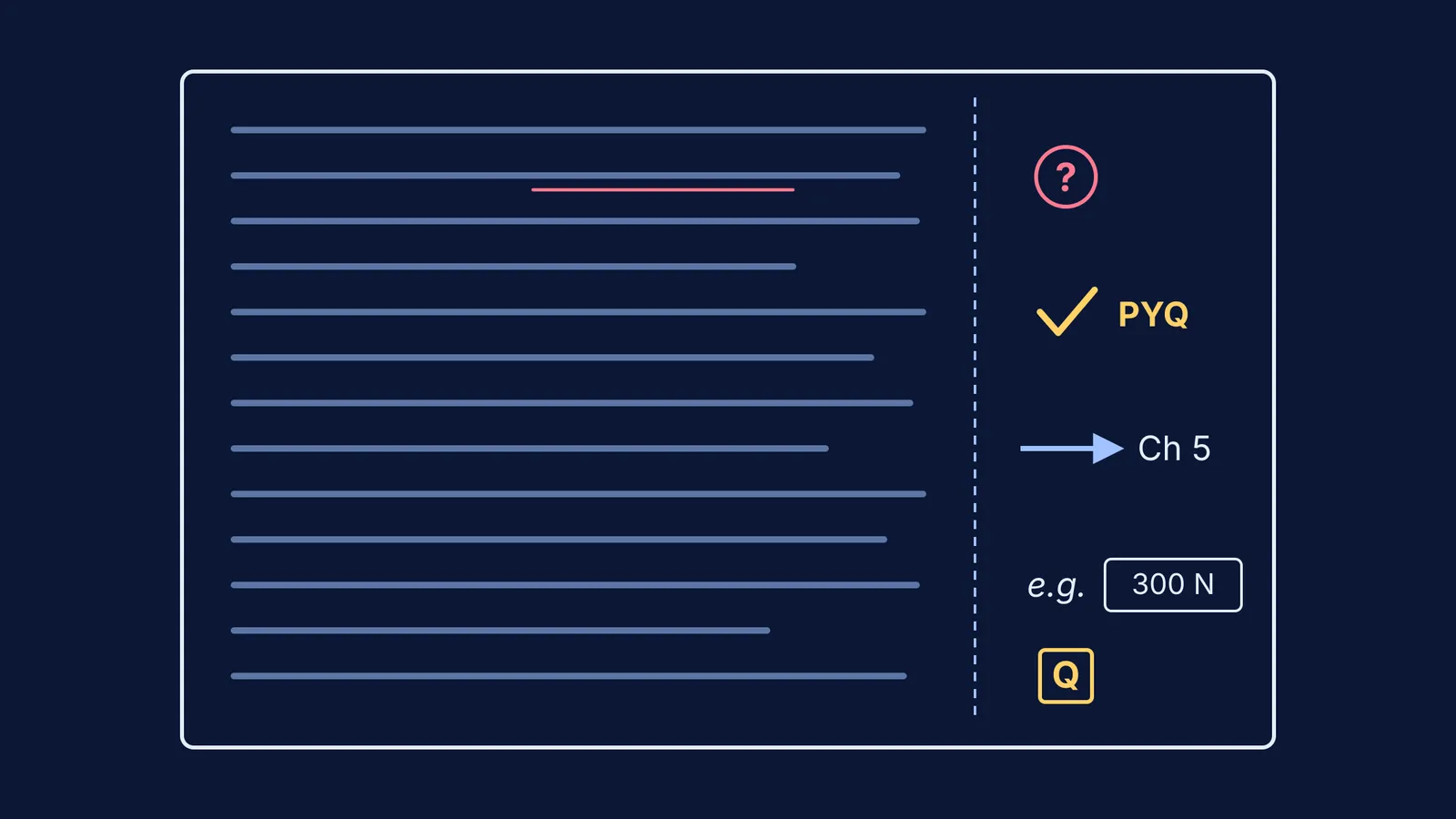
Keep it to five, so you use them consistently.
? (doubt). Put it beside any line you could not explain to a friend. When the doubt is cleared, write the answer in one line and circle the ?, so you can see which doubts are still open.
Tick + exam + year (PYQ). When you solve a previous-year question and trace it back to a line in the book, tick that line and write the exam and year, for example "JEE Main 2023".
Arrow + chapter (cross-reference). When an idea depends on, or reappears in, another chapter, write the link: "→ work, energy and power chapter".
e.g. (short example). One line with your own numbers or a real case. If you cannot make up an example, that is a ? in disguise.
Q (self-test question). A question whose answer is in that paragraph. In revision you cover the text and answer the Q.
Use pencil on the first read and switch to pen once a note has survived a second read.
What does an annotated NCERT page look like?
Take the idea of impulse from the Class 11 physics chapter on laws of motion, and the familiar question of why a fielder draws the hands back while catching a fast ball. Here is what the margin could hold:
? Why is it average force and not just force? Answer, once cleared: the force changes during the catch, so impulse equals average force times time.
e.g. A 0.15 kg ball at 20 m/s is stopped in 0.01 s: change in momentum is 3 kg m/s, so average force is 300 N. Spread the stop over 0.1 s and it drops to 30 N.
→ motion graphs Impulse is the area under a force-time graph.
Tick beside the line, with the exam and year, once you meet it in a past paper.
Q What changes, and what stays the same, when the catcher moves their hands back?
How do you revise from an annotated NCERT book?
In the final weeks, read the margins first and the text only when a margin sends you there.
Go through the chapter's Q codes with the text covered. Mark any you miss.
Check every ? is circled. An open ? a few weeks before the exam is your top priority.
Scan the PYQ ticks. Lines with several ticks deserve a second look; untouched pages still need a quick read, since past papers only sample the syllabus.
Follow two or three arrows and explain the link in a sentence.
Redo one e.g. with new numbers.
Spread these passes out over several days rather than doing one long sitting, since distributed (spaced) practice was one of the two techniques Dunlosky's review rated high-utility (Dunlosky et al., 2013). For a fuller method, see how to read a science textbook actively and how to use previous-year papers without memorising answers.
If a ? will not close after a second read and a word with your teacher, the gap is often in an earlier idea the chapter assumes. The Fermi Concept Library gives every concept in physics, chemistry, biology, mathematics and computing its own lesson and its place in the map, so you can trace the doubt back to where it starts. And when a PYQ goes wrong because of the method rather than the fact, the Fermi Problem Library has worked problems with a step-by-step solver that explains the reasoning rather than printing an answer.
Start with the chapter you are reading this week: five codes, pencil first, and one Q per paragraph.


