

On this page
A board paper is not a set of chapter questions. It is three hours of switching between one-mark MCQs and five-mark long answers, with no notes. To rehearse that, sit a whole paper at home, then mark it the way an examiner would.
Why sit a whole paper instead of doing chapter questions?
A test does more than measure what you know. In a classic experiment, students tested on prose passages remembered more two days and one week later than students who restudied the passages the same number of times, even though the restudy group felt more confident (Roediger and Karpicke, 2006). Restudying won on a test five minutes later; the gain shows up over days.A later meta-analysis found practice tests more beneficial for learning than restudying and every other comparison condition it examined (Adesope, Trevisan and Sundararajan, 2017). We looked at whether those gains carry over to new questions in our explainer on practice tests and transfer.
A full paper also trains what chapter practice cannot: pacing and third-hour stamina.
What do you need before you start?
CBSE publishes a sample question paper and a matching marking scheme for most subjects on its Class 12 sample papers page for 2026-27. Download both, but print only the paper. Put the marking scheme somewhere you cannot see it.
The printed paper, unseen (do not skim it beforehand)
A clock or kitchen timer, not your phone
Blank answer sheets, two pens, pencil, ruler and eraser
A table cleared of books and notes
A quiet three-hour morning slot
No calculator if the paper bans one (the Physics paper does)
Parents can help most here: guard the door, hold the phone, and say nothing about the score until marking is done.
How should you split the three hours?
CBSE's 2026-27 Class 12 Physics sample paper has 33 questions worth 70 marks, to be finished in 3 hours (CBSE Physics sample paper). Section A has 16 one-mark questions, Section B five two-mark questions, Section C seven three-mark questions, Section D two four-mark case studies and Section E three five-mark long answers.
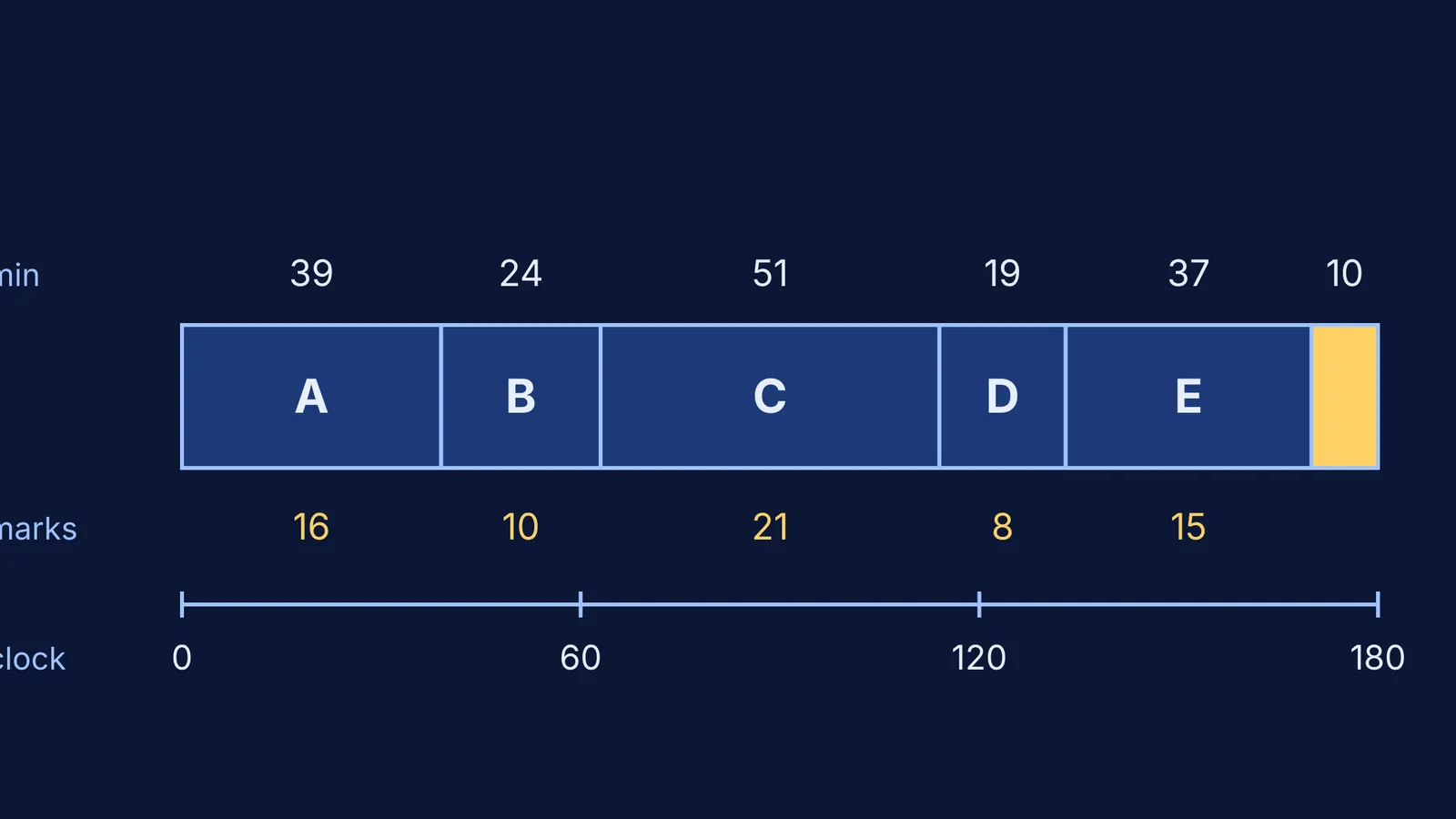
A simple rule: keep 10 minutes for checking and share the other 170 minutes in proportion to marks, about 2.4 minutes a mark. Rounded to whole minutes, with the one spare minute given to Section E, this Physics paper gives:
Section A (16 marks): 39 minutes
Section B (10 marks): 24 minutes
Section C (21 marks): 51 minutes
Section D (8 marks): 19 minutes
Section E (15 marks): 37 minutes
Checking: 10 minutes
Write each section's end time at the top of the paper. Past a checkpoint? Star the question and move on. Other subjects have different section patterns, so redo the sums from the paper in front of you.
How do you mark your own paper with the scheme?
Take a break of an hour, then mark strictly, with a red pen and the marking scheme open. The scheme gives marks for steps, not only the final answer. In the 2026-27 Physics marking scheme, Question 24 (binding energy of an oxygen nucleus) is worth 3 marks: 1 for the mass defect, 1 for the binding energy and 1 for the binding energy per nucleon (CBSE Physics marking scheme). Award yourself only the steps you actually wrote.
More on this in our guide on how to use CBSE marking schemes to write answers that earn the marks.
What should go in your mistake log?
For every mark you lost, write one line: question number, marks lost, and one reason from this list.
Concept gap: you did not know the idea or misremembered it
Method error: you knew the topic but set the question up wrong
Slip: arithmetic, sign, unit or copying
Presentation: a missing step, diagram, label or unit that the scheme rewards
Time: not attempted, or rushed at the end
Say you score 52 out of 70, and your log shows 6 marks lost to time, 5 to presentation, 4 to method and 3 to concepts. Your biggest fixes are pacing and how you set out answers, not another reread of the textbook.
Pick the top two causes and choose one fix for each before the next paper. Concept gaps go back to the lesson: the Fermi Concept Library covers every concept in physics, chemistry, biology and mathematics, each with its own lesson. For method errors, redo the question from scratch, then compare your setup with a worked solution; the Fermi Problem Library has a step-by-step solver that explains the reasoning rather than printing an answer. Slips and time problems are fixed by the next timed paper, not by more reading. Our 60-minute mock test review routine shows how to spot patterns across several papers.
Space full papers about a week apart so your fixes have time to work. If practice papers leave you worried for days, tell a parent and talk to your school counsellor or a doctor.
Book your first three-hour slot this weekend, and put the marking scheme in a drawer until the timer stops.


