

On this page
Many students in India go from school straight to a kirana counter, a field or a weekend job. What you can change is how you use the hours that are left. The good news from learning research is that short, regular sessions are not a second-best option: spreading study out tends to help memory more than packing the same time into one long sitting.
How do you study when you also work in the family business?
Start from what is fixed. Write down school, shop or farm hours and travel. What is left is your study time; protect it the way the shop protects its opening time.
In a 2013 review, John Dunlosky and colleagues rated ten common study techniques, and only two got a "high utility" rating: practice testing and distributed practice (Psychological Science in the Public Interest). Distributed practice means spreading study over several shorter sessions instead of one long sitting. Practice testing means recalling answers from memory, not rereading.
A meta-analysis by Nicholas Cepeda and colleagues pooled 839 assessments of distributed practice from 317 experiments in 184 articles (Psychological Bulletin, 2006). It also found that the best gap between study sessions grows with how long you need to remember something, which is why a weekly review sits on top of daily blocks.
So short fixed blocks on most days, plus a weekly review, are likely to serve you better than one long Sunday session.
What does a study plan look like on a work day?
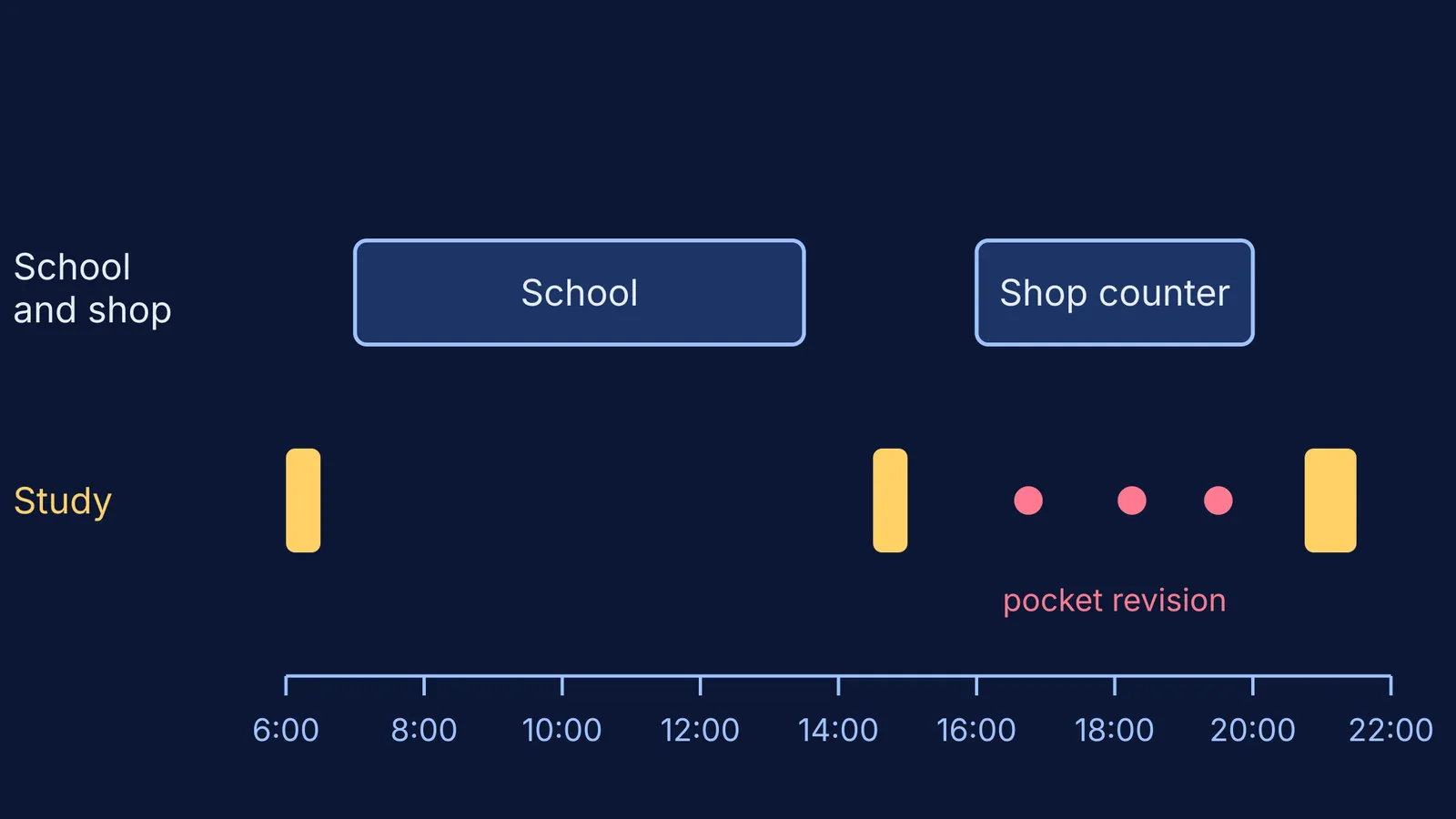
Here is a worked example for a Class 11 student whose family runs a shop from 4 pm to 8 pm. It is the day shown in the diagram above.
6:00 to 6:30 am, before school: one new topic from the hardest subject, read and summarised from memory in five lines.
7:00 am to 1:30 pm: school.
2:30 to 3:00 pm, after lunch: school homework only, so it never spills into the night.
4:00 to 8:00 pm, at the counter: three pocket revision moments when customers thin out.
8:45 to 9:30 pm: problems on the morning's topic, without looking at notes first.
Sunday: one 60 to 90 minute block to retest the whole week's topics and plan the next week.
That is under two hours of desk study, but every piece has a job. If the shop runs late, cut block 5 to 20 minutes rather than skipping it. For more on this, see planning your day around the school timetable.
What can you revise at the shop counter or in the field?
Short gaps at work suit retrieval practice: answering a question from memory, then checking.
Henry Roediger and Jeffrey Karpicke found that students who took recall tests on a prose passage remembered more of it two days and one week later than students who spent the time restudying it, even though restudying made students feel more confident (Psychological Science, 2006).
Useful pocket revision:
Index cards with a question on the front and the answer on the back: formulas, definitions, reaction conditions, dates.
A folded sheet with three questions from this morning's topic, written before you leave home.
If you get stuck on an idea and only have a phone, the Fermi Concept Library covers every concept in physics, chemistry, biology, mathematics and computing, each with its own lesson. Our post on studying with an AI tutor on your phone has more ideas for small-screen study.
How do you talk to your family about study time?
Ask at a calm time, not during a rush, and bring your written week.
Offer something in return, such as covering a busy weekend slot, and agree to review the plan in a month. Parents juggling their own shifts may find our piece on a family routine when both parents work shifts useful.
What should parents keep in mind?
India's child labour law was amended in 2016 to prohibit the employment or work of children below 14 in all occupations and processes, and the 2017 Rules define what "help" in a family enterprise owned by the child's family means, according to the Ministry of Labour and Employment. Some hazardous occupations and processes are off-limits even in a family business, so check the Ministry's schedule if your work involves machinery or chemicals.
If your child seems constantly exhausted or low, talk to a doctor or counsellor. Tele-MANAS, the government's tele-mental health service, runs a toll-free helpline on 14416 that is available 24x7 (PIB).
When you sit down for a block and do not know where to begin, Fermi's AI tutor can work out what you already know and build a plan for the session, so the 30 minutes you protected go on the right thing.


