

On this page
Sanskrit, or whichever third language you take, usually gets the least study time in Class 10. That is fine, as long as the time you do give it goes to the marks that respond to practice. This plan uses the official CBSE sample paper and marking scheme as its map.
How is the Class 10 Sanskrit paper marked?
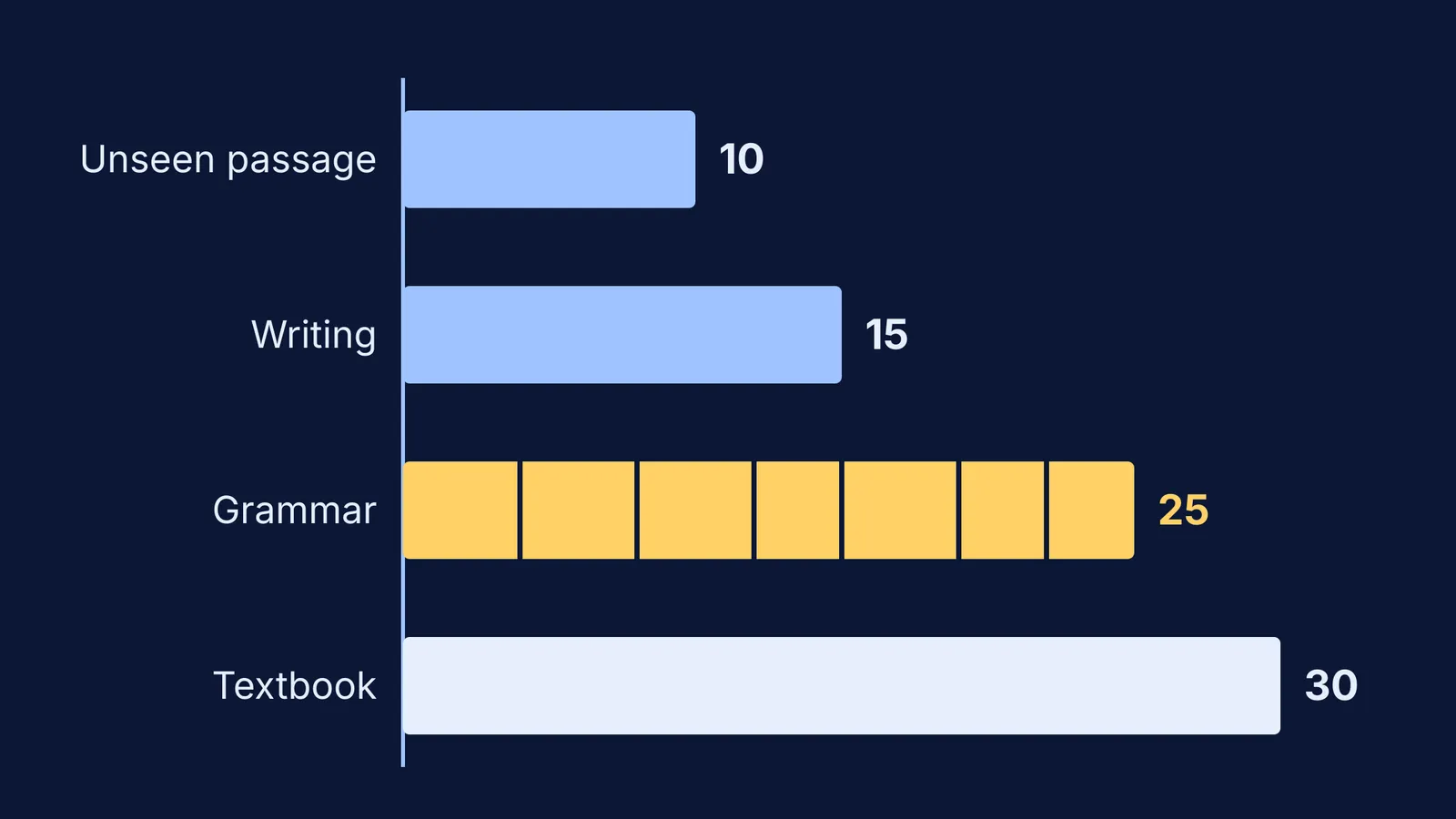
The CBSE Class 10 Sanskrit sample question paper for 2026-27 is a 3-hour paper worth 80 marks, with 18 questions in four sections. A note on every page says the pattern and evaluation method have not changed for 2026-27.
Unseen passage (अपठितावबोधनम्): 10 marks
Writing, meaning a letter, a picture description or paragraph, and translation (रचनात्मककार्यम्): 15 marks
Applied grammar (अनुप्रयुक्तव्याकरणम्): 25 marks
Textbook prose, verse and drama (पठितावबोधनम्): 30 marks
Grammar is the most drillable part of the paper. Its 25 marks come in seven short questions: sandhi (4), samasa (4), pratyaya (4), vachya (3), time words (4), avyaya (3) and error correction (3), and four of them (samasa, pratyaya, vachya and error correction) are multiple choice. Each is a small, repeatable skill that a 15-minute drill can build.
The instructions also ask you to write every answer in Sanskrit and to keep each section's answers together. All subjects' papers and marking schemes are listed on CBSE's sample paper page.
Why do short daily drills beat weekend cramming?
Two research findings explain it. In a 2008 study in Science, Karpicke and Roediger had students learn foreign-language vocabulary. Repeated testing after a word was learnt produced a large gain in delayed recall, while repeated studying had no effect. Students' predictions of their own scores were uncorrelated with their actual scores, so feeling ready is a poor guide.
A 2006 meta-analysis by Cepeda and colleagues pooled 839 assessments from 317 experiments on spaced versus massed practice in verbal recall. It found that the best gap between study sessions grows as the time until the test grows. For a board exam months away, that suggests coming back to the same words and rules across weeks, not in one sitting. Our guide to spaced practice for languages covers how to set the gaps.
What should a 15-minute daily drill look like?
Split each session into three parts:
5 minutes, vocabulary self-test. Cover the meanings of 10 words from this week's textbook lesson and write them from memory. Words you miss go into tomorrow's set.
7 minutes, one grammar type. Do 8 to 10 questions of the day's type from textbook exercises or old sample papers.
3 minutes, check and log. Mark against the answer key and write each error on one line: the question, your answer, the right one.
Rotate the grammar type through the week:
Monday: sandhi
Tuesday: samasa
Wednesday: pratyaya
Thursday: vachya and avyaya
Friday: time words and error correction
Saturday: one textbook passage with its full question set
Sunday: one section of a sample paper, timed
For the grammar rules themselves, our guide to practising Sanskrit grammar for boards goes topic by topic.
How do you write Sanskrit answers that get full marks?
The official marking scheme shows what examiners look for. Here is how it treats two unseen-passage questions from the 2026-27 sample paper:
One-word question, 1 mark: वृद्धः कस्मै सर्वां सम्पत्तिम् अयच्छत्? The expected answer is just कनिष्ठपुत्राय, in the right case.
Full-sentence question, 2 marks: कनिष्ठः पुत्रः कक्षं पूरयितुं किमकरोत्? The expected answer lifts the passage's own words into a complete sentence: कनिष्ठपुत्रः एकं दीपकम् आनीतवान् कक्षे च तं दीपकं प्रज्वालितवान्।
Three rules from the scheme are worth knowing:
Synonyms are accepted in comprehension answers, but wrong case endings or number cost part of the marks.
In letters and picture descriptions, correct sentence construction counts, not elegant style, and partly correct sentences earn partial marks.
In the picture description, each sentence carries half a mark for meaning and half for grammar, and length does not matter. You may use the words in the मञ्जूषा box, change their case, or use your own.
So five short, correct sentences beat five long, shaky ones. Each Sunday, write one five-sentence picture description using only words you can decline correctly. Matching the question's format pays off in other language papers too; see our piece on Hindi board exam answer writing.
What if you take a different third language?
Download your board's latest sample paper and marking scheme and write down the marks per section, as above. Circle the sections built from small, repeatable question types; those become your daily drill. Keep the 5-7-3 split and the Sunday timed section.
Keeping the language to 15 minutes a day protects time for heavier subjects. If science or maths is where the rest of your evening goes and you are not sure where to start, Fermi's AI tutor works out what you already know and builds a plan for the session, so you sit down to a clear next step.


