

On this page
When you are preparing for JEE or NEET, subjects like physics and maths tend to swallow your whole timetable. But if you have Hindi, Sanskrit, or English as a second language in your board exams, you still need to memorise vocabulary, grammar rules and literary forms. Cramming these the night before a unit test is stressful and rarely works.
Instead, the science of learning points to a strategy that takes just a few minutes a day: spaced practice.
Why do we forget new words quickly?
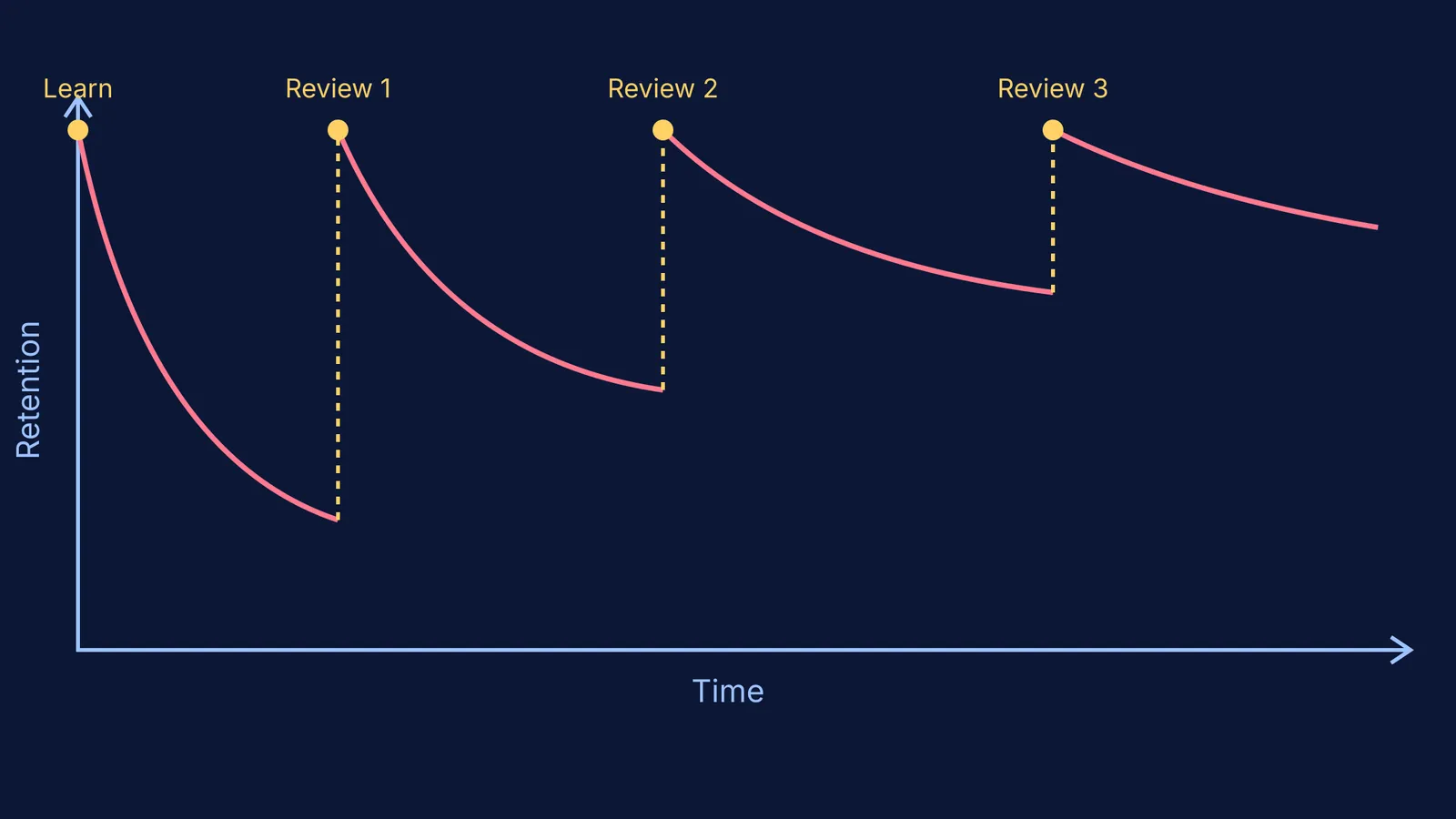
If you read a list of new Sanskrit verbs once, your brain assumes it is not important information. In a classic replication of the forgetting curve, researchers found that without review, people forget a large percentage of new information within the first few days (Murre & Dros, 2015).
However, every time you review that information, you interrupt the forgetting process. This is known as the spacing effect. By spacing out your reviews—rather than massing them together in one long cram session—you signal to your brain that these words matter, which builds a durable long-term memory.
How does spacing out reviews build lasting memory?
Spacing out your study sessions is more efficient than cramming. A 2023 study found that distributing a 45-minute lesson into three 15-minute sessions throughout the week led to statistically significant improvements in foreign language vocabulary retention compared to studying in a single block (Al-Khasawneh, 2023).
Over the long term, the effects are even more striking. A classic nine-year study found that 13 study sessions spaced 56 days apart resulted in the same long-term vocabulary retention as 26 sessions spaced just 14 days apart (Bahrick, 1993). By simply waiting longer between reviews, students achieved the same memory strength with half the total effort.
How to revise Hindi or Sanskrit vocabulary regularly?
To apply spaced practice to your language studies, you need a system that brings words back to you just as you are about to forget them.
Use flashcards for active recall. Write the Hindi or Sanskrit word on one side and the meaning on the back. When you review, try to retrieve the answer from memory before flipping the card.
Follow a spaced schedule. Review new words after one day, then three days, then a week, and then a month. You can do this with physical card boxes (the Leitner system) or by using digital apps that handle the scheduling for you.
Keep sessions short. A 10-minute session every morning is better than an hour on Sunday.
If you want to apply this schedule to other subjects, read our guide on building a 4-week spaced revision schedule for any chapter. And if you are navigating bilingual studies, you might also find it helpful to read about studying science in English when you think in another language.
How do you keep language study going during science-heavy weeks?
The hardest part of spaced practice is maintaining the habit when your science subjects get difficult. It is tempting to skip your language review to spend another hour on a tough physics problem.
If you find yourself stuck on a concept in chemistry or biology, reading the same textbook paragraph again is rarely the fastest way forward. The Fermi Concept Library maps out every concept in physics, chemistry, biology and maths, each with its own lesson. If you are struggling with a specific numerical, you can use the Fermi Problem Library. Its step-by-step solver explains the reasoning behind each step instead of just printing an answer.
By getting unstuck faster in your core subjects, you will easily find the 10 or 15 minutes you need to keep up with your spaced vocabulary practice. Over time, those short daily sessions compound, leaving you fully prepared for your language exams without a last-minute panic.


