

On this page
The grammar section in the CBSE Class 10 Sanskrit exam, officially called Anuprayukta-Vyakaranam, carries 25 marks out of the 80-mark theory paper 1. For many students, this section is the difference between a good score and a great one. Unlike literature where you can write around the topic, grammar is purely rules-based.
To secure these marks, you have to master topics such as Sandhi (4 marks), Samasa (4 marks), Pratyaya (4 marks), Vachya Parivartanam (3 marks), Samaya (4 marks), Avyaya (3 marks) and Ashuddhi-Samshodhanam (3 marks) 1. The mistake many students make is trying to cram these rules the night before the exam.
Why does cramming Sanskrit grammar fail?
When you learn all the rules of Vowel Sandhi and Consonant Sandhi in one sitting, your brain holds them in working memory. But by the next morning, the rules blur together. Students often find themselves staring at a word in the exam hall, knowing they read the rule but unable to recall whether it needs a Visarga Sandhi or a consonant change.
It is easy to fall into the trap of Knowing what you know: why students misjudge their own learning when you just read the textbook passively. Instead of studying grammar for three hours on a Sunday, you will remember far more if you study for 15 minutes a day.
How do daily drills and spaced repetition work?
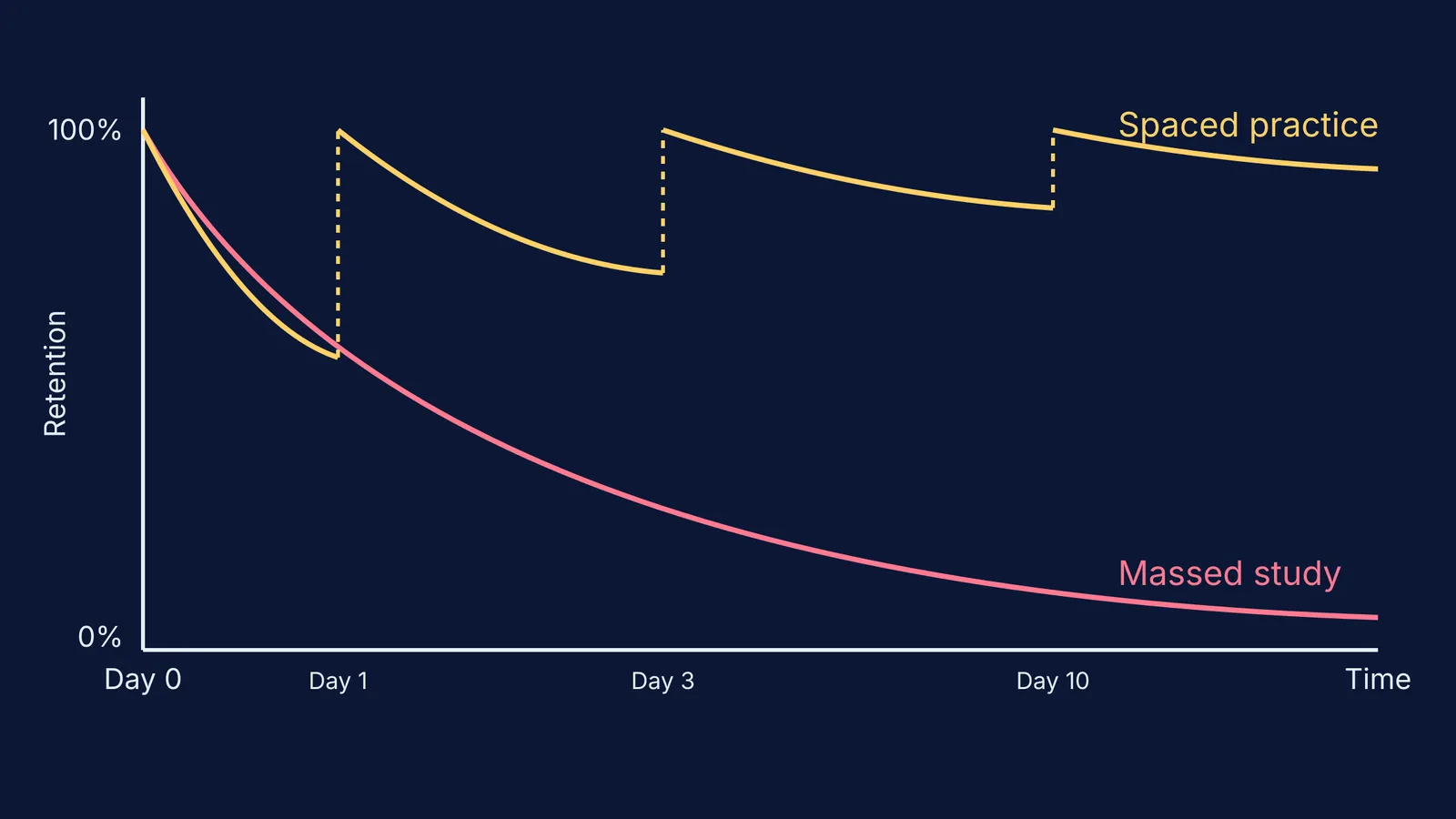
Research consistently demonstrates that spaced repetition is significantly more effective than traditional massed study for long-term retention. A 2022 meta-analysis of 48 studies and 3,411 learners confirmed that spaced practice has a medium-to-large effect on language learning 2.
The benefit of this method becomes obvious over time. In a 1987 study on foreign language retention, learners using spaced repetition retained 2.5 times as much vocabulary after eight years as those who crammed 3.
When you review a few Shabd Roop or Samasa examples just as you are about to forget them, your brain strengthens the neural pathway. This is one of the most reliable methods discussed in our breakdown of the Ten study techniques rated: inside the 2013 Dunlosky review.
Spaced repetition works across all your subjects. Whether you are using Fermi's AI tutor to build a plan for a tough physics session, or reviewing Sanskrit rules on your own, spreading the work out ensures the material stays with you.
How to score in Sanskrit grammar boards?
The current CBSE exam pattern focuses on competency-based and multiple-choice questions. You no longer need to write long definitions of Avyayibhava or Tatpurusha; you simply need to apply the rule correctly to a given sentence.
Unlike subjects that require you to hold a line of reasoning through a long calculation—where tools like the Fermi Problem Library provide worked problems with a step-by-step solver that explains the reasoning rather than printing an answer—Sanskrit grammar is about quick, accurate pattern matching.
To prepare for this pattern:
Focus on the textbook: All exam questions are based on the NCERT Shemushi (Part 2) textbook and the Abhyasavaan Bhava grammar workbook.
Practise past question patterns: Do 10 MCQs a day from past papers to recognise how the board tests each rule.
A 30-day practice routine
To turn these strategies into a habit, set up a daily drill schedule a month before the board exams:
Days 1 to 10: Dedicate 15 minutes daily to Vowel, Consonant and Visarga Sandhi, and Samasa. Do 5 past paper questions for each.
Days 11 to 20: Focus on Pratyaya, Vachya Parivartanam (Active to Passive voice) and Samaya.
Days 21 to 30: Master Avyaya and Ashuddhi-Samshodhanam (error correction). Start taking full 25-mark grammar mock tests to build speed.
By breaking the grammar syllabus into daily drills, you ensure the rules become second nature long before exam day.


